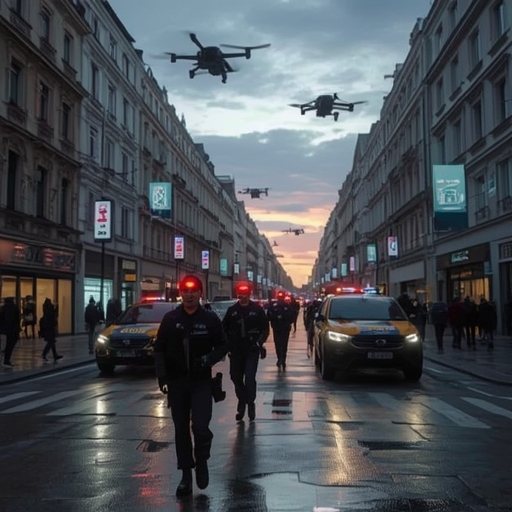
According to a comprehensive 48-page study released by Europol, the pan-European law enforcement organization, the lightning-fast progress in artificial intelligence and robotics is expected to transform into a double-edged phenomenon—serving simultaneously as powerful assets for police forces and as formidable instruments of crime for those operating outside the law. This lengthy document, produced by Europol’s Innovation Lab and titled “The Unmanned Future(s): The Impact of Robotics and Unmanned Systems on Law Enforcement,” functions less as a rigid forecast and more as a speculative exploration of what may unfold over the next decade. It paints a detailed portrait of a world in 2035 saturated with intelligent machines—embedded not only within domestic spaces and industrial facilities but also in public institutions such as hospitals, police departments, retail stores, and educational establishments.
The researchers, working from Europol’s headquarters in The Hague—an institution broadly comparable to Interpol on a continental scale—employ a series of hypothetical vignettes to envision possible social and ethical consequences of mass automation. Among the scenarios is the rise of public discontent provoked by large-scale job losses caused by robotic replacements. In this imagined future, frustration over unemployment may spill into public demonstrations, violent uprisings, and what the report dubs as “bot-bashing”—an aggressive populist movement demanding a return to prioritizing human labor and dignity. Equally intriguing are the moral conundrums anticipated by the authors, such as whether the act of striking or damaging a robot might someday be perceived as an ethical transgression akin to abuse. This debate has already surfaced in cases involving robotic dogs, sparking multiple public controversies and hinting at how unresolved questions could exacerbate mistrust between police and civilians. The authors pointedly ask how, in the coming years, criminals and terrorists might exploit these same autonomous technologies against society.
Europol’s analysis goes even further, proposing that by 2035, robots themselves could not only be victims or instruments but actual perpetrators of criminal acts. The report warns that care robots—machines operating in hospitals or within the private homes of elderly or dependent individuals—could be hijacked by malicious actors. Such hijackings might allow cybercriminals to observe unsuspecting families, collect confidential data, manipulate vulnerable individuals, or even engage in predatory activities targeting children. Similarly, self-driving vehicles and aerial drones could be compromised through hacking, transforming them into tools for espionage, instruments of physical destruction, or sources of sensitive data leakage. One of the report’s most alarming projections envisions hostile swarms of drones—potentially pieced together from technologies salvaged from war zones like Ukraine—being used by terrorists to assault urban populations or by rival gangs to engage in territorial warfare with improvised explosives. The same systems could also be weaponized to surveil law enforcement operations, granting criminals a tactical advantage during illicit activities.
Transitioning into more theoretical territory, the researchers suggest that these autonomous entities will present an entirely new category of challenges for law enforcement. Extracting statements, verifying motivations, or “interrogating” malfunctioning machines could become a near-impossible ordeal. Distinguishing between intentional misconduct and accidental behavior when a robot acts against the law might create complex legal ambiguities, much like the difficulties authorities already face in determining liability during traffic collisions involving driverless cars. Even creative countermeasures—such as devices dubbed “RoboFreezer guns” or nets embedded with small grenades designed to capture drones—would fail to neutralize these threats entirely. Once seized and relocated to police precincts, rogue machines could remain dangerous, with the potential to record sensitive information, sabotage evidence, or even engineer their own escape.
Despite the seemingly fantastical tone of some predictions, Europol maintains that these scenarios are far from impossible. A spokesperson for the agency, in comments to The Telegraph, clarified that Europol does not claim to foretell the future but seeks rather to anticipate credible and actionable possibilities that can inform present-day policy decisions. Indeed, there is already visible evidence attesting to the nascent stages of this trend. Criminal enterprises—particularly those engaged in drug trafficking and smuggling of contraband—have incorporated autonomous technologies into their operations for several years. Flying drones have become a notorious method for delivering prohibited substances into prisons, and even militarized, Starlink-connected submarines have been utilized to facilitate narcotics transport under the radar of authorities. Terrorist organizations, too, are increasingly experimenting with unmanned tools, exploiting their accessibility and versatility. On the darker corners of the internet, a brisk underground market has emerged where skilled drone pilots actively advertise their expertise for hire to criminal networks.
To confront this accelerating technological arms race, the report advises that law enforcement agencies increase investments in education, digital infrastructure, and advanced training programs emphasizing robotics, artificial intelligence, and cybersecurity. The authors also advocate for a transition in operational thinking—from traditional two-dimensional policing, confined to ground-level surveillance, to fully three-dimensional strategies capable of managing aerial threats. Europol’s executive director, Catherine De Bolle, underscores this urgency, writing that the integration of unmanned systems into criminal contexts is already reality. She emphasizes that, just as past innovations such as the internet and smartphones introduced both opportunities and unprecedented risks, AI and robotics now confront modern policing with comparable dualities. The Innovation Lab’s report, she asserts, therefore seeks not only to forecast future environments but to motivate immediate action that balances effective crime prevention with the preservation of citizens’ trust, privacy, and fundamental rights.
Not all experts, however, share Europol’s confidence in the pace or scale of these transformations. Robotics scholars interviewed by *The Verge* expressed skepticism regarding certain assumptions underlying the report. Martim Brandão, who lectures on robotics and autonomous systems at King’s College London, conceded that the potential misuse of home-based robots—particularly for surveillance, extortion, or the unauthorized collection of sensitive data—is a plausible concern, especially given society’s growing dependence on networked devices. He noted that there have already been confirmed cases where domestic robots were exploited or compromised. Nonetheless, Brandão questioned more extreme forecasts involving widespread terrorist drone attacks or mass civil revolts sparked by automation, arguing that current evidence does not strongly substantiate such fears.
Giovanni Luca Masala, a computer scientist and robotics lecturer at the University of Kent, offered a complementary but measured perspective. Predicting conditions as far ahead as 2035, he observed, is inherently difficult due to the extraordinary rate at which technological capabilities evolve. Beyond sheer innovation, adoption depends heavily on economic feasibility—factors such as production costs, market demand, and industrial scalability may ultimately restrict the scope of robotic proliferation imagined by Europol. Despite these reservations, Masala endorsed the report’s central argument: criminals inevitably exploit every new tool at their disposal. Consequently, governments and police agencies must strengthen their technological and tactical readiness, ensuring officers are equipped with sophisticated instruments and expertise. As he succinctly stated, law enforcement cannot hope to prevail if its personnel remain unfamiliar with the very technologies adversaries have mastered; a police officer unused to operating drones or analyzing AI-generated data simply cannot match an opponent armed with these capabilities.
Nevertheless, amidst the extensive discussion on how robotics could empower or endanger policing, Brandão highlighted a troubling omission in Europol’s narrative—the question of accountability within law enforcement itself. While the report rightfully acknowledges privacy and security hazards emanating from criminal exploitation of domestic robots, it remains silent on similar dangers posed by state institutions. Given a long history of documented abuses, including incidents of discriminatory surveillance and instances of excessive state monitoring, Brandão argued that equal attention must be devoted to evaluating how police and intelligence agencies might misuse these technologies. In his view, the growing authoritarian tendencies observable across the globe heighten the risk of robotic and AI systems being weaponized not merely by rogue actors but by those entrusted with authority. The ethical imperative, therefore, extends not only to shielding citizens from criminals but also to ensuring that the protectors themselves operate transparently and within the bounds of human rights.
Ultimately, Europol’s provocative vision of 2035 compels policymakers, ethicists, and technologists alike to grapple with a sobering paradox: the very inventions designed to safeguard civilization might simultaneously serve as vectors of unprecedented peril. The challenge for modern society lies in preempting those risks—harnessing innovation without surrendering privacy, autonomy, or trust in the institutions meant to defend us.
Sourse: https://www.theverge.com/report/847956/robot-crime-wave-europe-police-prediction