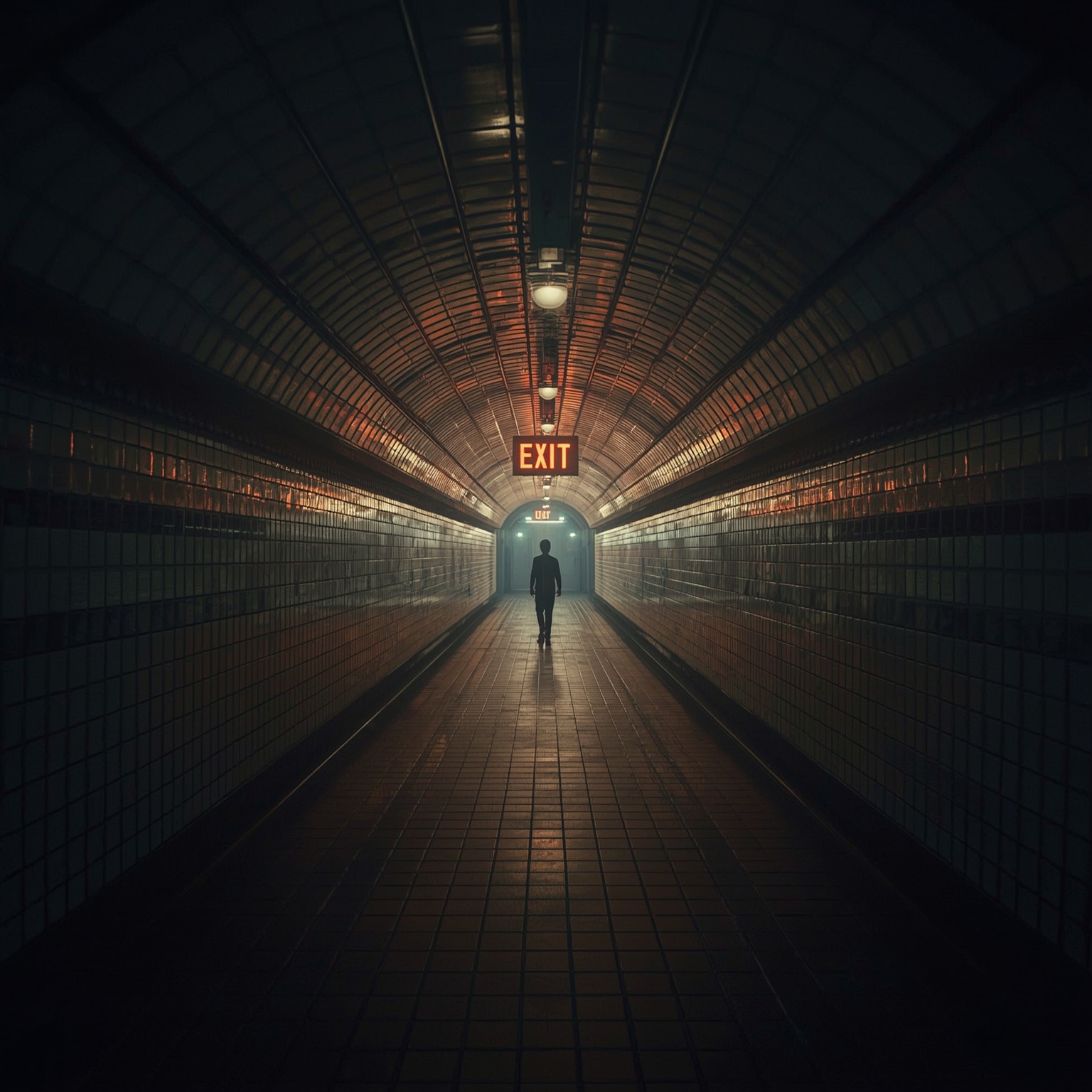
Few adaptations of video games have demonstrated such a deep comprehension of their source material as the cinematic interpretation of *Exit 8*. Unlike many productions that merely replicate a game’s surface-level imagery or narrative conceits, this film delves directly into the logic, rhythm, and structural mechanics of the original experience. The game itself strands the player within a seemingly infinite corridor of a Tokyo subway station, where escape is possible only through vigilance: carefully observing each iteration of the hallway, identifying subtle abnormalities, and adjusting direction accordingly. The film takes this brilliant minimalist foundation as a springboard and expands it into an elaborate narrative, populated by characters whose emotional journeys lend human gravity to the eerie puzzle at its core.
According to director Genki Kawamura, the sense of novelty that permeates the adaptation is partly a result of his creative mindset during development. Rather than conceptualizing the project strictly as a conventional video game adaptation, he envisioned it as an opportunity to construct a new kind of cinematic encounter—one that deliberately blurs the boundaries between the passivity of watching and the interactivity of play. This meant not only honoring the game’s design principles but also reimagining them in ways suited to the film medium. Appropriately, the movie opens in first-person perspective, a striking homage to its digital predecessor. As in the source material, we follow a figure trapped within a corridor that endlessly recycles itself; the only path forward—or backward—depends on the ability to detect anomalies, uncanny details that distort normality in ways both subtle and grotesque.
Kawamura explains that he discovered *Exit 8* precisely because of his habit of playing independent games, which often present experimental ideas outside the mainstream. What immediately fascinated him was the authenticity of the virtual environment: the underground passage looked, sounded, and felt unmistakably Tokyo. At the same time, he recognized in the premise a resonance that could transcend geographical context. Losing one’s bearings in the labyrinthine spaces of a modern city is a universal human experience, and combining this familiarity with the specificity of Tokyo’s design offered fertile ground for cinematic storytelling.
Yet transforming a short, story-free title—one that lasts less than an hour—into a feature-length film demanded substantial invention. In Kawamura’s adaptation, we meet the protagonist known simply as the Lost Man, portrayed by Kazunari Ninomiya. He is not merely navigating a puzzle; he struggles simultaneously with precarious employment and the overwhelming prospect of imminent fatherhood. As the loops progress, other individuals materialize in the corridor: the menacing Walking Man (Yamato Kochi), who initially terrifies both protagonist and audience; a young woman played by Nana Komatsu; and a small boy, embodied by Naru Asanuma, each of whom is ensnared in the same recursive nightmare. The screenplay introduces new anomalies absent from the original, each unsettling in a way that draws psychological connections to the external world. For Ninomiya’s Lost Man, disturbing sounds associated with infants—crying, echoing coos—inject both dread and thematic weight, reflecting his anxieties about impending fatherhood.
A particularly fascinating narrative element is how these characters interpret and apply the underlying rule of the hallway: every loop requires examining one’s surroundings for deviations before deciding whether to advance or retreat. Each character does so differently—some proceed with meticulous caution, some hurry in panic, and each notices details in a unique sequence. Watching their varied approaches resembles observing multiple players experiment with the same game, which was Kawamura’s precise intention.
He recalls a discussion with Shigeru Miyamoto, the visionary creator of *Super Mario* and *The Legend of Zelda*, who once remarked that a well-designed video game is enjoyable not only to play but also to watch others play. Inspired by this perspective, Kawamura and his creative team scoured online video platforms, studying diverse playthroughs of *Exit 8*. What struck them was how differently players navigated identical spaces: they made distinct mistakes, reacted in idiosyncratic ways to each failure, and revealed aspects of their personality in how they coped with repetition and surprise. These observations shaped the portrayal of the film’s characters, whose individuality emerges not from scripted dialogue alone but also from the manner in which they face the uncanny mechanics of the loop.
For those who have already played the game, viewing *Exit 8* becomes what Kawamura describes as an eerily surreal undertaking. You find yourself inhabiting a space you already know almost instinctively, only to watch it warped, restaged, and twisted into new patterns of unease. Filming the project generated a similar sensation for the crew. The production team constructed the subway hallway set on a soundstage and designed it as two corridors—affectionately nicknamed Hitchcock and Kubrick—linked by a narrow connecting passage called Mizoguchi. This architectural trickery enabled long, uninterrupted shots that convincingly produced the illusion of a perpetually looping corridor. The design not only disoriented viewers but also managed to confuse the filmmakers themselves. Kawamura recalls moments when even the crew lost track of their position within the space, blurring reality and illusion in a way that mirrored the story they were telling.
Ultimately, *Exit 8* exemplifies how a game-to-film adaptation can evolve beyond simple reproduction. Instead, it uses the original mechanics as a conceptual skeleton upon which to build atmosphere, metaphor, emotion, and richly developed characters. Viewers can expect to encounter this ambitious vision when the film reaches theaters in early 2026.
Sourse: https://www.theverge.com/interview/777509/exit-8-director-interview