Long before Satoshi Kon reached international acclaim for redefining the medium of anime through seminal works such as *Perfect Blue* and *Paranoia Agent*, his creative brilliance had already manifested in an equally compelling medium: manga. These early pieces, far from being mere precursors to his later career, serve as intricate blueprints of the thematic, aesthetic, and psychological complexity that would later distinguish his cinematic storytelling. In particular, the collections *Dream Fossil* and *Opus* stand as testaments to a mind deeply fascinated by the porous boundary between imagination and reality—a fascination that would come to characterize all of Kon’s artistic endeavors.
*Dream Fossil* captures an extraordinary range of human emotion within short, self-contained stories that oscillate between the ordinary and the fantastical. Each vignette invites readers to confront deeper truths concealed beneath everyday existence. Through his expressive linework and fluid composition, Kon transforms mundane scenes into moments of surreal revelation. What appears at first to be a simple slice of life inevitably takes a philosophical turn, urging reflection on identity, memory, and the transient nature of perception. This seamless interplay between realism and the dreamlike already reveals Kon’s signature narrative voice—one that gently blurs distinctions between what is seen, imagined, or remembered.
Meanwhile, *Opus* represents an even more intricate exploration of the creative process itself, functioning as both metafiction and emotional confession. The manga’s protagonist—an artist entangled in the world of his own unfinished story—mirrors Kon’s own introspective inquiry into the nature of authorship and control. The result is a work that collapses the wall separating creator and creation, suggesting that every piece of art is, by its nature, an act of dialogue between worlds, where imagination becomes as real as the hand that conceives it. This layering of realities prefigures the narrative architecture of *Perfect Blue* and *Paprika*, films that similarly refuse to provide the comfort of a single stable perspective.
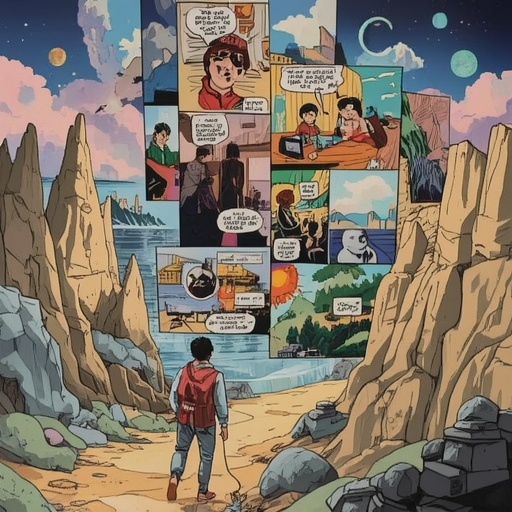
What makes these manga so remarkable is not only their thematic ambition but also the precision with which Kon manipulates visual language. His confident panel layouts, shifting vantage points, and rhythmic pacing convey psychological states more eloquently than dialogue ever could. The emotional cadence of his art anticipates the cinematic sensibility that would later allow him to depict dreams, delusions, and desires with uncanny immediacy. Readers can sense that Kon approached even static images with a director’s eye, composing each frame as though it were a scene in motion.
To revisit these works today is to witness the genesis of an auteur’s vocabulary—the moment when ideas about identity, artifice, and consciousness first began to coalesce into a distinct personal mythology. They reveal Kon not merely as an illustrator or storyteller, but as a philosopher of the human imagination, one who understood that the act of creation is itself a way of navigating reality’s endless metamorphosis. Appreciating *Dream Fossil* and *Opus* thus means encountering the unfiltered consciousness of an artist still shaping his voice, yet already in command of extraordinary technical and conceptual control.
For admirers of Satoshi Kon’s later films, exploring these manga provides a newly enriched perspective on his artistic evolution. They offer the missing chapters of a creative journey that would eventually transform the landscape of Japanese animation. Through them, readers gain a deeper understanding of how surrealism became Kon’s language for truth, and how his visual imagination transcended mediums to probe the very structure of perception itself. Rediscovering these works is not merely an act of nostalgia—it is an invitation to see the world, as Kon did, through the shifting lens of dream and reality, where every boundary is an opportunity for wonder.
Sourse: https://gizmodo.com/satoshi-kon-manga-opus-dream-fossil-perfect-blue-akira-2000762137