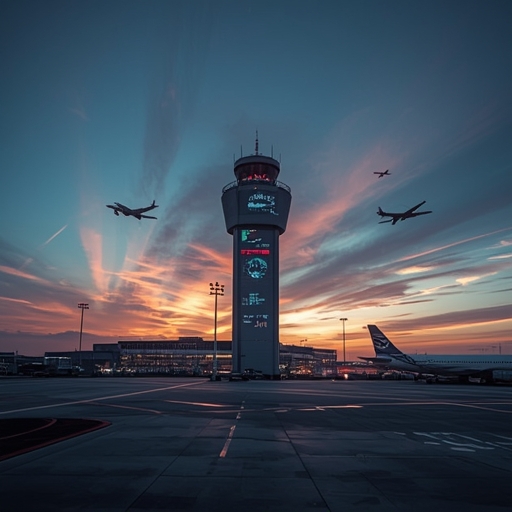
Billions of dollars are poised to be invested in a sweeping modernization of the nation’s air traffic control network, a transformation that the head of the Federal Aviation Administration described as both urgent and essential for the long‑term safety and stability of American aviation. According to Administrator Bryan Bedford, the FAA has formally committed $6 billion to upgrading the telecommunications and radar infrastructure that underpins air traffic management across the United States. Speaking before a House subcommittee on Tuesday, Bedford emphasized that this reinvestment in the country’s aviation backbone will introduce a new generation of highly reliable, digitally integrated systems designed to replace the decades‑old framework still in use.
The Administrator further explained that this advanced infrastructure—encompassing enhanced radar technology, resilient data links, and modern communication networks—is expected to be fully implemented by the end of 2028. This represents an extraordinary acceleration of the modernization schedule: the original rollout plan had stretched across a fifteen‑year window. The newly compressed three‑year target illustrates not only the FAA’s determination to act swiftly but also the growing recognition, among both regulators and lawmakers, that the existing air traffic control system has reached a critical point of obsolescence. The decision comes in direct response to a series of incidents earlier this year that underscored the system’s vulnerability, demonstrating that the outdated technology and aging hardware can no longer reliably sustain the high volume of flights that define modern air travel.
While Congress has already signaled its commitment by authorizing an initial $12.5 billion to advance the broader air traffic control upgrades, Transportation Secretary Sean Duffy has cautioned that the ultimate cost of achieving a fully modernized, nationwide system will be far greater. Current estimates suggest the total investment required will approach $31.5 billion—an amount that reflects not only the expense of new equipment but also the extensive labor, software, and infrastructure work necessary to ensure long‑term resilience and operational security. This discrepancy between allocated and projected funding points to the scale of the challenge ahead, as well as to the government’s willingness to treat national airspace modernization as a generational project.
The urgency behind this initiative has been magnified by repeated disruptions affecting travelers throughout the country in recent months. Numerous passengers have endured flight delays, cancellations, and logistical chaos directly attributable to the aging air traffic control infrastructure. For instance, during April and May, a series of unexpected communication outages struck a key control facility responsible for managing aircraft traffic entering and departing Newark Liberty International Airport, one of the busiest aviation gateways on the U.S. East Coast. In those incidents, radar displays temporarily went offline, forcing the FAA to substantially slow the pace of arriving and departing flights to maintain safety margins. The airport, already navigating complex runway construction projects, faced acute operational limitations; at one point, it could accommodate only thirty‑four total departures and arrivals per hour—less than half of its normal capacity. These interruptions vividly demonstrated how quickly technical failures can cascade through the national airspace system, disrupting schedules at both regional and national scales.
The recent government shutdown in the fall laid bare another dimension of fragility within the air traffic control network—its heavy dependence on a fully staffed and funded federal workforce. During that period, air traffic controllers were legally required to remain on duty even as their paychecks were suspended. As the shutdown persisted, exhaustion and financial stress led to widespread absenteeism, culminating in an alarming decline in the number of active controllers nationwide. The consequences of this scarcity were felt most acutely in places such as California, where, for roughly six hours on one particularly strained day, the control tower at Hollywood Burbank Airport stood completely unmanned. The FAA was eventually compelled to impose mandatory cuts in flight operations at forty of the country’s busiest airports, a measure designed to preserve safety standards under diminished staffing conditions but one that simultaneously revealed how precarious the system had become.
Taken together, these events have strengthened the argument for sweeping modernization. By drastically accelerating its timeline and dedicating billions of dollars to structural and technological renewal, the FAA aims to deliver a new era in American air travel—one defined by more reliable communication channels, robust system redundancy, and an operational capacity that can sustain the ever‑increasing demands of commercial, cargo, and private aviation. The forthcoming upgrades are not simply a matter of replacing old equipment; they represent an investment in the future architecture of national transportation, ensuring that the United States maintains safe, efficient, and responsive skies well into the next generation of flight.
Sourse: https://www.businessinsider.com/air-traffic-control-upgrade-brought-forward-after-shutdown-chaos-2025-12