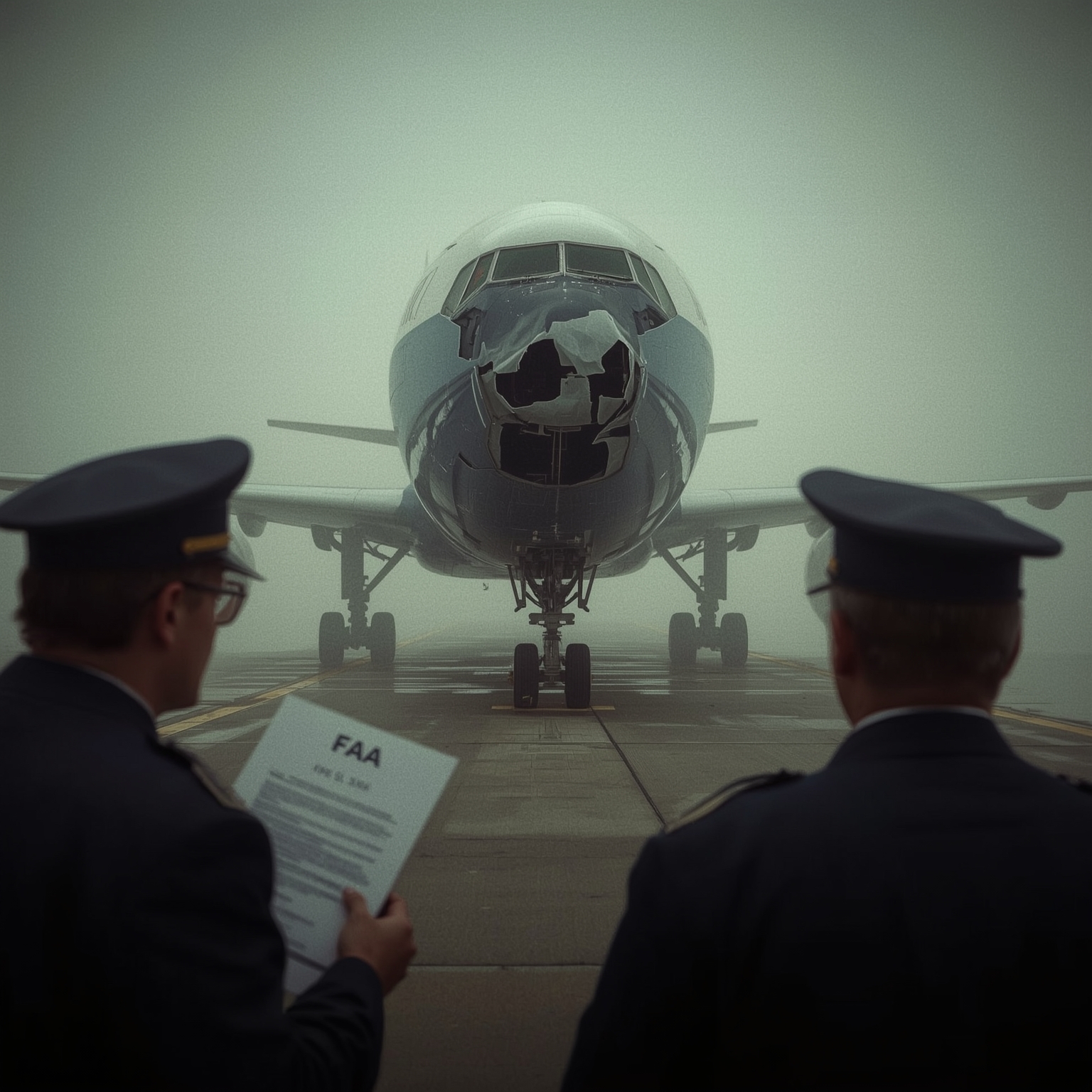
The Federal Aviation Administration (FAA) revealed on Friday that it intends to impose financial penalties totaling $3.1 million against Boeing, citing what it characterizes as significant safety violations that occurred during the closing months of 2023 and the early weeks of 2024. This announcement, delivered through an official press release, underscores mounting concerns over Boeing’s operational practices and the regulatory scrutiny directed toward its quality control systems.
The FAA’s allegations highlight a particularly alarming event that unfolded on January 5, 2024, when a mid-flight incident involving Alaska Airlines captured global attention. During the journey of one of the carrier’s Boeing 737 Max 9 aircraft departing from Portland, Oregon, a structural component known as a door plug became detached and fell away from the fuselage. Despite the terrifying circumstances of the occurrence—an emergency that could have escalated into a much broader catastrophe—no passengers sustained physical injuries. Days later, the missing panel was discovered by chance in the backyard of a Portland schoolteacher, further dramatizing the seriousness of the breakdown and its potential risk to public safety.
This malfunction did not emerge in isolation. The episode reignited long-standing fears regarding Boeing’s manufacturing oversight, particularly given recent history. The company is still attempting to rebuild trust after the devastating crashes of two separate 737 Max aircraft in 2018 and 2019, which collectively resulted in the loss of 346 lives. Earlier in the current year, Boeing successfully reached an agreement with the U.S. Department of Justice to stave off possible criminal prosecution connected to those earlier disasters, though the shadow of those tragedies continues to loom heavily over its reputation.
While the penalty now being advanced amounts to $3.1 million, a figure that may appear modest for a corporation of Boeing’s size and financial stature, the FAA emphasized that this sum represents the maximum civil sanction the agency is legally authorized to levy. In its carefully worded statement, the FAA pointed out that the fine reflects the limits of statutory authority rather than the scale of the violations themselves, leaving observers to question whether current laws provide regulators with adequate tools for deterrence.
In addition to the high-profile door plug failure, the FAA is also drawing attention to troubling instances of undue influence within the certification process itself. According to the regulator, a Boeing employee was found exerting inappropriate pressure on a member of the FAA’s Organization Designation Authorization (ODA)—the system under which certain safety approvals are delegated—to approve the clearance of a 737 Max aircraft in order to satisfy delivery deadlines. This revelation compounds ongoing criticisms that the FAA has historically maintained too accommodating a relationship with the very manufacturers it oversees, raising questions about independence, transparency, and accountability in the safety approval process.
The regulatory body also documented numerous lapses in Boeing’s production pipeline and those of its subcontractors. Specifically, investigators identified hundreds of violations within the quality assurance systems at Boeing’s Renton, Washington, factory, where the 737 series is assembled, as well as at the Wichita, Kansas, facility operated by Spirit AeroSystems, a major supplier of fuselage sections. Among the most troubling findings, Boeing allegedly attempted to present two aircraft for FAA certification despite them being deemed unairworthy, a maneuver starkly inconsistent with its stated commitment to safety and compliance.
In a written statement provided via email, a spokesperson for Boeing expressed the company’s regret regarding the January door-plug accident and underscored Boeing’s commitment to fortifying what it referred to as its “safety culture.” According to the message, the manufacturer is currently prioritizing improvements in production quality, promoting greater accountability across its entire workforce, and advancing safety-focused reforms. The spokesperson pointed out that, under the oversight of the FAA, Boeing introduced in the previous year a Safety & Quality Plan designed around measurable performance indicators, with the ultimate objective of strengthening management of safety concerns and instilling more rigorous quality assurance mechanisms within the production environment. These initiatives, as the company highlighted, include targeted investments in workforce training, enhancing compliance standards throughout the production system, and cultivating an organizational environment in which employees feel empowered to voice concerns without hesitation.
Although the FAA has outlined its case against Boeing, the process is far from complete. Boeing now has a 30-day window to formally respond to the agency’s letter concerning the proposed fines. The complete letter, which likely contains additional details about the specific violations, has not yet been released to the public. Moreover, when reached late Friday evening, the FAA itself declined to provide immediate responses to follow-up questions from the press. News outlets, including Gizmodo, have indicated that they will publish updates should further information become available.
Taken together, the FAA’s proposed penalty, the discovery of systemic quality control irregularities, and the legacy of past 737 Max tragedies form a portrait of a company at a crossroads between regaining public trust and addressing deep-rooted cultural and structural challenges. The coming weeks will be critical, as Boeing’s official response to the regulator will shed light not only on its willingness to comply but also on its broader resolve to enact authentic systemic reform rather than limited corrective measures.
Sourse: https://gizmodo.com/faa-fine-boeing-safety-accident-2000658494