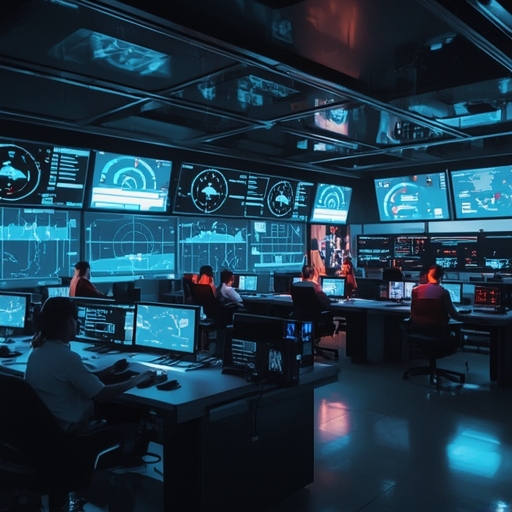
The Federal Aviation Administration (FAA) is addressing one of the most pressing challenges in modern aviation — a critical shortage of qualified air traffic controllers — by looking to a perhaps unexpected yet remarkably fitting talent pool: the gaming community. In an era defined by rapid technological evolution, the agency’s decision to recruit from among passionate gamers reflects both creativity and pragmatism, as it aligns the distinctive capabilities honed within digital worlds with the intricate demands of real-world aerospace operations.
Traditionally, air traffic controllers have been sourced through specialized training pipelines requiring exceptional concentration, rapid processing of dynamic information, and tight coordination under stress. Interestingly, these are precisely the proficiencies that avid video gamers often cultivate through years of immersive play. Gaming environments frequently demand instantaneous responses, accurate spatial awareness, and multitasking across multiple screens or objectives — in effect mirroring the kinds of cognitive agility necessary to manage the complex choreography of aircraft moving through national and international airspace.
By drawing parallels between these two skill sets, the FAA seeks to reimagine how high-performance digital literacy can evolve into a vital asset within aviation safety and efficiency. In today’s gaming landscape, many players continuously interpret high‑velocity information, communicate strategically with teammates, and maintain composure amid virtual chaos. Translated into the air‑traffic control context, such mental agility can support critical decision‑making when dozens of flights converge, weather systems shift, or unforeseen variables alter established flight paths.
Moreover, this unconventional recruitment effort offers a broader commentary on the changing dynamics of workforce development. As industries across the globe wrestle with technological disruption and generational turnover, institutions are increasingly compelled to redefine what constitutes relevant expertise. The FAA’s outreach to gamers exemplifies how the boundary between entertainment and professional application can blur to society’s advantage. What was once dismissed as hobbyist behavior is now being reconsidered as potential training for high‑stakes operational excellence.
This initiative also signals a shift toward inclusivity in identifying talent, valuing cognitive skill and digital adaptability alongside traditional credentials. Gamers often exhibit the precision, situational awareness, and problem‑solving instincts essential to aviation’s demanding tempo. By channeling those abilities toward public service and national infrastructure, the FAA demonstrates both ingenuity and openness to unconventional career pathways.
Ultimately, this strategy raises intriguing questions for the future: could other sectors — from emergency response to cybersecurity — also tap into the vast reservoir of digitally skilled individuals emerging from gaming culture? As cross‑disciplinary recruitment becomes more common, the FAA’s experiment may serve as a pioneering model for bridging virtual mastery with tangible, real‑world responsibility.
In essence, the collaboration between gaming and aviation represents not only a clever response to staffing shortages but also a deeper recognition that the competencies of the digital generation — precision, focus, strategic foresight, and composure under pressure — are profoundly transferable. The skies, whether virtual or real, demand the same unwavering attention and quick thinking. Now, the FAA is betting that those who have conquered the digital frontier may be ready to guide the planes that traverse our actual horizons.
Sourse: https://www.theverge.com/games/910434/now-the-faa-says-gamers-are-the-answer-to-its-air-traffic-controller-shortage