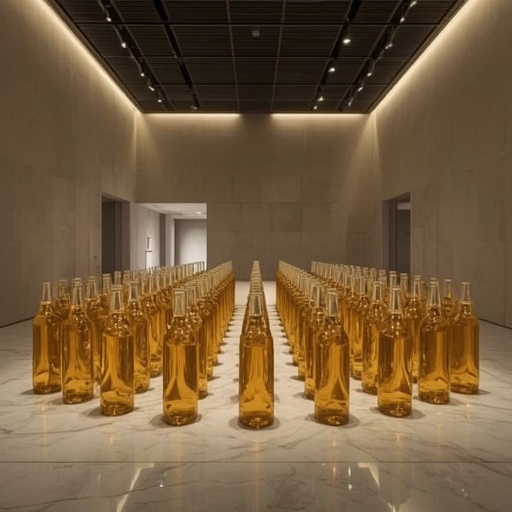
In an arresting and unconventional act of artistic defiance, a group of protesters staged a symbolic intervention inside one of the world’s most renowned museums, mere hours before the illustrious Met Gala commenced. They strategically placed hyperrealistic bottles that appeared to contain urine—objects simultaneously mundane yet shockingly intimate—transforming the pristine gallery floors into a space of confrontation between luxury and rebellion.
This gesture was far more than a prank; it was an eloquent, albeit provocative, critique of the intertwined relationship among art, privilege, and institutional authority. The timing could not have been more deliberate: just before an event that annually celebrates extravagance, opulence, and high fashion, often seen as both a showcase of creativity and a display of excess. By introducing simulated waste into such a revered cultural environment, the protesters invited audiences to rethink who and what museums ultimately serve. Were these grand halls built to preserve aesthetic ideals or to mirror the values of the elite who fund them?
To some observers, the golden-hued bottles embodied a biting metaphor for the commodification of everything—even dissent itself—within the art world. Others interpreted the act as performance art in its purest sense: ephemeral, transgressive, and unsettling, a moment that forces spectators to engage with discomfort. Whether viewed as an affront to taste or as a masterstroke of institutional critique, the installation fulfilled its primary aim: it sparked dialogue. Museum visitors, curators, and social media commentators alike found themselves debating the boundaries between vandalism and vision, art and activism, propriety and protest.
The deeper resonance of this act lies in its paradoxical elegance. The protesters did not destroy or desecrate valuable artwork; instead, they recontextualized space, using minimal yet visceral symbolism to question the moral architecture surrounding cultural celebration. Within that context, each bottle became a mirror—reflecting the tension between wealth and authenticity, between access to art and exclusion from influence. It was as though the museum, for a fleeting moment, was no longer a neutral vessel of beauty but a contested ground where art confronted the mechanisms of its own containment.
Ultimately, this curious episode illuminated a recurring truth about contemporary art: its most potent expressions often occur not in carefully curated exhibitions but in spontaneous, discomforting acts that lay bare society’s contradictions. In the wake of the protest, the Met Gala proceeded as usual, its glamour undimmed, yet the lingering question remained echoing through the marble halls—whose stories, whose values, and whose power does art truly represent?
Sourse: https://gizmodo.com/fake-urine-bottles-planted-in-museum-before-met-gala-to-protest-jeff-bezos-2000754487


