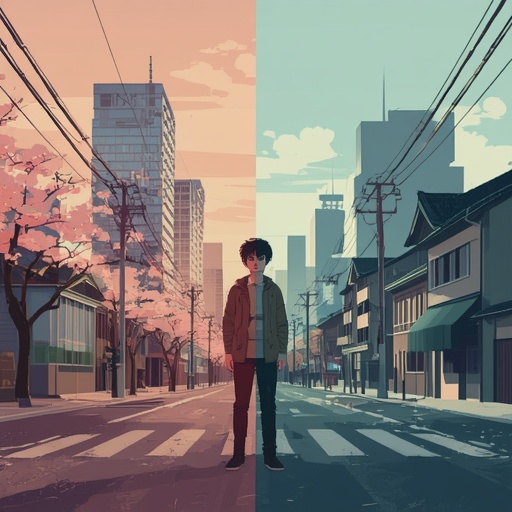
The journey toward understanding the true meaning of ‘home’ often unfolds in the most unexpected places and through experiences that challenge one’s sense of identity. For many, moving abroad in early adulthood serves as a profound period of discovery — a time when personal freedom meets cultural immersion, and the self begins to stretch beyond familiar borders. Yet, returning to that place years later can reveal an even deeper form of transformation, one that redefines belonging not merely as a location, but as an emotional and psychological state where authenticity thrives.
At twenty-two, leaving one’s native country for Japan can feel exhilarating — the neon-lit nights of Tokyo, the serene rhythm of distant temples, and the quiet exchanges with strangers who become friends all carve powerful memories into the heart. The thrill of adaptation often blurs the loneliness that initially accompanies displacement. Over time, however, those experiences fuse together into a narrative of growth, resilience, and emerging self-awareness. For Laura, this decade-long gap between her first and second stay in Japan was marked by shifts not only in geography but in emotional perspective. By the age of thirty-one, her return was less about adventure and more about reconnection — both to a culture that had once nurtured her and to the person she had become in its absence.
When she boarded the plane home after her first teaching contract ended, she expected to feel relief, believing that familiarity and proximity to family would provide the comfort she sought. Instead, she found an unexpected emptiness. The version of ‘home’ she returned to no longer mirrored who she was. The connections that once felt grounding appeared superficial, while the friendships she left behind in Japan continued to echo through messages and memories that sustained her spirit across continents. Through this realization, Laura recognized that belonging is not anchored solely in birthplace or language but in emotional consonance — in the environments and relationships that encourage genuine expression.
Her return to Japan years later was less an external relocation and more a homecoming of the soul. She rediscovered the small rituals that had first captivated her — early morning walks beneath cherry blossoms, the orderly bustle of commuter mornings, and the quiet courtesy woven through everyday interactions. These details, once ordinary, became symbols of mindfulness and presence, teaching her how to be at ease with herself. Amid Tokyo’s vast energy, she found a form of calm that restored her mental balance, gently dissolving the self-doubt that had accumulated during her years abroad from this place she once called home.
Laura’s story illustrates a universal truth: that ‘home’ is less a fixed point on a map and more the feeling of being genuinely understood and supported. In her mid-twenties, she experienced Japan as a place of discovery; in her thirties, it became a sanctuary of self-acceptance. The contrast between the two stages reflects how emotional maturity reframes our concept of belonging. The same streets, faces, and sounds that once symbolized novelty evolved into reminders of stability and peace.
In essence, this return was not simply geographical but deeply psychological. It affirmed that mental health and a sense of rootedness intertwine — that well-being flourishes where one feels both seen and safe. Laura’s narrative urges anyone struggling with the transition between cultures, roles, or chapters of adulthood to consider that ‘finding home’ might not mean going back, but going deeper — to the environments that rekindle joy and the communities that allow us to breathe freely.
Ultimately, her journey invites reflection on a broader notion of identity in a globalized world. We build versions of ourselves in different cities and languages, cultivating fragments of belonging across time and space. For Laura, Japan was never merely a foreign country; it was the mirror reflecting the most genuine version of her own life — the one where distance transformed into clarity and rediscovery became her path toward peace.
Sourse: https://www.businessinsider.com/moved-to-tokyo-japan-teach-career-depression-engaged-planning-future-2026-5