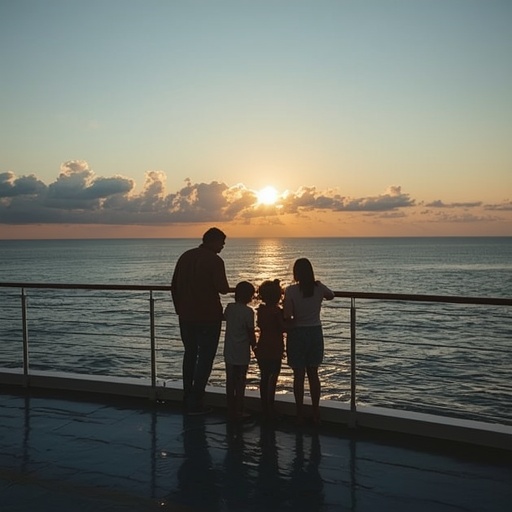
Grief has never followed a straight or predictable road, and in the wake of losing my father, that truth became painfully clear. Each of us in the family experienced his absence differently — some through quiet reflection, others through unstoppable tears or silent numbness. Everyday routines felt foreign, as though life had shifted permanently out of focus. Amid that emotional uncertainty, we decided to do something that might have seemed unconventional: we used a portion of my father’s life insurance money to take a family cruise. At first, the idea appeared strangely trivial in comparison to the depth of our loss. None of us had ever considered ourselves ‘cruise people’; organized travel had never appealed to our independent spirits. Yet what began as an experiment in distraction evolved into one of the most unexpectedly healing experiences we could have imagined.
The cruise was not about indulgence or luxury in the traditional sense — there were no grand expectations of entertainment or lavish dining. Instead, it provided exactly what our grieving hearts craved: a suspended space away from the demands of daily life, a pause in which time seemed to expand and soften. Surrounded by the endless horizon, we discovered a rhythm of stillness that allowed us to breathe in ways we hadn’t since my father’s passing. The motion of the ship — gentle, cyclical, endless — became almost meditative, echoing the movements of grief itself: forward and back, calm and storm, presence and absence.
As the days passed, conversations that had felt impossible at home began to unfold naturally. Over quiet breakfasts overlooking the sea, we found ourselves speaking about my father not only with sorrow but with gratitude — recalling his laughter, his stubbornness, his unwavering devotion to family. The ocean breeze seemed to carry our memories and scatter them across the waves, returning them tenderly in moments of silence. Even the mundane shared experiences — sitting together at dinner, watching the sun sink slowly into an endless sky — took on a sacred quality. In those unhurried hours, we rediscovered one another. We laughed again, hesitantly at first, then genuinely. The tension that had filled the months after his death began to lift, replaced by a calmer kind of togetherness that asked for nothing but presence.
What surprised me most was how profoundly the simplicity of the sea aided our healing. The vastness of water offered perspective: grief, though heavy, was just one current in the wider expanse of life. There was humility in recognizing how small we were against that horizon, yet comfort, too, in knowing that our pain would eventually move and transform, as the ocean always does. We began to understand that healing is less about sudden revelation than it is about allowing time and space — literal and emotional — to do their quiet work.
When we returned home, nothing outwardly monumental had changed: the world still looked the same, my father was still gone, and our lives still held echoes of ache. But internally, something subtle and powerful had shifted. The cruise had given us permission to breathe again, to hold both grief and joy in the same moment without guilt. It reminded us that even in pain, connection remains possible, and that healing rarely appears as grand transformation; more often, it emerges through small acts of presence and shared humanity.
Sometimes, the path toward peace reveals itself not in profound places of worship or in structured therapy sessions, but in the gentle rocking of a ship upon calm waters, in the endless conversation between sea and sky. That journey taught us that mourning and living are not opposing forces — they coexist, and through acceptance, they find balance. For our family, the ocean became both witness and teacher, guiding us softly toward reconciliation, connection, and the quiet beginnings of hope once more.
Sourse: https://www.businessinsider.com/parent-died-used-insurance-money-take-trip-cruise-grieve-2026-5