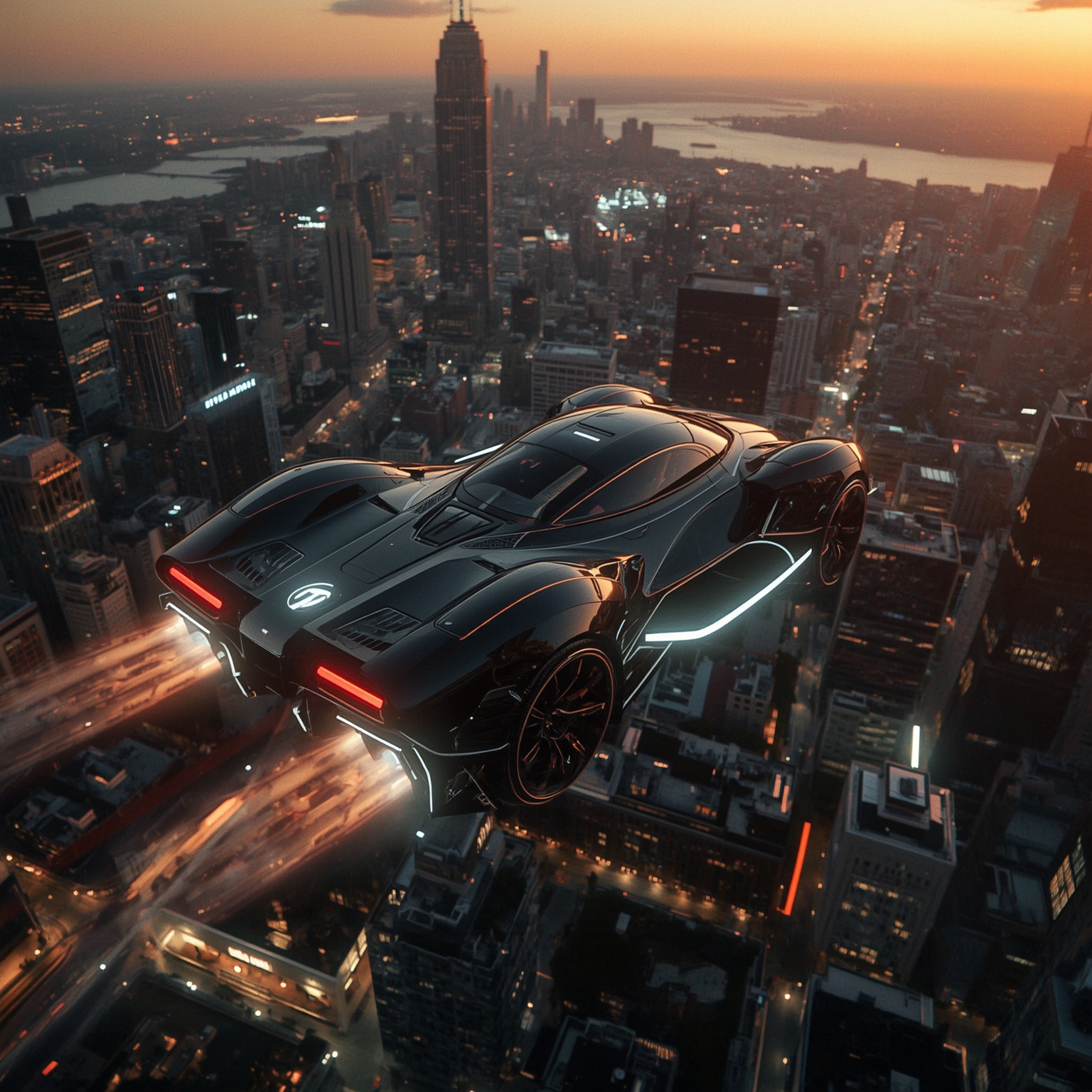
On Friday, billionaire entrepreneur and oft-controversial industrialist Elon Musk made yet another appearance on Joe Rogan’s widely watched podcast. Although the conversation initially covered familiar territory—subjects such as technology, innovation, and Musk’s vision for the future—this episode featured a fresh revelation. In a particularly memorable moment, Musk announced his intention to demonstrate, before the year’s end, a prototype of what he described as a “flying car,” a claim that immediately reignited curiosity and skepticism alike among enthusiasts and critics who have watched him make similar promises over the years.
For long-time followers of Musk’s ventures, the idea of him discussing a flying vehicle is hardly novel. As early as 2014, he had been publicly musing about the possibility of developing airborne automobiles, often framing them within his broader narrative of human technological evolution. This latest conversation began, however, in the context of Tesla’s Roadster—a sports car originally produced between 2008 and 2012. A second-generation version of the vehicle has been promised to eager fans for several years, with the initial release target set for 2020. Yet, delays and shifting priorities have kept the Roadster tantalizingly out of reach. When Rogan pressed Musk on when this next-generation model might finally materialize, Musk’s responses grew progressively more cryptic, ultimately revealing that his ambitions for the Roadster now included an unprecedented—perhaps literal—elevation of the vehicle off the ground.
With his characteristic pauses and dramatic delivery, Musk told Rogan, “We’re getting close to…,” before stopping momentarily for effect and finishing with, “…demonstrating the prototype.” He went on to declare, with a faint sense of mischief, that the forthcoming Tesla product demonstration would be “unforgettable.” This vague yet provocative phrasing left Rogan puzzled, prompting him to ask what exactly would make the unveiling so memorable. Musk’s enigmatic reply—“Whether it’s good or bad, it will be unforgettable”—did little to clear the air. Only later in their discussion did he deliver a concrete clue, referencing his longtime associate Peter Thiel, the cofounder of Palantir and fellow PayPal alumnus. According to Musk, Thiel once lamented that the future people had long envisioned—a world of flying cars—had never arrived. Musk suggested that perhaps it was time to make Thiel’s wish come true.
Rogan, still uncertain of the specifics, attempted to extract more details. He asked whether the mysterious vehicle might employ retractable wings or some other innovative aerodynamic mechanism. Musk, accustomed to walking the tightrope between revelation and secrecy, simply smiled and refused to elaborate further, insisting that he “can’t do the unveil before the unveil.” Nevertheless, he confidently asserted that the event would be “the most memorable product unveil ever,” carefully emphasizing the word “hopefully” when estimating the likelihood of showcasing it before year’s end.
For anyone acquainted with Musk’s pattern of public announcements, such guarded optimism feels familiar. His history is replete with grand prototypes and visionary ideas that often surface long before the technology is ready for real-world deployment. From the Hyperloop, once hailed as a revolution in high-speed ground transport, to the Loop system—a proposed network of autonomous underground shuttles capable of moving passengers at breathtaking velocities—Musk has rarely shied away from making audacious promises. When it finally came time to deliver on those systems, however, the results proved more modest: a Las Vegas tunnel where conventional Teslas, driven by humans rather than software, crawl through at slow and decidedly un-futuristic speeds.
That context is instructive in evaluating Musk’s current promise. Even if a prototype of this so-called flying car does appear imminently, a working prototype remains deeply distinct from a consumer-ready product. Consider, for instance, Musk’s announcement of the autonomous two-seater Cybercab more than a year ago, a vehicle that has yet to approach commercial availability. By contrast, Tesla’s semi-autonomous “Robotaxis” are operating today in certain Texan cities, albeit with safety drivers present to ensure human oversight.
Beyond production feasibility lies a more fundamental question—one that has vexed every aspiring flying car inventor for the past hundred years: who, precisely, will use such a machine? Unlike terrestrial cars, aircraft in the United States require operators to possess pilot licenses, an obvious barrier to widespread adoption. Autonomous flight could, in theory, resolve this limitation, but that solution introduces an entirely new web of technical and regulatory challenges, from ensuring navigational safety to managing low-altitude air traffic.
Later in the podcast, Musk continued describing the extraordinary technology embedded within the next-generation Roadster, though he remained evasive about its concrete functionality. He repeatedly emphasized how “crazy” the integrated systems were—advanced enough, he claimed, to blur the boundary between car and aircraft. Laughing at the comparison, Musk told Rogan, “It’s crazier than all the James Bond cars combined,” further hinting that what he envisions may transcend the conventional definition of an automobile altogether.
These hints strongly suggest that the project could in fact be a vertical take-off and landing, or VTOL, vehicle—machines that lift straight up from the ground like helicopters and do not require runways or even, strictly speaking, wheels for road travel. Such vehicles have frequently been branded “flying cars” in past media cycles, even though their operation is closer to that of small electric aircraft. Rogan, clearly fascinated yet baffled, confessed that he could barely keep up with the limited information Musk provided. Musk, sensing his curiosity, made him an intriguing offer: to view the prototype in person, albeit privately, before any public unveiling.
The lingering question, of course, is whether this long-promised dream will manifest as more than a futuristic prototype designed to distract from Tesla’s ongoing struggles. After all, fully functional flying cars have existed in experimental form since at least the 1950s, yet none have achieved mainstream commercial success. Moreover, Tesla’s recent decline in sales, attributed in part to Musk’s political controversies and polarizing public behavior, makes the timing of this new revelation appear strategic, if not opportunistic. Still, for those willing to suspend disbelief, Musk’s latest pronouncements rekindle the age-old fantasy of effortless personal flight, reviving the same optimism and skepticism that have always accompanied his grandest ambitions.
In closing, Musk summed up his cautious enthusiasm with understated confidence: “We need to make sure that it works,” he said, noting that the project incorporates an almost unbelievable level of innovation and complexity. Whether this so-called flying Roadster ultimately becomes a transformative leap forward in human mobility or merely another chapter in Musk’s growing anthology of unrealized visions, one thing is certain—the next few months promise to be, as he put it, unforgettable.
Sourse: https://gizmodo.com/elon-musk-tesla-flying-car-2000680264


