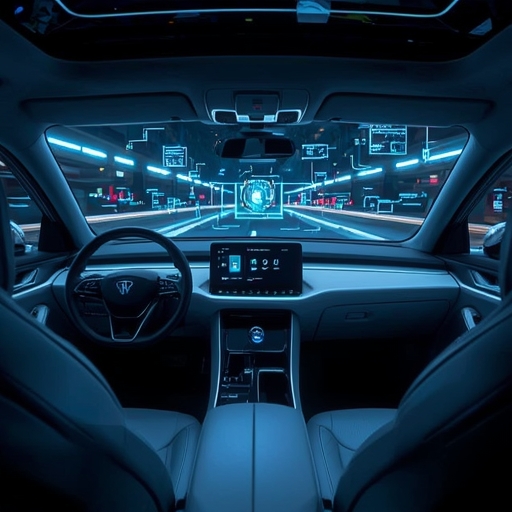
Ford, one of the world’s leading automakers, is making a decisive move toward the next era of intelligent and autonomous transportation. The company has announced the introduction of a new AI-powered voice assistant, scheduled to debut later this year. This advanced system represents not just an incremental software update, but a major leap toward a more naturally connected, conversational driving experience—one in which the vehicle itself becomes an intelligent companion that enhances safety, ease, and enjoyment on the road.
This upcoming voice interface will allow drivers to interact with their cars in an increasingly human-like manner, enabling seamless communication while minimizing distractions. By relying on cutting-edge natural language processing and real-time machine learning, Ford’s assistant aims to anticipate driver intent, understand contextual cues, and respond adaptively to both spoken commands and in-vehicle conditions. Imagine setting navigation routes, adjusting in-cabin settings, or retrieving important information—all through effortless, intuitive dialogue rather than traditional manual controls. The result is not only greater comfort, but also a significant increase in driver focus and on-road safety.
Beyond this immediate innovation, Ford has also revealed a bold vision extending into the near future. By 2028, the company plans to bring Level 3 autonomous driving capability—defined as hands-free and eyes-off operation under specific conditions—to its vehicle lineup through the Universal Electric Vehicle (UEV) platform. This level of autonomy promises to fundamentally expand what mobility means, allowing drivers to disengage from direct control while the system safely manages acceleration, braking, and navigation in compliant scenarios. The implications for long-distance travel, urban commuting, and accessibility are profound, representing a bridge between current semi-autonomous systems and the fully self-driving world yet to come.
This dual announcement underscores Ford’s broader mission to redefine mobility through intelligence, sustainability, and user-centered technology. The simultaneous pursuit of AI-led interactivity and high-level automation demonstrates a cohesive strategy in which electric powertrains, digital interfaces, and autonomous systems converge. In this vision, vehicles are no longer mere modes of transportation—they are dynamic, adaptive environments designed to simplify daily life, reduce human error, and improve energy efficiency.
Ultimately, Ford’s roadmap emphasizes both practical progress and aspirational design. The arrival of the AI voice assistant marks the dawn of a new era of connected experiences, while the forthcoming Level 3 autonomy sets the stage for a near future of unprecedented convenience and control. Through this fusion of artificial intelligence and automotive engineering, Ford is positioning itself at the forefront of technological evolution—pioneering a smarter, safer, and more responsive world of electric mobility that prioritizes not only innovation, but also the human experience at its core.
Sourse: https://www.theverge.com/transportation/857400/ford-ai-assistant-level-3-automation-ces-2026