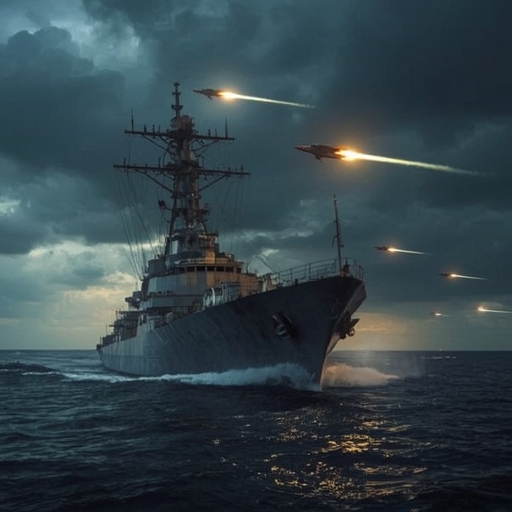
A decorated U.S. Navy pilot, whose advanced fighter jet was tragically shot down by an American warship during a mission over the Red Sea, told investigators that in the final moments before he ejected from his crippled aircraft, he vividly saw his life flash before his eyes. The comprehensive command investigation into this alarming friendly fire event—an incident that took place in late December 2024 and whose findings were reviewed by Business Insider before their public release—provides a disturbing reconstruction of how the warship’s crew mistakenly identified two F/A-18 Super Hornet fighter jets as incoming anti-ship cruise missiles, allegedly launched by Houthi rebels in Yemen. What followed was a catastrophic sequence of misjudgments and system failures that culminated in the cruiser USS Gettysburg launching surface-to-air missiles at friendly aircraft, bringing down one of them, nearly destroying a second, and even targeting a third before the fatal command could be executed.
The investigation paints a somber and intricate picture of a single moment of mistaken perception occurring in a volatile combat theater. The USS Gettysburg, operating as part of a larger strike group led by the aircraft carrier USS Harry S. Truman, had been deployed to the region in September 2024, reaching the Red Sea three months later to assume operational responsibility for the Navy’s combat mission against Iran-backed Houthi forces. For months, those rebels had been menacing vital maritime trade routes with relentless missile and drone attacks, destabilizing key shipping lanes vital to global commerce. Merely a week after the Gettysburg entered the Red Sea, on December 22, its systems and crew made a fatal error, firing upon one of Truman’s own aircraft—a $60 million F/A-18 Super Hornet belonging to Strike Fighter Squadron 11, renowned as the “Red Rippers.” Both aviators aboard managed to eject and survive, though the jet itself was completely destroyed.
While the immediate public narrative focused on the single aircraft struck down by friendly fire, the investigation’s detailed findings reveal that the situation was even more perilous than initially believed. The Gettysburg did not stop at one missile launch; another projectile was fired at a second American jet that narrowly evaded certain destruction, and a third friendly aircraft—luckily—was locked as a target but was spared when the crew refrained from following through on the firing sequence. As the first missile rocketed skyward from the Gettysburg’s launch tubes, the F/A-18’s pilot and weapons officer, unaware of the grave error taking place, assumed the projectile was tracking a Houthi drone that had previously eluded their detection. Their confusion turned to terror as the missile abruptly veered off course and homed in on their own jet. In that fleeting instant, the pilot described experiencing the chilling phenomenon of seeing his entire life replay in his mind—a psychological hallmark of life-threatening moments. With no other option for survival, both crew members ejected seconds before the missile obliterated their aircraft.
The chaos did not cease there. Almost simultaneously, the Gettysburg launched another missile, this time at the second friendly fighter jet. The aviators aboard that aircraft, in a desperate sequence of radioed mayday calls, made the split-second decision to outmaneuver the weapon rather than eject. The missile, guided by precision tracking, executed several corrections in pursuit of the jet before missing it by mere feet, the explosion’s shockwave violently rattling the aircraft as it passed. A Navy helicopter crew observing the event from nearby testified that they saw the missile streak overhead, describing its flash and explosive detonation with disbelief, and confirming that there had been no forewarning prior to the engagement.
According to the investigation, this tragic event was not the product of a single error but the culmination of systemic failures, lapses in judgment, and the cumulative effects of fatigue and technological degradation. The report cited deficiencies in the Gettysburg’s combat systems—particularly in its ability to manage networks, maintain coherent surveillance data, and correctly identify allied targets through its interoperability systems. These technical weaknesses, identified earlier in the deployment, impaired coordination between the cruiser and the Truman, whose forces often operated at a significant distance from one another. This operational divide, combined with the pressure of defending against a recent barrage of Houthi missile and drone attacks, created a confusing tactical environment in which the crew believed hostilities were still ongoing.
Against this chaotic backdrop, the Gettysburg’s commanding officer made the decision to fire—one that, the inquiry later concluded, was demonstrably incorrect when weighed against the full spectrum of available information. The report further noted that the captain’s situational awareness was dangerously limited, and the ship’s Combat Information Center failed to provide him with the clarity necessary to make a sound judgment under immense time pressure. Fatigue, technological deficiencies, and the pressure of operating in a high-threat zone all intersected in a perfect storm of misinterpretation.
This was not, regrettably, the only episode of friendly fire during the Red Sea campaign, though it stands as the most consequential. In a separate incident earlier that same year, a German warship accidentally engaged a U.S. MQ-9 Reaper drone, an error that fortunately ended without harm when the missile failed to reach its target due to a radar malfunction. The December 2024 episode, however, was particularly grave, representing one of four major operational mishaps suffered by the Truman strike group during its extended deployment in the Middle East. Among those earlier incidents were a February collision between the aircraft carrier and a civilian cargo vessel, followed by two additional Super Hornet losses—one that slipped overboard along with its tow tractor in April, and another that crashed after an equipment failure during landing in May.
Reflecting on these troubling events, Vice Chief of Naval Operations Adm. Jim Kilby emphasized in a public statement the Navy’s unwavering commitment to self-assessment and reform. He affirmed that these investigations underscore the institution’s ongoing obligation to invest in personnel development, technological resilience, and procedural integrity—ensuring that future naval forces remain both vigilant and combat-ready. The friendly fire incident over the Red Sea thus stands not merely as a sobering tragedy narrowly contained, but as a vital, painful reminder of the razor-thin line separating operational success from disaster in the unforgiving realm of modern warfare.
Sourse: https://www.businessinsider.com/navy-warship-fired-at-us-fighter-jets-mistaken-enemy-missiles-2025-12