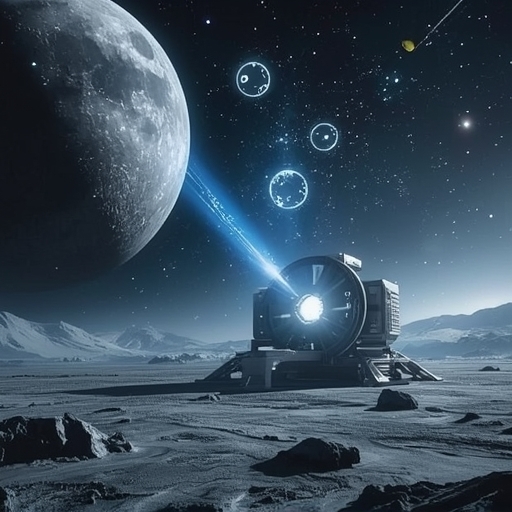
When the visionary realm of innovation begins to blur with the seemingly boundless territory of science fiction, conversations ignite across industries and imaginations alike. Elon Musk’s thought-provoking musings about deploying artificial intelligence satellites through moon-based electromagnetic launchers have sent ripples through both the technological community and the general public. The proposition sounds almost cinematic — a concept that evokes vivid imagery of glittering lunar facilities flinging intelligent machines into the great unknown. Yet beyond the sensational surface lies a serious contemplation: where does ingenuity end, and where does unfettered imagination take over?
The fascination with such bold forecasts is not unwarranted. Humanity’s greatest feats — from powered flight to digital computing — were once dismissed as impracticable fantasy. Musk’s idea awakens that same debate anew, positioning visionary ambition against the constraints of current scientific reality. On one hand, these conversations exemplify the restless drive that propels technological evolution. They challenge existing paradigms, inspiring researchers, engineers, and entrepreneurs to extend the boundaries of feasibility. On the other, critics caution that too much indulgence in hypothetical wonders may divert attention and resources from achievable advancements. Thus, this discourse becomes not merely about rockets or AI but about how societies interpret and balance creative optimism with disciplined execution.
Across different professional circles — from seasoned leaders on LinkedIn pondering the ethics and logistics of extraterrestrial innovation, to social media audiences reveling in the dream of humanity’s celestial expansion — the dialogue reflects an enduring truth: innovation is born from imagination. The notion of utilizing the Moon as a cosmic launching platform might sound extravagant, yet its allure lies precisely in its audacity. It forces collective reflection on how far our technological aspirations should reach, and whether humankind’s next giant leap should be one of spirit before science. Whether deemed pure genius or splendid folly, such daring visions remind us that progress repeatedly springs from ideas once labeled impossible.
Ultimately, the conversation transcends Musk himself. It encapsulates the tension between daring creativity and rational restraint, between those who dream of interplanetary infrastructures and those who build the incremental steps toward them. Our world advances because individuals — and entire generations — dare to envisage realities that outpace the moment. Therefore, even if the prospect of AI satellites launched from lunar accelerators remains a distant prospect, its power as a thought experiment endures. It rejuvenates the culture of innovation by encouraging society to look upward, outward, and forward — toward the luminous intersection of imagination and invention where the improbable begins its metamorphosis into the possible.
Sourse: https://gizmodo.com/well-find-the-remnants-of-ancient-alien-civilizations-read-musks-gibberish-rant-from-his-xai-all-hands-meeting-2000720876