In 2019, our family reached a milestone that filled our home with anticipation and joy. Our 5-year-old son and 4-year-old daughter were bursting with excitement as they prepared to begin their very first year at a public school—a moment every parent envisions as the start of a lifelong educational journey. However, like countless families across the globe, we could never have predicted the abrupt and transformative upheaval that lay just months ahead. When March of 2020 arrived, the once-familiar rhythm of classroom learning came to an immediate halt. The COVID-19 pandemic shuttered schools nationwide, leaving children’s laughter to fade from playgrounds and replacing in-person education with uncertainty. Overnight, my husband and I were confronted with a daunting question: how should we continue to nurture our children’s curiosity and growth in a world where classrooms suddenly stood empty?
After much reflection, we discovered an unconventional yet deeply inspiring path—an outdoor learning school called The Learning Tree, which operated through a local day care center. This program, centered on experiential learning in nature, offered an opportunity that felt both safe and enriching. To our delight, what began as a pandemic necessity blossomed into a profoundly rewarding educational experience that surpassed every expectation we held.
### Why We Chose an Outdoor Learning School
As the summer of 2020 approached, global uncertainty still loomed large. Though schools began drafting reopening plans, the prospect of sending our young children back under rigid and unpredictable health mandates made us apprehensive. The policy that one infection could close an entire classroom for two weeks presented an impossible challenge for our household, where both parents worked full-time. Beyond logistical concerns, we feared the emotional and academic toll such stop-and-start disruptions could cause. Our children needed stability—a consistent, engaging environment that could adapt more gracefully to changing circumstances.
It was during that uneasy summer that The Learning Tree, the day care our children had long attended, announced an innovative K/1 program. It introduced project-based, student-driven learning within a small, close-knit community of about a dozen children per class. Lessons were designed not only to accelerate academics but also to cultivate physical well-being through outdoor exploration and healthy habits. Although the tuition—$125 per week per child—gave us pause, the benefits quickly outweighed our concerns: smaller class sizes, minimal exposure risks, and built-in after-school care all made the decision clear. Thus, for the 2020–2021 academic year, our daughter embarked on her kindergarten adventure while our son entered first grade. When the school expanded to include second grade the following year and then third shortly after, we chose to remain, recognizing the profound impact this educational system was having on our children.
### We Missed Some Traditions, but Gained Far More
Initially, our plan had been to return to public schooling once safety and stability were restored. Yet as time passed, comparing what public school offered versus what The Learning Tree provided made the choice increasingly simple. Admittedly, The Learning Tree lacked many of the resources available in a traditional setting. There was no library stacked high with picture books, no art or music room humming with creative expression, no cafeteria filled with the scent of lunchtime chatter. Even the playground was modest in size, and formal gifted testing was absent from the curriculum.
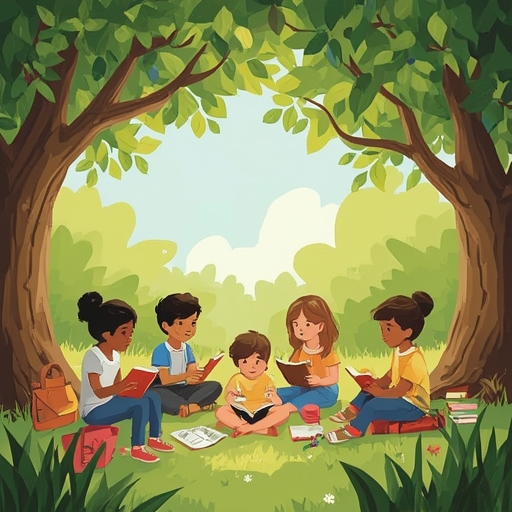
But those seeming deficiencies were overshadowed by the richness of what the outdoor model offered instead. The school featured an in-ground swimming pool, where swimming lessons were not a mere extracurricular but a built-in part of the curriculum during warmer months. A winding one-mile nature trail doubled as both a fitness track and a living science classroom, where children greeted the morning with stretches and exercises amid birdsong and sunlight. Instead of fluorescent lighting and digital screens, they learned by doing—building gardens, planting seeds, and watching their crops transform into the healthy meals that fueled their days. Technology, while present, remained nearly invisible; screen time was intentionally minimal, allowing imagination and human connection to fill the void.
Beyond academics, there was a beautiful integration of family and community. Parents were not distant observers but active participants in the learning journey. I still remember our family kayaking trip on the nearby river, which tied seamlessly into a history unit about local waterways and their role in early settlements. Seasonal celebrations—like Thanksgiving feasts and Christmas gatherings—brought parents, teachers, and students together, echoing a sense of warmth often missing in larger, more formal institutions.
Even traditional subjects took on imaginative new forms. Instead of reading abstract math word problems from worksheets, students physically enacted them—running small-scale farmers’ markets, measuring garden plots, or calculating ingredients during food-preparation projects. Each grade’s focus was shaped by hands-on inquiry and self-guided exploration, rendering separate gifted programs unnecessary. Every child, regardless of label or pace, was empowered to learn in a way that matched their individual curiosity and development.
### Transitioning Back to the ‘Real World’
The outdoor program grew organically, adding one new grade level each year until it reached fifth grade. Yet as our children approached fourth grade, we faced another pivotal decision. In our district, fifth grade marks the beginning of middle school, a transition that brings new demands in structure and social adjustment. We decided it would be best for our children to rejoin the public system before this milestone, giving them time to readapt to more traditional learning environments. While they were eager to reconnect with friends who had remained in public school, the shift still proved formidable.
The contrast was immediate. Gone were the endless hours outdoors and the freedom to set their own academic pace. Recess now lasted a mere twenty minutes—a fraction of the open-air time they once enjoyed. Classrooms were larger and more structured, leaving fewer opportunities for individualized attention or creative detours. The day grew heavier with rules, seated work, and a rhythm of assigned worksheets rather than exploratory projects.
Emotionally, the adjustment was equally challenging. Our children deeply missed the warmth and attentiveness of their outdoor school teachers, whose genuine curiosity about each student’s interests had made learning feel personal. They longed for the autonomy to shape their lessons, to follow their passions, and to see learning as a natural extension of living, rather than a segmented task confined to desks and bells.
Still, as all chapters must conclude, so did this one. When we look back, our gratitude for those outdoor years far outweighs any nostalgia for what we left behind. Our children emerged not only stronger academically but also more confident, resilient, and independent thinkers. They carry with them a profound sense of curiosity, leadership, and self-discipline—traits that guide them far beyond the classroom walls. If given the opportunity to choose again, whether within a pandemic or under normal circumstances, we would embark upon that path without hesitation. The Learning Tree gave our family more than an education; it offered a lifelong reminder that learning thrives wherever curiosity is nurtured and the natural world becomes the teacher.
Sourse: https://www.businessinsider.com/kids-loved-private-outdoor-school-struggled-adjusting-public-school-2025-12