This as-told-to essay draws upon a candid and reflective conversation with Luke Barwikowski, the founder and chief executive officer of Pixels. The following narrative has been thoughtfully condensed and refined to enhance both readability and coherence.
I grew up in what could easily be described as a quintessentially traditional Michigan household, a familiar portrait of Midwestern life. My father devoted his career to a steel company, embodying diligence and stability, while my mother served her local church with genuine care and humility. My upbringing was warm and supportive, and I remain deeply thankful for the steady foundation and the values my parents instilled in me. Yet, even from an early age, I sensed that my path would diverge from the expectations that surrounded me. The life my parents lived—respectable and grounded though it was—did not feel like the one I was destined to pursue.
At the age of twelve, curiosity drove me toward technology, and I began to teach myself how to code. I kept this new passion secret, concealing it from friends and even family, out of embarrassment. At that time, programming lacked the allure it enjoys today; it was considered obscure, the domain of a few enthusiasts who existed far from the social mainstream. My small hometown was steeped in traditional trades, so the world of software development seemed foreign, almost unreachable. Yet, working with code quietly gave me an outlet for creativity and problem-solving that no one around me understood.
I eventually pursued computer science in college, confident that the logical professional trajectory would lead to a standard role as a software engineer. However, while immersed in academic life, another interest unexpectedly took hold. Through online videos showcasing breathtaking landscapes where people were scaling cliffs and exploring the wilderness, I fell deeply in love with the outdoors. The contrast between an indoor, tech-driven profession and the freedom of nature tore me in two. I struggled to decide whether to center my life around technology or to carve out a path more closely connected with the natural world.
During my college years, a particularly remarkable opportunity tested that decision. A company offered me a fully remote software job, astonishingly generous for a nineteen-year-old—it came with a salary of $130,000, surpassing what my parents earned combined. Despite the temptation, I declined. That choice surprised everyone around me, but looking back, I am profoundly grateful. I needed more time at the University of Michigan to grow, to mature personally and professionally, and to understand the type of life I wanted to build.
After graduation, I followed the expected route, accepting what my family considered a proper and secure job. Yet fulfillment eluded me. Within a short time, I realized that conventional employment confined the energy and ambition I felt. So, with mixed emotions, I decided to strike out on my own and start a company. My original reasoning was simple: if I worked exceptionally hard for a year, perhaps I could earn enough to travel freely. That bold leap marked the beginning of my entrepreneurial journey.
By the end of that first year, I had managed to save approximately $30,000—not a fortune, but sufficient to fund an adventure I’d long envisioned. With that savings, I set my sights on New Zealand. When I told my family, they were baffled, perhaps even alarmed. In our community, people rarely ventured far from home; stability was prized above all else. They could not understand why I would willingly abandon a steady career for a destination halfway across the globe. Nevertheless, the decision was mine to make.
Once in New Zealand, an unexpected chapter began. Not long after my arrival, the COVID-19 pandemic swept across the world, forcing isolation on nearly everyone. I spent roughly two months alone in a small cabin deep in the countryside, completely disconnected from the internet. Those solitary weeks turned into an extraordinarily productive period. In almost constant states of focus and creative flow, I began developing an idea that would eventually become the foundation for Pixels. My workflow was both primitive and determined: I coded offline for hours, then drove half an hour just to reach a spot with an internet connection so I could upload my progress. That discipline and resourcefulness shaped the product’s earliest form.
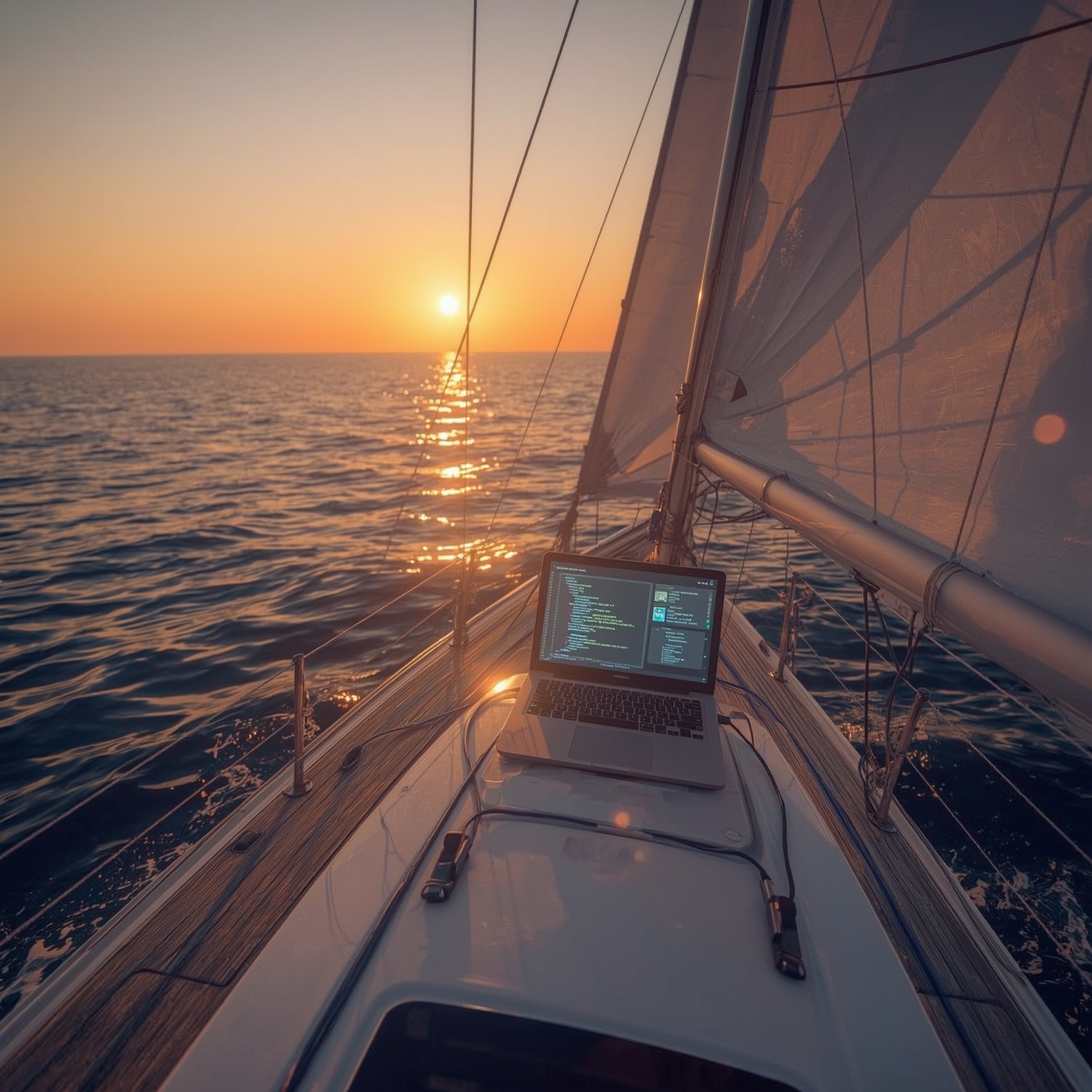
When global restrictions began to ease, I resumed traveling, still captivated by both exploration and remote work. On one occasion, I embarked on a perilous sea voyage from New Zealand to Fiji aboard a sailboat with a malfunctioning bilge pump. The vessel’s owners couldn’t afford the repair, so every night I would climb into the dark hull and manually remove water with a sponge. Afterward, I returned to my laptop and continued building Pixels late into the night. It was exhausting, but also exhilarating—a vivid metaphor for entrepreneurship itself: patching leaks even while steering forward toward an uncertain horizon.
Among my fellow travelers—many of whom were backpackers seeking leisure and escape—my dedication seemed incomprehensible. They wondered why I would spend precious travel moments hunched over a computer. For me, the answer was simple: the beauty of technology allowed me to create anywhere, whether in a city apartment, on a rocking sailboat, or under the stars in Kenya. I deliberately chose the more adventurous path, accepting that others might judge my priorities without understanding them.
As Pixels evolved, the company began to attract serious attention from investors and startup accelerators. For the first time, I felt external validation not only of my idea but of my capabilities as a founder. Until that point, I had navigated the entrepreneurial world largely on my own, without mentors or a support network. The recognition offered reassurance, even as the journey remained grueling.
Still, success did not come without deep valleys. In 2021, during one of the company’s lowest points, I became convinced that Pixels was destined to fail. In a moment of resignation, I accepted seasonal work farming potatoes in Idaho. Ironically, on my drive there, I received news that Pixels had been accepted into a major Bay Area accelerator program. The experience should have been an inflection point, yet by its conclusion I still hadn’t resolved some core challenges. Determined to find clarity, I rented another remote cabin—this time voluntarily—and immersed myself in concentrated problem-solving. Emerging weeks later, I had completely redefined Pixels. From that point onward, growth was rapid and sustained. By the following year, our revenue surpassed twenty million dollars.
The road from those early struggles to tangible success transformed not only my company but my perspective on life. Initially, launching a startup consumed all my freedom. Every waking hour revolved around the business, and eventually, burnout crept in. A conversation with one of my investors sparked a revelation: even as a CEO, I could construct a lifestyle that balanced leadership with mobility. I realized that much of my previous overworking had arisen from anxiety, not necessity. I could perform better by eliminating redundant tasks and embracing a rhythm of work that energized rather than drained me.
Today, I lead Pixels from my van in the deserts of Utah, surrounded by towering red rock formations and endless sky. Technology has truly liberated me; with reliable connectivity, I can oversee operations from anywhere. In this solitude, free from distractions, I enter a state of focus that renews both my creativity and strategic thinking. The freedom to explore while steering a thriving company reflects exactly the life I had hoped to build years earlier.
I often think back to my time at the accelerator in the Bay Area, where fellow founders often discussed how many millions they would need before they could retire. Their goals seemed astronomical and abstract. Mine, in contrast, was refreshingly modest: I dreamed simply of earning enough—about one hundred thousand dollars—to buy a sailboat and continue navigating both the literal and figurative seas of my journey. Recently, I achieved that goal. Sailing and outdoor living are not just hobbies for me; they are essential to maintaining balance. They sharpen my clarity as a leader and remind me that success is not confined to wealth or corporate scale but defined by meaningful independence.
In that sense, every choice—from rejecting early job offers to coding offline in a cabin—contributed to more than a business achievement. It built a life of my own design, one that merges adventure with innovation and resilience with freedom. This blend, I’ve learned, keeps me performing at my best, both as a CEO and as a human being fully alive to possibility.
Sourse: https://www.businessinsider.com/pixels-ceo-nomadic-life-better-boss-time-outside-2025-10