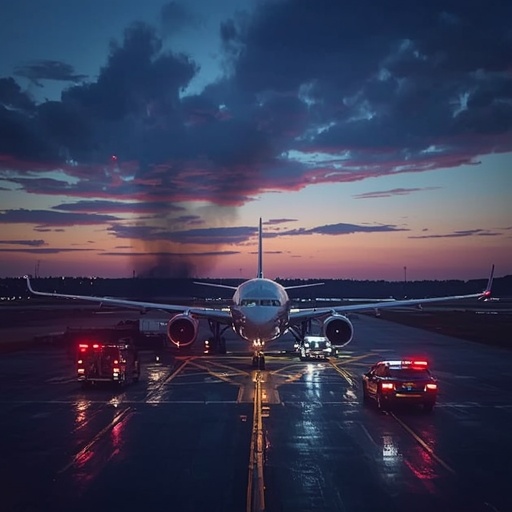
At Denver International Airport, an alarming and deeply unsettling event recently took place that has drawn significant attention across both local and national aviation circles. A Frontier Airlines aircraft, during ground operations, reportedly made contact with a pedestrian on or near the airfield, resulting in a grave and urgent safety situation. Almost immediately after the collision, sources indicate that one of the airplane’s engines briefly caught fire, producing a short burst of flames and smoke that caused widespread concern among onlookers and responding personnel. Fortunately, the emergency was swiftly and competently contained by the airport’s experienced firefighting and rescue teams, whose prompt coordination successfully prevented the situation from escalating into a greater catastrophe.
The rapid containment of the engine fire demonstrated the effectiveness of Denver International Airport’s comprehensive emergency response infrastructure—a system designed precisely for critical moments like this, where seconds can make the difference between a limited incident and a severe aviation disaster. The professionalism and readiness of first responders, maintenance crews, and airport control staff were evident as they worked in unison to secure the affected area, ensure the safety of passengers and personnel, and prevent further operational disruptions. It is understood that the response adhered closely to Federal Aviation Administration (FAA) standards and internal airport protocols, which emphasize immediate communication, mechanical assessment, and medical support when accidents occur on the tarmac.
This unsettling occurrence serves as a stark reminder of the complex interplay between human presence, high-powered machinery, and operational precision at modern airports. Aviation facilities like Denver International operate with finely tuned choreography—vehicles, pedestrians, and aircraft all move through controlled zones that demand absolute awareness and adherence to safety boundaries. An incident of this nature underscores why rigorous oversight, constant training, and reinforced safety measures remain indispensable. Every element—from reflective gear and designated pathway markings to real-time surveillance and emergency readiness—plays a vital role in protecting lives and minimizing risk.
Frontier Airlines, along with airport authorities, has reportedly launched internal investigations to understand the precise sequence of events and identify contributing factors, whether human error, communication lapses, or procedural misjudgments. These inquiries will likely yield additional safety recommendations, helping to prevent repetitions of similar occurrences elsewhere in the aviation network. In the broader context of airline operations, this event reinforces the continual and necessary emphasis on ground safety management systems (SMS), safety audits, and inter-departmental coordination, ensuring that every employee—from aircrew to janitorial staff—operates within clearly defined safety expectations.
Although the fire was short-lived and was extinguished before causing severe mechanical damage to the aircraft, witnesses describe scenes of urgency and professionalism as airport emergency vehicles surrounded the plane within moments of ignition. Crews efficiently deployed foam extinguishing systems and thermal suppression equipment, neutralizing the flames and examining potential residual heat sources along the engine cowling and airflow ducts. Their ability to bring the situation under control reflects not only elite training but also the investment Denver International has made in modern firefighting technologies and simulation-based emergency preparedness programs.
Public communication following the event was handled with caution and measured transparency, as officials balanced the urgency of informing the community with the obligation to avoid premature speculation. Initial reports expressed relief that the incident did not evolve into a more severe tragedy and that no wide-scale fire or aircraft evacuation was required. Passengers and witnesses were escorted safely to terminal areas while airport authorities temporarily restricted ground traffic around the affected zone. Flight operations resumed after all risk assessments confirmed environmental and mechanical safety.
Beyond its immediate operational impact, this episode highlights the unspoken reality of aviation—that even with advanced technology, human awareness and adherence to safety procedures remain indispensable. Airports are dynamic, high-stakes environments that rely on synchronized communication and proactive decision-making. Any lapse, even for a moment, can provoke serious consequences. Thus, the key lesson emerging from this event is that perpetual vigilance, procedural discipline, and seamless coordination between carriers, ground staff, and emergency units are vital to maintaining aviation’s outstanding overall safety record.
As investigations continue and official statements emerge, this incident will likely serve as a case study for the broader industry. From a training perspective, it will provide crucial insights into the efficiency of rapid-response frameworks and the importance of situational awareness within restricted airfield zones. While undeniably distressing, the fact that the fire was swiftly extinguished, and that emergency teams responded so effectively, reaffirms both the preparedness of Denver International Airport and the resilience inherent within the aviation community as a whole.
Sourse: https://www.businessinsider.com/frontier-flight-reported-it-struck-person-denver-international-airport-2026-5


