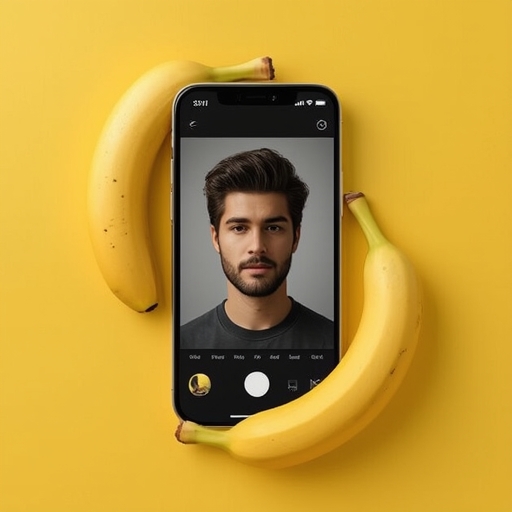
After spending several days experimenting with Google’s new visual AI model, I’m finally beginning to grasp the reasoning behind its whimsical name. The experience can best be summarized by the very word that inspired it: bananas. The images this model generates are so uncannily realistic that the only appropriate reaction is disbelief—a kind of awe mixed with slight unease. It’s as if every output pushes my perception of digital imagery past its limit, making me feel as though I’m personally going bananas after staring at these creations for too long. The realism is startling, and if I had to identify the single most defining quality that sets Nano Banana Pro apart from the earlier, less polished wave of AI image tools, it would be this simple but crucial observation: its pictures genuinely resemble photographs taken with an ordinary smartphone camera.
Of course, the subtle artificial traces—what AI researchers and photographers alike call the “tells”—still exist for those who actively search for them. Take, for instance, the image featured at the top of this article, depicting what appears to be a perfectly natural couple strolling down a city sidewalk. Upon closer inspection, anomalies start to emerge. The streetlight in the background doesn’t quite conform to the physics of real light diffusion, and several of the building facades, particularly those receding deeper into the frame, look oddly geometric, almost blocky, betraying their synthetic origin. Yet, despite these clues, if I were simply scrolling past this image in my social media feed, I would never suspect it to be AI-generated. The realism of the subjects—their posture, shadows, and clothing—feels deeply convincing, and paradoxically, it’s the slight imperfections, the fact that the scene isn’t too flawless, that truly sell the illusion of authenticity.
Another generated image reveals a towering mountain rising behind a boat and a cityscape so vivid that it almost feels plausible, though the mountain’s dramatized scale gives away its fictional nature. What’s remarkable, however, is how the rendering of the boat, the reflective water, and the surrounding architecture mirrors the particular way a smartphone camera processes visual information. The lighting feels bright and evenly exposed; each object is sharply defined yet retains a familiar digital crispness. It’s the quintessential smartphone aesthetic—an optical fingerprint instantly recognizable to anyone who has ever taken a snapshot on their phone.
Ben Sandofsky, the cofounder of the esteemed iPhone camera app Halide, seems to share this assessment. He pointed out that in the AI-created image of the ferry boat, one can clearly detect the kind of aggressive image sharpening typical of many smartphone photos—a deliberate computational enhancement designed to make images appear crisper and more vibrant, even at the cost of natural texture. This subtle over-sharpening, he notes, is what helps a digital photo “pop.” Another hallmark that Nano Banana Pro convincingly reproduces is image noise. Most AI-generated images in the past have looked overly pristine, almost too clean to be believable. By contrast, the faint grain and texture in these new outputs feel as if they originated from the small, constrained sensor of a real smartphone camera, adding a tactile realism that most generative systems have previously lacked.
And in true-to-life fashion, even Google’s virtual passengers on an imaginary King County Metro bus stubbornly refuse to remove their backpacks—an oddly human detail that underscores how deeply the model understands subtle social behavior in visual form.
This naturally raises an important question: where exactly is Google’s AI learning its visual intuition about the look and feel of smartphone imagery? At first glance, Google Photos might seem like an obvious and tempting data source—albeit one fraught with serious privacy and ethical implications. However, according to Elijah Lawal, who serves as global communications manager for the Gemini app, “for Nano Banana we don’t use Google Photos.” Lawal also insists that the model wasn’t deliberately guided toward achieving a ‘phone camera’ aesthetic. Instead, one of the major advancements of Nano Banana Pro lies in its new ability to access real-time information from Google Search. For instance, if a user requests an infographic about today’s weather, Nano Banana Pro can actually retrieve the current temperature itself, reducing the need for users to manually include such context in their prompts. While this feature is presently limited to text-based searches rather than image lookup, the capability to autonomously gather contextual data appears to be a crucial factor in why the model constructs such coherent, plausible visuals.
Lawal’s explanation suggests that what truly powers Nano Banana Pro’s realism is not simply technical refinement, but context sensitivity—the ability to insert logical, environment-appropriate details even when they aren’t explicitly requested. The AI is able to enrich its images with background elements that match the prompt’s scenario, like including historically appropriate clothing and cars when asked to depict a scene from decades past. In one instance, when I requested a fabricated Zillow listing for a fictional house in Seattle, Nano Banana Pro not only generated the home itself but also added an authentic-looking watermark for the Northwest Multiple Listing Service—an uncanny detail that no human had instructed it to include.
When I combined Gemini’s text description of a craftsman-style house with Nano Banana Pro’s generated image, the result went beyond mere visual accuracy. The image bore a copyright mark that read “©2023,” a touch that was unintentionally humorous yet impressively context-aware. The AI even inserted a watermark remarkably similar to those found on almost every genuine real-estate photograph in the Seattle area. Even more intriguingly, it wasn’t the current version of that watermark’s logo—it was the older one, identical to the emblem that appeared on property photos from several years ago, including those of the home I personally purchased in 2018.
Puzzled by this specificity, I inquired where Nano Banana might have derived that detail. DeepMind product manager Naina Raisinghani hypothesized that it could have been a hallucination—AI terminology for a confident but fabricated output. She explained, “Nano Banana Pro provides major upgrades to character consistency, image generation, and search-grounded accuracy. While this is our most precise image model to date, AI hallucinations can occur. If an image isn’t quite right, we encourage you to retry, as a subsequent attempt often yields results closer to your intention.” Yet ironically, in this scenario, the supposed “hallucination” appeared to demonstrate precisely the kind of intuitive contextual reasoning developers aim to achieve. The inclusion of a watermark for a real estate service seemed less like a glitch and more like a model functioning exactly as intended.
Despite the breathtaking fidelity of Nano Banana Pro’s images, there remain subtle discrepancies—a slightly off-center potted plant, a too-perfect porch, or the fine print on a “for sale” sign that betrays its algorithmic origin. Still, the overall realism is disorienting. Confronted with one of these house listings on a real website, most people would not hesitate for a moment before assuming its authenticity. If artificial intelligence continues to so adeptly reproduce the visual cues that signal photographic truth, then the implications for media trustworthiness are profound. It would not be an exaggeration to say: we might already be past the tipping point.
Another generated composite places elements from Apple Park into a single plausible but non-existent scene—blending several distinct physical locations into one coherent image. Nano Banana even inserted an older Verge logo on a digital microphone when asked to depict one of the publication’s reporters covering a live event. Details like this, consistently accurate yet subtly nostalgic, display the model’s startling contextual awareness.
This, in essence, is the most unsettling part of the experiment: the traditional “AI tells” are vanishing. Nano Banana Pro is becoming so adept at interpreting ambiguous prompts and filling them with logically consistent, photojournalistically believable details that distinguishing truth from fabrication becomes an exercise in forensic scrutiny. We asked it to imagine a Verge reporter broadcasting from a live event, and it autonomously added a correctly rendered microphone, a news chyron in the lower portion of the frame, and perfectly legible text—no jumbled alphabets, no distorted hands, and no surreal indicators that once made AI imagery easy to spot. Every pixel contributes to the illusion of authenticity.
Only a year ago, or perhaps even a few months back, it still felt safe to assume that evidence of artificial generation could be detected with the naked eye. But now, I’m convinced that the long-anticipated moment when one must approach every unfamiliar image or video online with deep skepticism has already arrived. That day is no longer in some speculative future—it’s today. Our collective challenge is to recalibrate our internal sensors, to attune our “AI radar” to this new reality. And, as fate would have it, doing so might just drive us all a little bit bananas.
Sourse: https://www.theverge.com/report/837971/google-nano-banana-pro-realistic-phone-photos