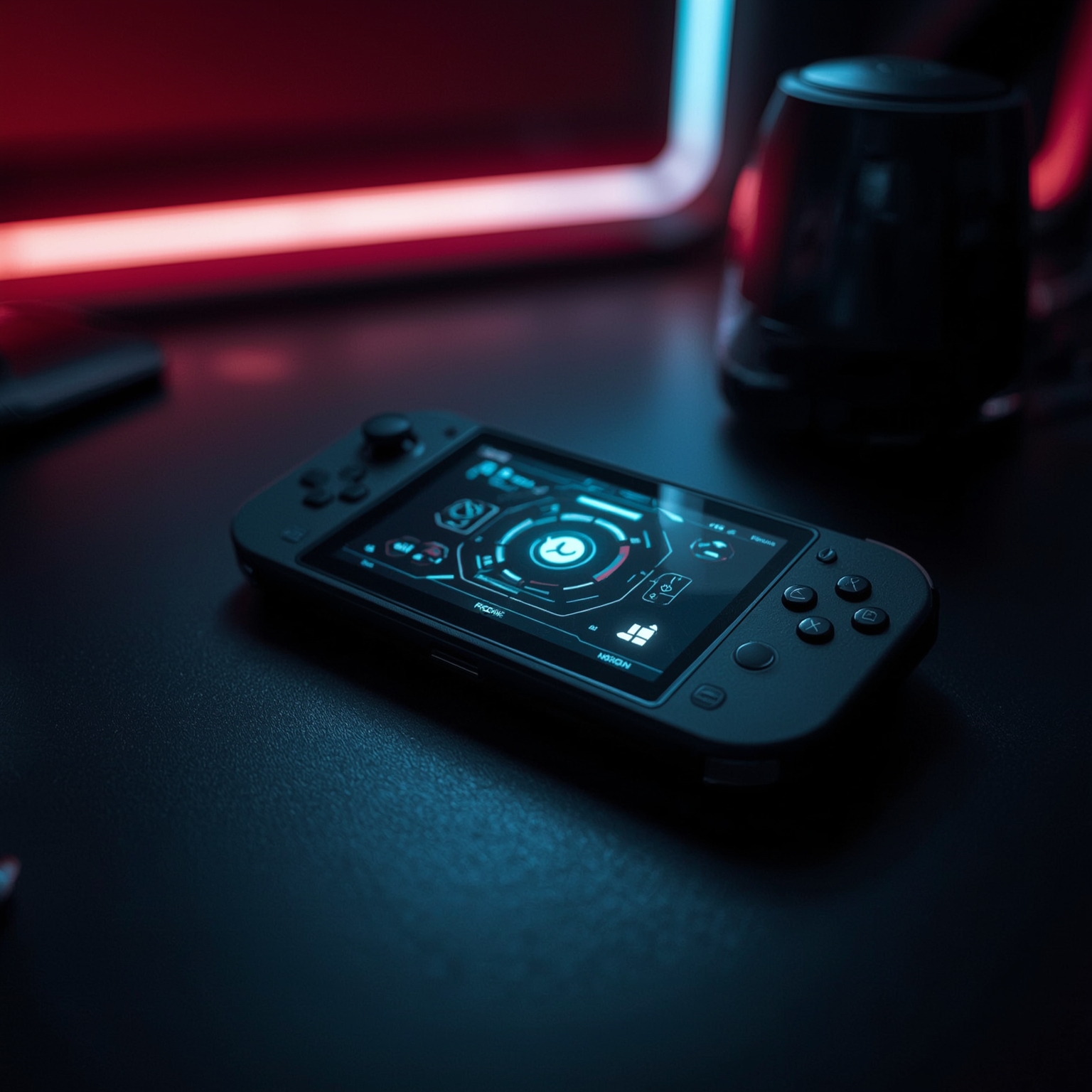
Across the increasingly competitive landscape of portable gaming, manufacturers of handheld devices appear to be experimenting in every conceivable direction—almost as though they are throwing paint at the wall simply to see what adheres. Confronted by the Steam Deck’s unassailable dominance in terms of value for money, many brands have recognized that price-based competition is unwinnable and have therefore shifted their strategies toward differentiation through design and innovation. These companies are producing a diverse array of unconventional models: some boast massive chassis and expansive screens, others dabble in stereoscopic 3D displays, while a few aim to evoke nostalgic comfort through familiar ergonomics. Still others target a premium demographic by offering sophisticated constructions with Switch-style detachable controllers that can even function as computer mice. The result is a fragmented but fascinating ecosystem of devices, many of which now exceed the $1,000 price point, cementing handheld gaming as a serious, high-end hobby rather than a casual pastime.
Among these experimenters, boutique manufacturer GPD has emerged as an especially audacious pioneer, pushing the notion of a premium handheld to its farthest logical extreme. With its latest creation—the GPD Win 5—the company appears to have produced what can legitimately be called the most powerful handheld computer yet conceived, though it achieves this feat by willingly sacrificing much of the portability that defines the category. Sold at prices ranging between $1,600 and $2,200, the Win 5 exists well beyond the financial comfort zone of many players, myself included. Nevertheless, the device sparks an intriguing question: might a new class of so-called “cord-first” handhelds—machines designed to deliver desktop-caliber performance while tethered to an outlet—represent the next frontier for demanding PC gamers who are unwilling to compromise on speed and fidelity?
Despite its unorthodox design philosophy, GPD has packed the Win 5 with thoughtful features. The circular power button doubles as a fingerprint reader, while the Menu button faithfully emulates the layout of Xbox controllers for intuitive navigation. Visually, the hardware could be described as a modern reinterpretation of Sony’s classic handhelds—it resembles an oversized PlayStation Vita combined with the PSP’s industrial minimalism, complete with sleek metallic curves and a transparent directional pad that ranks among the finest I have ever encountered. Yet the physical aesthetics are secondary to the componentry within. The Win 5 proudly introduces AMD’s cutting-edge Strix Halo chip—the same processor slated to appear in the Framework Desktop—making it the inaugural portable gaming device endowed with the fastest integrated gaming GPU yet developed.
To sustain such a performance-hungry chip, GPD has implemented a radical structural compromise. The Win 5 offers no internal battery at all. Instead, players must either connect the device via a power cord or attach a modular battery “backpack,” an external unit that clips onto the rear. Initially, this arrangement seems like a potential dealbreaker—after all, the freedom to play anywhere, free from cables, lies at the heart of handheld gaming’s appeal. I fully expected to abandon the device after a few days of awkward cable management or frustrated attempts to balance the hefty battery pack. However, after extended hands-on time with a pre-production prototype, my skepticism transformed into appreciation. GPD clearly studied the ergonomic realities of a wired system and engineered around them. When connected to a power cable, the machine becomes significantly lighter, capitalizing on the absence of an internal battery to enhance portability in tethered use. When freedom of movement is desired, the external pack can be attached directly or connected by a short cable so that the heavy brick can rest conveniently in a pocket or bag.
Unlike a typical USB-C power bank, this configuration unlocks performance levels that previously seemed unattainable in portable gaming. For years after the Steam Deck’s debut, handheld performance metrics had stagnated: while competitors introduced faster processors, none could render modern titles at full 1080p resolution with acceptable framerates. High-definition screens, therefore, often felt ornamental rather than functional. The GPD Win 5 decisively breaks this pattern, vindicating its 1080p display by effortlessly running titles such as *Cyberpunk 2077*, *Returnal,* and *Shadow of the Tomb Raider* at ultra settings above 60 frames per second—without relying on technologies like AI upscaling or frame generation. Even newly released, graphically demanding games including *Expedition 33* and *Indiana Jones and the Great Circle* perform at similar fidelity. Depending on the selected power mode, the Win 5 can outperform rival handhelds by two-, three-, or even fourfold margins.
However, this superlative performance comes at a steep energetic cost. Whereas the Steam Deck’s chip consumes a modest 15 watts, and fancier alternatives such as the MSI Claw 8 or Lenovo Legion Go 2 run at roughly 30–35 watts, the Strix Halo within the Win 5 can draw up to 60 watts on battery power alone. When plugged into the included 180-watt AC barrel adapter, the system channels as much as 80 watts directly to the processor and even exceeds 100 watts total under peak load. An optional external battery rated at 80 watt-hours offers only about forty-five minutes of high-power play before depletion, during which the fans roar loud enough to make public use nearly impractical. The combined unit also surpasses two pounds in weight, shifting the center of gravity rearward. Yet once unplugged and stripped of the battery, the handheld reverts to a surprisingly nimble 1.25 pounds—lighter, in fact, than a Steam Deck. The end result is a device that allows users to literally choose their preferred trade-off between raw power and mobility.
Power management options are unprecedentedly granular. GPD’s control software permits adjustment of the chip’s thermal design power (TDP) from as little as 6 watts—enabling over six hours of light gaming—to as high as 60 watts for uncompromising performance. The data clearly indicate that the Win 5’s advantage materializes only when one is willing to feed it considerably more power than competing systems. For instance, if a player seeks three hours of uninterrupted *Cyberpunk 2077* gameplay, MSI’s Claw 8 actually delivers smoother results per watt; but when runtime expectations are lowered to around two hours or less, GPD’s design overtakes the field decisively.
All this engineering prowess is still subject to early-stage limitations. The prototype experienced occasional system freezes, touchscreen glitches, and slightly squeaky trigger buttons—reminders that GPD remains a small, crowdfunded manufacturer whose products often reach early adopters before every imperfection has been polished away. It is important to note that this account is not a formal review; *The Verge* only reviews finalized consumer-ready models. Nevertheless, my general impression remains positive. Much as the earlier Win Max 2 surprised users with its blend of laptop efficiency and handheld capability, the new Win 5 demonstrates GPD’s innovative spirit through tactile enhancements such as a hardware toggle for mouse mode, a full-sized USB port, and even a novel SSD slot reminiscent of a SIM card tray for easy storage upgrades.
The GPD Win 5 thus stands as both an evolution and an experiment—a bold attempt to redefine what handheld gaming can mean when one refuses to accept traditional constraints. It symbolizes an acknowledgment that in this moment, the future of portable computing may not lie solely in shrinking form factors or undercutting competitors on price, but in reimagining what performance, flexibility, and user choice truly entail for the next generation of serious gamers.
Sourse: https://www.theverge.com/games/791460/gpd-win-5-corded-handhelds