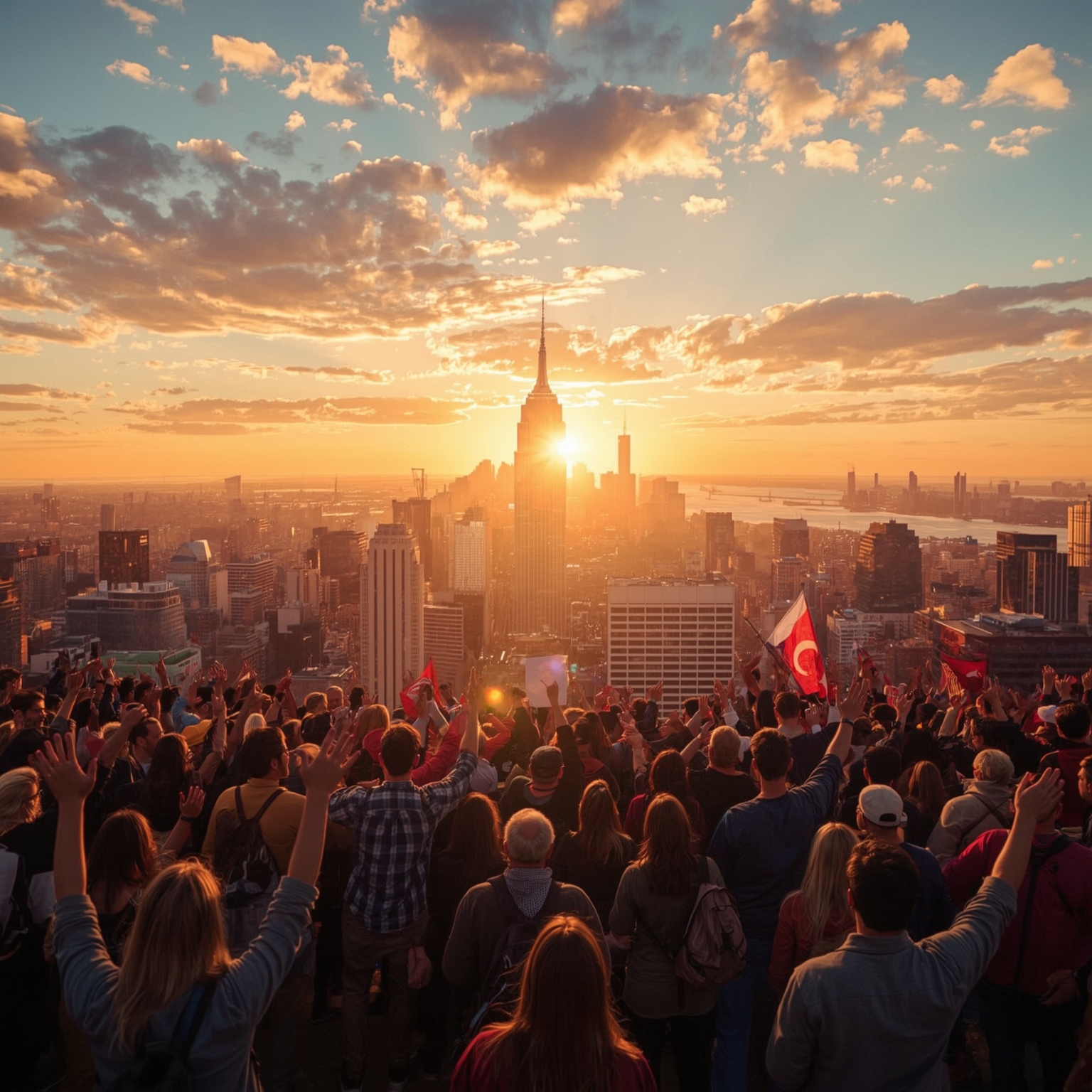
It is now confirmed beyond speculation: Zohran Mamdani is set to become the next mayor of New York City—a moment that marks both a generational and ideological shift within one of the world’s most influential metropolises. According to official projections from the Associated Press, the Democratic nominee and current state assemblyman has secured victory over two formidable opponents: former Governor Andrew Cuomo and Republican candidate Curtis Sliwa, in what has been one of the most intensely observed mayoral elections in recent history.
The race was called less than an hour after polling stations closed, with early numbers indicating Mamdani’s commanding position. At that pivotal moment, he was forecast to receive approximately 50 percent of the vote, while Cuomo trailed at 41.4 percent and Sliwa garnered just 7.7 percent. These results underscored not only a decisive electoral outcome but also a profound statement about the city’s political mood and evolving priorities.
Mamdani’s win carries historic resonance: he will become New York City’s first Muslim mayor and, at just thirty-four years old, the youngest individual to hold the office in more than a century. His ascent to power represents a striking departure from the traditional political mold—a generational turnover invigorated by the rise of progressive grassroots movements. A self-identified democratic socialist, Mamdani centered his campaign on the urgent issue of affordability for working-class New Yorkers, championing policies aimed at improving the quality of everyday life. Key among his proposals were universally free public bus service, no-cost childcare, and a city-wide rent freeze—each initiative designed to reduce the financial strain on ordinary residents while fostering a sense of community stability.
Mamdani’s achievement is especially remarkable in light of the powerful financial opposition he faced throughout both the Democratic primary and the general election. Wealthy donors and some of the nation’s most prominent billionaires collectively funneled millions of dollars into political action committees intended to undermine his candidacy and bolster Cuomo’s. Figures such as former New York City Mayor Mike Bloomberg, investor Bill Ackman, cofounder of Airbnb Joe Gebbia, and media magnate Barry Diller were among those who directed substantial resources to these efforts. This unified opposition, however, proved insufficient to halt Mamdani’s momentum—a candidate who has publicly argued that the existence of billionaires itself is incompatible with a truly equitable society.
Adding to the spectacle, Cuomo received last-minute endorsements from two highly visible billionaires on the national stage: former President Donald Trump and entrepreneur Elon Musk. Trump, writing on his Truth Social platform, insisted that despite one’s personal feelings toward Cuomo, voters had “no choice” but to support him, declaring that Mamdani was unfit for the mayoralty. Musk, meanwhile, issued a similar plea on X (formerly Twitter), asserting that a vote for Curtis Sliwa amounted to indirectly supporting Mamdani and urging his followers to “VOTE CUOMO.” Despite such endorsements, these interventions were unable to counter the growing wave of popular enthusiasm propelling Mamdani’s campaign.
The contest was not merely about individuals but about competing visions for the future of New York. Much of the criticism levied against Mamdani by the city’s business elite revolved around concerns regarding New York’s identity as a global hub of commerce, finance, and innovation. His proposed funding mechanisms for expansive social programs included raising the corporate tax rate and increasing the personal income tax on millionaires by two percentage points. Critics within the billionaire class argued that these tax adjustments would initiate a mass exodus of affluent residents and large corporations, depriving the city of valuable capital and talent. Hedge fund manager Bill Ackman vividly likened such a scenario to “Ken Griffin leaving Chicago for Miami—on steroids.” In a similar vein, grocery magnate John Catsimatidis expressed his intent to relocate his company’s headquarters across the Hudson River to New Jersey, should Mamdani’s policies take effect.
These apprehensions reverberated far beyond the realm of billionaires, creating ripples of anxiety across a variety of sectors—from Wall Street and real estate to the city’s burgeoning technology industry. Many business leaders feared that an aggressively redistributive agenda could undermine New York’s entrepreneurial character. Bryan Rosenblatt, a partner at Craft Ventures, succinctly captured that sentiment in a statement to Business Insider, emphasizing that New York City was built on “ambition, innovation, and capitalism.” Electing a mayor perceived as antagonistic to those forces, critics warned, risked diminishing the very dynamism that has long defined the city’s global stature.
Yet, in the months following his primary victory, indications emerged that the relationship between Mamdani and New York’s corporate power brokers was beginning—if cautiously—to thaw. Reports suggest that the mayor-elect has engaged in dialogue with several influential figures, including Steve Cohen of Point72, Brad Karp of the prestigious law firm Paul Weiss, and JPMorgan Chase CEO Jamie Dimon. The latter, while pragmatic, conveyed a readiness to cooperate, remarking during a recent conference that “I have to deal with the world I got, not the world I want.” Such statements reflect an evolving realism within the business community: an understanding that partnership may prove more productive than confrontation.
Yasser Salem, a former McKinsey executive serving as a bridge between Mamdani’s team and the city’s business elite, has noted that while skepticism remains, some corporate leaders recognize merit in select elements of Mamdani’s platform. Policies like universal childcare, for example, are increasingly viewed not as ideological experiments but as pragmatic solutions that alleviate workers’ daily hardships—challenges that often hinder productivity and contribute to high employee turnover.
Moreover, among the rank-and-file within New York’s vast financial sector, Mamdani’s message resonated with striking clarity. Data indicates that while roughly eighty percent of senior Wall Street professionals—those in investment banking, hedge funds, and private equity—channeled their contributions toward Cuomo and his affiliates, Mamdani’s campaign drew overwhelming support from back-office employees involved in essential yet less glamorous functions such as operations, human resources, research, and technology. Their donations were a testament to shared frustrations: rising living costs, unaffordable rents, and the widening gap between executive privilege and everyday struggle. One such donor encapsulated the prevailing sentiment, explaining that even for those working within finance itself, “the emphasis on affordability felt especially relevant and personal.” That sense of identification, rooted in the lived experience of ordinary residents rather than abstract ideology, may well have provided the decisive energy behind Zohran Mamdani’s historic victory.
Sourse: https://www.businessinsider.com/zohran-mamdani-wins-nyc-mayor-election-race-2025-11


