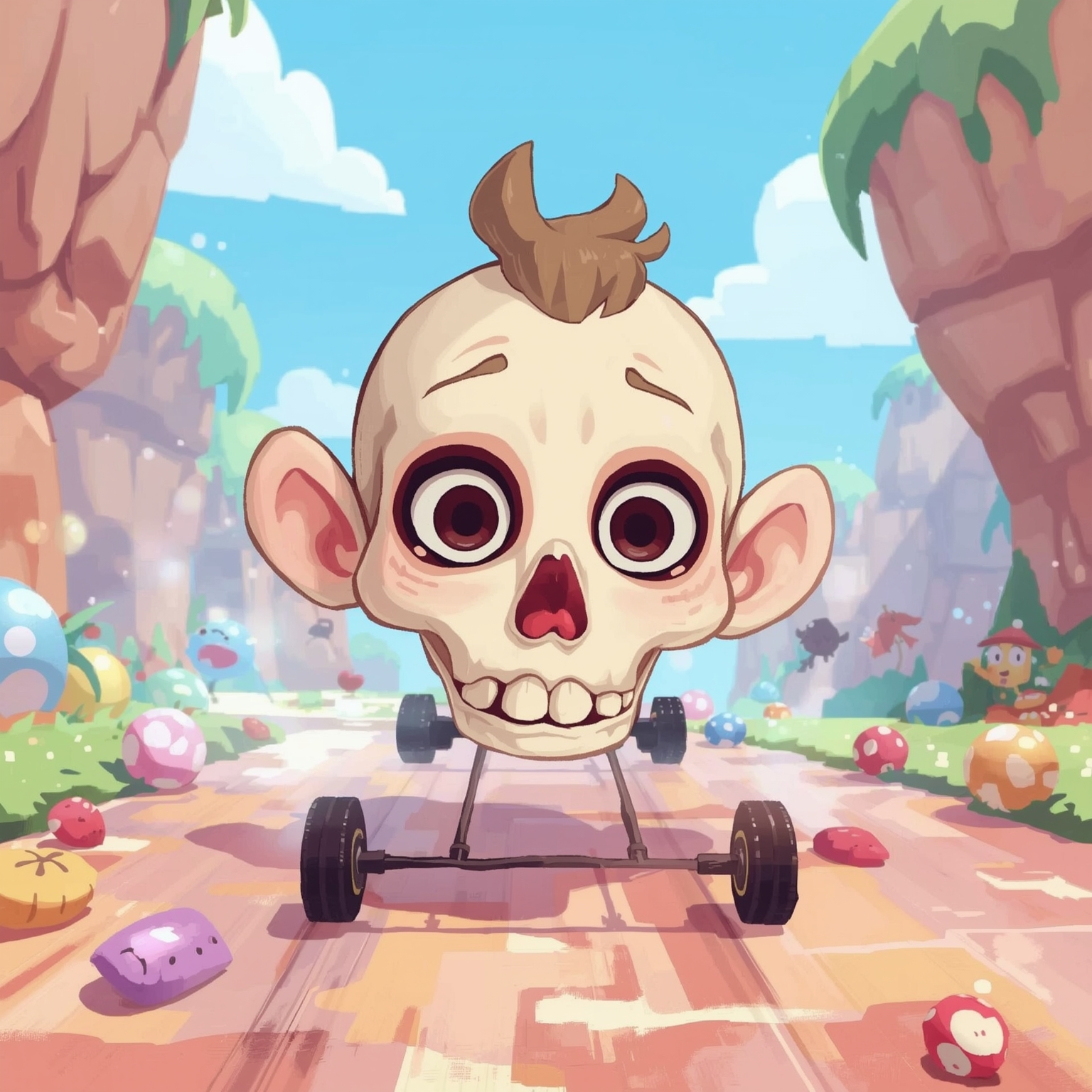
In *Henry Halfhead*, players are invited to experience the entirety of one individual’s life, but the journey is anything but ordinary. The protagonist, Henry, is portrayed in an unusual and intentionally comedic manner: he exists only as the upper portion of a human head — eyes, ears, a nose, and scalp — completely detached from a body. As a result, Henry’s form of locomotion consists of sliding across the floor, bouncing upward with energetic hops, and improvising clever ways to traverse a world designed for full-bodied humans. Even more remarkable is Henry’s peculiar ability to inhabit and control common household objects. Through this mechanic, everyday items transform into tools of self-expression, comedy, and chaos, creating an experience where absurdity and heartfelt storytelling coexist harmoniously. The creative minds at Lululu Entertainment employ this bizarre premise not merely for laughs but to frame an unexpectedly touching narrative, balancing silliness with sincerity.
The adventure begins in the earliest moments of Henry’s existence, with the player guiding infant Henry inside a nursery. Here, the gameplay encourages gleeful mischief — one can bounce around disrupting order and turning the child’s room into a scene of delightful havoc. Progressing through the game reveals additional environments and marks Henry’s passage through the different stages of life. With each transition—growing from toddler to school-aged child, onward to adulthood, and eventually into old age—the opportunities for playful experimentation multiply. The mechanic of object possession means that nearly everything visible on-screen can be interacted with, resulting in humorous or disorderly outcomes. For instance, an especially memorable segment tasks the player with arranging candles on a cake to commemorate Henry’s third birthday, but the task quickly escalates into slapstick chaos. Later, in a school setting, Henry’s antics extend to upending classroom order, scattering supplies, and contributing to an atmosphere of gleeful disruption.
The world of *Henry Halfhead* has been meticulously staged, with objects placed deliberately to spark curiosity and experimentation. Each element of the environment invites players to tinker, rearrange, and subvert expectations without fear of punishment or failure. Unlike many games that penalize mistakes, *Henry Halfhead* removes the possibility of truly “losing” and instead rewards exploratory behavior. This clever design choice cultivates a sense of psychological safety, where one feels free to be reckless, inventive, or outright mischievous without consequence. The result is gameplay that feels more like inhabiting a sprawling digital playground than fulfilling a linear series of objectives.
Complementing this spirit of play are the game’s aesthetics and auditory design. The visuals are bright, whimsical, and cartoon-like, suffused with vivid colors and shapes that communicate warmth and wonder. Audio cues amplify the lightheartedness, particularly Henry’s comical little “yips” as he hops from one spot to another. Layered onto this is the presence of an omniscient, dryly humorous British narrator whose observations add wit and charm, grounding the fantastical action in a tradition reminiscent of whimsical absurdist storytelling. For those familiar with cult classics, the quirky, chaotic sensibility inevitably evokes comparisons with *Katamari Damacy*. The inspiration is not merely theoretical — at one point, attentive players may notice a radio that bears a playful resemblance to Katamari’s iconic green character. In another level, Henry himself becomes the nucleus of a rolling ball of laundry, directly nodding to Katamari’s unforgettable mechanics.
Although the surface of *Henry Halfhead* is colored with joy and slapstick humor, the narrative does not shy away from engaging with more sobering realities. As the story arcs across Henry’s life, it transitions into darker and more reflective tones, particularly as it depicts the drudgery of Henry’s unfulfilling adult job. These sections emphasize the monotony and soul-sapping weight of adulthood, creating a dramatic contrast to the exuberant chaos of Henry’s childhood. Finally, the game concludes with Henry in old age, delicately addressing the inevitable themes associated with the end of life. Without requiring explicit detail, the trajectory of the game subtly suggests the closing of Henry’s journey, leaving the player with both poignancy and perspective.
Yet what lingers most strongly after the credits fade is not sorrow but the game’s broader and uplifting message: that life is enriched by curiosity, playfulness, and the courage to engage with the world creatively. *Henry Halfhead* reminds us that joy can be found in experimentation, whether in the simple act of jumping into objects or in our own daily lives as we embrace spontaneity. By the conclusion of my two-hour playthrough, I felt an unexpected emotional resonance, touched by how this whimsical adventure had managed to communicate sincerity through absurd humor. In parting from Henry, I carried with me inspiration to integrate moments of silliness into my own existence and to appreciate the transformative power of imagination.
For those eager to experience Henry’s journey firsthand, *Henry Halfhead* is available now on multiple platforms, including PC, PlayStation 5, and Nintendo Switch.
Sourse: https://www.theverge.com/games-review/776873/henry-halfhead-review-pc-ps5-switch