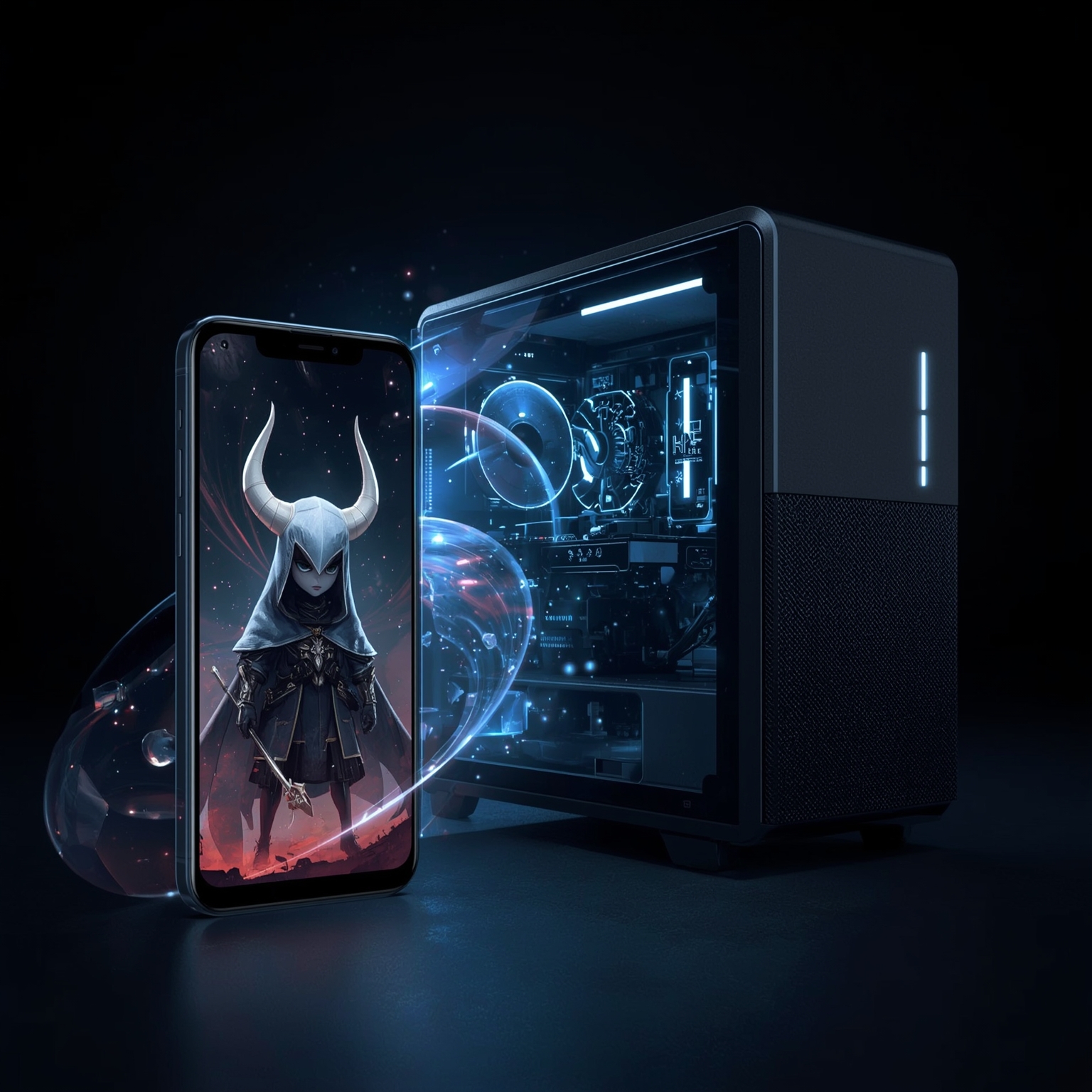
Hollow Knight: Silksong, unquestionably one of the most eagerly anticipated and celebrated titles of the year, has already captured the attention of millions of players worldwide, with five million enthusiasts reported to have jumped in during its very first week. Despite such remarkable momentum, the game was not made available on smartphones at launch, leaving mobile users initially excluded from the experience. However, recent strides in the field of Windows-to-Android emulation have effectively altered that reality. Thanks to these technical advances, PC games purchased and installed on Steam can now be fluidly brought over to high-end Android devices. To put this into perspective, I successfully set up the Steam version of Silksong on my Samsung Galaxy S25, transforming a device designed for communication and entertainment into a surprisingly capable handheld gaming console.
The key software enabling this breakthrough is GameHub, an application created by Chinese hardware and accessory manufacturer GameSir. While the company has previously focused primarily on producing well-regarded mobile controllers and input devices, its foray into sophisticated emulation solutions has quickly proven to be noteworthy. GameHub’s recently released version 5.0 introduces two crucial innovations that decisively elevate it above competitors in the emulation ecosystem. The first improvement lies in its remarkable ability to automatically configure necessary components when launching a game. Instead of requiring users to struggle through the painstaking process of aligning graphics drivers, configuring translation layers such as Wine and Proton, or calibrating additional technical dependencies — tasks that previously forced me to spend hours experimenting with rival solutions like Winlator, GameNative, and even earlier iterations of GameHub — the current version eliminates that frustration by setting everything up on its own. Equally transformative is the second feature: seamless synchronization with Steam cloud saves. This allows players to retrieve their existing saved progress directly from their Steam accounts, reducing an otherwise complicated transfer process to a few simple taps.
The overall effect of these refinements is significant. After downloading the GameHub app and signing in with a standard Steam account, the process becomes astonishingly easy. A user need only tap through a short sequence: install the desired game, begin running it, enable cloud synchronization, and within minutes, they are immersed in true PC gameplay on a phone. Unfortunately, cross-platform syncing is not yet fully symmetrical. As of mid-September, GameSir developers were actively refining the technology to allow saved data to flow not just from PC to Android, but also back from Android to PC. For Silksong enthusiasts hoping to seamlessly resume phone sessions on their desktop computers, this limitation is currently frustrating. While the company remains publicly committed to enabling such two-way synchronization, the feature is not yet functional.
What does gameplay actually feel like on a modern Android flagship? Even on my standard Galaxy S25, without any customized modifications or experimental firmware, the experience proved genuinely playable. Naturally, the intense speed, precise reflexes, and dexterous controls central to Silksong’s design make it ill-suited to touchscreen-only input. Once I connected a USB-C gamepad equipped with active cooling — specifically the GameSir X3 Pro that I am presently evaluating — the performance was surprisingly satisfying. Yesterday alone, I invested over an uninterrupted hour of play without once feeling an urge to trade the setup for my dedicated Steam Deck console.
From a performance standpoint, the experience was far more impressive than I initially anticipated. While using a standard DualSense (PS5) controller, I observed frame rates that fluctuated between 50 and 120 frames per second, even at the Galaxy S25’s full widescreen native resolution. This revelation was enhanced by GameHub’s additional support for technologies like high dynamic range (HDR) display and expanded aspect ratios. Predictably, the performance climbed even further when resolution was lowered to 720p. Attaching the GameSir X3 Pro with its integrated Peltier cooling system and external power supply pushed results to a whole new level: frame rates stabilized above 100fps even amid complex combat sequences that traditionally strain mobile hardware. Although the Peltier element’s cooling plate and the attached fan generate audible noise, their impact on performance cannot be overstated. My skepticism regarding phone cooling contraptions has been greatly diminished by firsthand results.
Nevertheless, thermal throttling remains an unavoidable concern for devices not explicitly crafted for gaming. Once my Galaxy S25 began generating excessive heat, temporary dips to 50fps or 60fps felt disproportionately severe, almost rendering portions of gameplay unresponsive. Under those conditions, one can immediately appreciate how indispensable a dedicated cooling system becomes. It stands to reason that larger Galaxy models, or specialized gaming smartphones from competing manufacturers, might withstand extended sessions with greater natural efficiency.
The minimum required hardware for a tolerable experience appears real. Attempting to replicate the process on an older Google Pixel 9 fitted with the Tensor G4 chip nearly rendered the game unplayable. While technically functional, the system teetered on the edge of sustainability, quickly collapsing without integrated cooling. Immersion was further diminished by limited functionality in cutscene playback, an essential aspect of Silksong’s presentation. While the S25 effortlessly managed cinematic sequences under GameHub 5.0, the Pixel 9 could not, which is a critical drawback for narrative-driven experiences of this type.
As for input, touchscreen controls are strongly discouraged for fast, reflex-demanding gameplay such as Silksong. Theoretically, someone with exceptional patience might endure the frustration and possibly even conquer the entire game without a physical controller, but for the overwhelming majority of players, this would be impractical.
Elsewhere in the Android emulation community, some users are experimenting with Eden, a Nintendo Switch emulator, which appears to achieve superior consistency. Reports suggest it can run Silksong at a rock-solid 120Hz for extended durations without auxiliary cooling systems. Yet that alternative requires circumventing legitimate storefronts to acquire a downloadable Switch copy of the game, which introduces obstacles not only in terms of legality and practicality but also when attempting to manage save files across devices.
By contrast, GameHub’s strength lies in its legitimacy. With its direct integration to Steam, it retrieves officially purchased games and authentic cloud save data, maintaining the integrity of players’ libraries while simultaneously expanding their device compatibility. Although GameSir markets this process as powered by a proprietary “GameFusion” technology, in reality, much of its framework is built upon established open-source contributions from Linux and emulator communities, particularly Wine and Proton, which serve as translation layers between Windows applications and other operating systems.
The broader implications are worth emphasizing. Windows-based emulation functioning at this level of efficiency represents a major turning point in mobile gaming. Silksong is simply the current showcase example, benefiting from relatively modest performance requirements. Yet as mobile hardware continues to evolve with stronger processors and cooling solutions, ever-expanding portions of Steam’s expansive PC library will inevitably become playable on handheld Android devices of the future.
That being said, potential adopters should temper their expectations. Although GameHub 5.0 has undeniably demonstrated giant leaps forward, early reports also indicate instability with certain titles that previously functioned correctly. Some users celebrate the improved automation and performance, while others lament that cherished games no longer launch. Like any rapidly evolving technology, its ecosystem remains fragile. For now, cautious gamers might consider waiting for further patches and refinements before entrusting their entire PC library to this still-developing platform.
Sourse: https://www.theverge.com/hands-on/776180/hollow-knight-silksong-android-phone-windows-emulation-gamehub