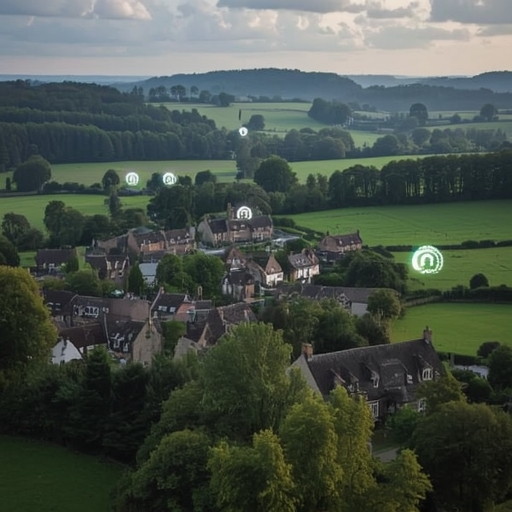
Only a brief journey from the bustling heart of London lies Potters Bar, a modest yet historically rich town resting amidst the gentle undulations of the Hertfordshire countryside. It is divided from the nearby village of South Mimms by approximately eighty-five acres of verdant farmland—terrain marked by a patchwork of hedgerows that meander across the landscape like an intricate, hand-drawn sketch. Amid these fields, a solitary oak tree rises against the skyline, offering weary walkers a moment of respite along a well-trodden public footpath. In recent months, however, this oak has assumed a secondary role far beyond its natural purpose: it has become a silent sentinel for protest, its trunk now displaying a weatherworn sign that proclaims, in striking letters, a simple demand—“NO TO DATA CENTRE.”
The controversy began in September 2024, when a property developer submitted an application seeking local authority approval to erect a vast, industrial-scale data center upon this farmland—an installation projected to be among the largest of its kind in all of Europe. Word of the proposal spread swiftly through the community, prompting residents to organize digitally. Within days, locals established a Facebook group with the singular aim of opposing the plan, its membership swelling rapidly beyond a thousand as townspeople rallied under a shared conviction to preserve their environment. Their collective energy, however, has so far met unyielding opposition. Despite numerous objections and impassioned appeals, the local council dismissed the group’s concerns. In January 2025, it officially granted planning permission, and by that October, the multinational data infrastructure giant Equinix had acquired ownership of the designated land parcel, signaling its intention to commence construction before year’s end.
One particularly bleak Thursday afternoon that same January, I found myself gathered at the edge of a muddy gate bordering the contested site. There, I stood in the company of Ros Naylor—one of the digital campaign’s most active administrators—and six other members of the local resistance. Together, they articulated a deeply felt opposition rooted not only in environmental consciousness but in a profound sense of loss. Their chief apprehension concerns the disappearance of open green space—land they regard as simultaneously a sanctuary for recreation, a crucial ecological buffer insulating the town from the nearby motorway, and a symbolic threshold between the urban and the rural. “The real beauty of walking here,” Naylor explained, gesturing toward the distant tree line and the faint hum of traffic beyond, “is how it allows you to move seamlessly from the bustle of town into a place of calm. It’s vital for our mental health, for our sense of wellbeing, for remembering something larger than noise and concrete.”
Their struggle, though intensely local, mirrors a growing national tension. Across the United Kingdom, the government is accelerating efforts to satisfy the insatiable appetite for new data centers—complexes essential for hosting artificial intelligence models and powering advanced computational systems. As this technological infrastructure expands, so too does the geographic footprint it demands, pushing development ever deeper into previously protected tracts of countryside. For nearby residents like those in Potters Bar, the promised economic benefits or potential advancements in digital connectivity offer scant compensation for the erosion of their landscape and lifestyle. To them, the future of AI—however dazzling in concept—comes at too steep a price when weighed against the quiet continuity of rural life.
This dispute unfolds against the backdrop of a long-standing urban planning policy. Since the mid-twentieth century, a ring of countryside known collectively as the green belt has encircled London. This protective corridor of farmland, meadows, forests, and parkland was established to preserve the natural environment from the creeping expansion of metropolitan sprawl and to prevent neighboring towns from merging into a seamless, indistinguishable mass. Under English law, development upon green belt land has traditionally been restricted, permissible only in what are termed “very special circumstances.” The policy has endured for decades as a cornerstone of Britain’s environmental and urban heritage.
Yet, following the election of the current government in 2024, the landscape of regulation began to shift. Officials introduced a controversial new classification—the “grey belt”—intended to redefine certain portions of the green belt considered underused or of lower environmental quality. On these parcels, the barriers to construction would be reduced significantly. Around the same time, the government designated data centers as “critical national infrastructure,” effectively granting them priority status in the hierarchy of necessary national facilities. Together, these policy changes opened an expansive pathway for data center developers to operate across the country, legitimizing projects that might once have been summarily rejected.
Globally, such dynamics are playing out with remarkable intensity. The world’s foremost AI laboratories—backed by unprecedented financial resources—are investing collectively in infrastructure projects that together will cost trillions of dollars. Each new installation requires vast energy supplies, advanced cooling systems, and extensive real estate. Inevitably, wherever these monumental facilities are proposed, they encounter organized resistance from communities fearful of the social, ecological, and aesthetic transformations they bring.
In the case of Potters Bar, the local planning authority justified its approval of the development by asserting that the farmland in question satisfied the criteria of the grey belt. Officials further noted that their decision was influenced by national governmental policy explicitly favoring the data center industry. From their perspective, the anticipated economic and infrastructural benefits outweighed the intangible, though deeply felt, value of preserving a relatively modest piece of countryside. “There’s a somewhat idealized notion,” explained Jeremy Newmark, the leader of Hertsmere Borough Council—the jurisdiction that includes Potters Bar—“that all green belt land is pristine, rolling, and of exceptional ecological merit. The truth, however, is more complicated. In this case, the site is little more than a low-performing stretch of agricultural land.”
Thus, what might appear to some as a minor local dispute is, in reality, emblematic of a greater conflict confronting the modern world: the tension between rapid technological advancement and the enduring human need for open landscapes and natural respite. The oak tree in the middle of that contested field now stands not only as a monument of nature’s persistence but also as a symbol of community resistance—a reminder that the quest for progress always demands careful negotiation between what must be built and what should remain untouched.
Sourse: https://www.wired.com/story/the-small-english-town-swept-up-in-the-global-ai-arms-race/