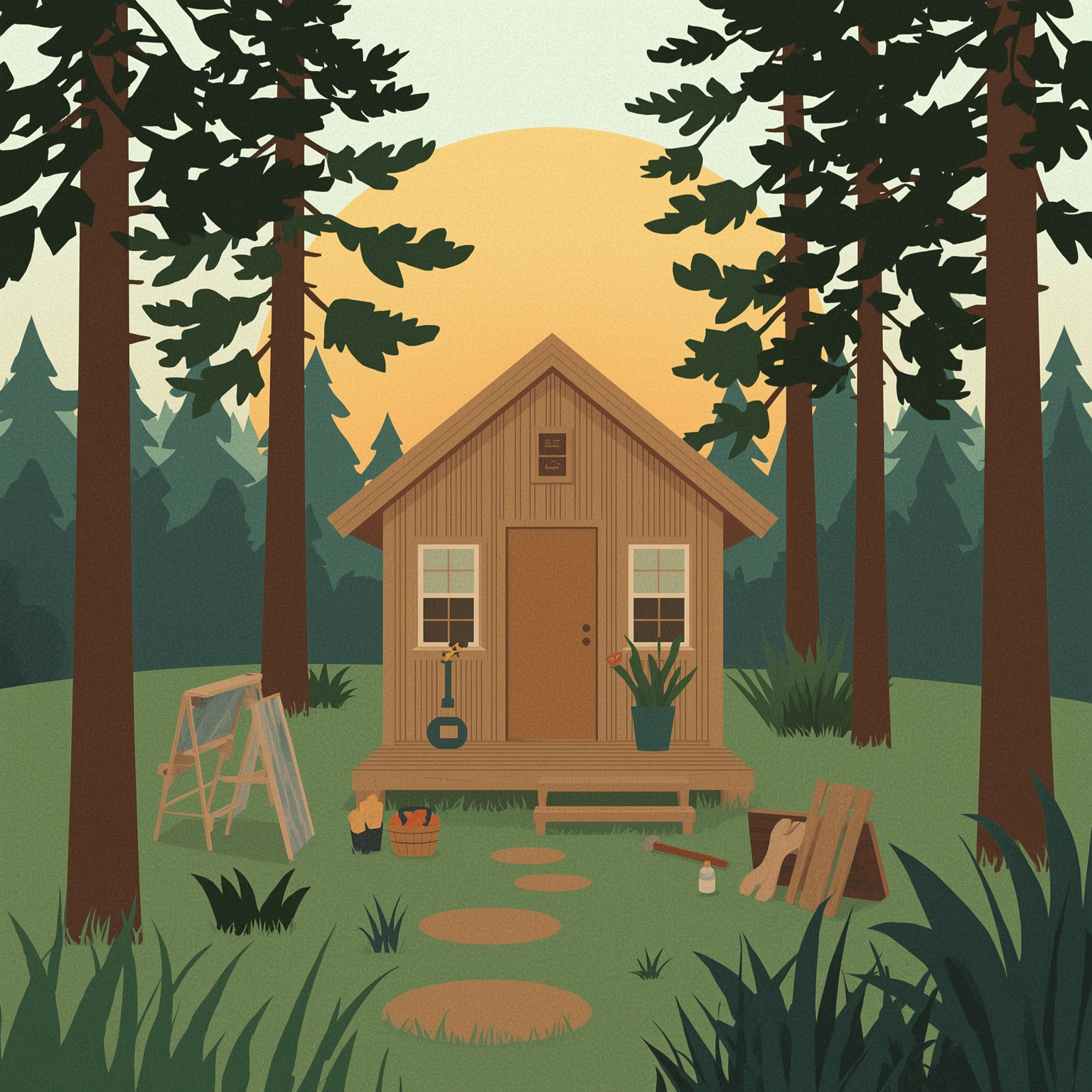
This narrative unfolds from an in-depth conversation with Melanie Copeland, a forty-five-year-old resident of Buckingham County, Virginia, and the insightful author of *Trailblazing Tiny: A Guide to Breaking Free.* Together with her husband, John, who is forty-six, Copeland co-owns and operates a small but steadily growing handyman business. The dialogue has been edited to preserve clarity while reflecting the essence of her experience and reflections.
For several years before finally taking the leap in February 2018, Melanie and John had contemplated simplifying their lifestyle by moving into a tiny home—a choice that would realign their priorities and redefine their concept of fulfillment. At that time, the cultural fascination with mobile tiny homes had not yet reached the mainstream enthusiasm seen today. Information and firsthand accounts were scarce; few online platforms, blogs, or social media channels offered detailed guidance or inspiration. Nonetheless, their curiosity and desire for a freer, more intentional way of living propelled them into meticulous research. The concept resonated deeply with their already minimalist sensibilities. Even during the years when they lived in what they affectionately describe as their “bigger” phase—renting a two-story home in Charlottesville, Virginia—they possessed far fewer belongings than many of their peers.
The decisive turning point came unexpectedly. Although Melanie maintained a demanding full-time career—her workweek often consumed with responsibilities in financial, legal, and real estate editing—she spent much of her limited free time tending to the large house: scrubbing, organizing, and doing the endless laundry that such a space required. Weekends, instead of offering rest or recreation, became extensions of the workweek, filled with household obligations that left little room for joy or restoration. When she was laid off from her realty agency position in December 2017, what might have been a moment of crisis instead became a rare opportunity to reorder their lives. That involuntary end to her corporate role opened a door to begin the downsizing adventure they had long envisioned.
Financing the transition, however, posed its own challenge. The project could not have moved forward without the timely generosity of Melanie’s mother, who extended an interest-free loan to cover the $27,000 cost of their tiny-home contract with Incredible Tiny Homes, a Tennessee-based company. The agreement included design consultations—such as careful consideration of window placement and dimensions of key features—and covered all necessary materials, though not the labor itself. It was a manageable sum, but only through familial support did it become attainable.
Neither Melanie nor John entered the venture with hands-on experience in construction or carpentry. During a weeklong immersive workshop held at the company’s expansive warehouse in Inca, Tennessee, they, along with John’s mother, a close friend, and a volunteer, took up residence in a simple bunkhouse for the duration of the build. The company provided three meals a day to sustain participants, while a supervisor offered instruction in handling power tools and various mechanical equipment—table saws, drills, and other essentials. Professional plumbers and electricians occasionally intervened to ensure the structure met safety requirements, yet the vast majority of the labor remained their own. From cutting timber and erecting frame walls to laying the flooring, every stage demanded determination and focus.
For two people who had never previously undertaken a DIY project of considerable scale, it was an intense crash course in craftsmanship. Fortunately, Melanie discovered a natural aptitude for mechanics—something she had perhaps always possessed. Her childhood, she recalls, foreshadowed this inclination: while her sister enjoyed orchestrating doll tea parties, Melanie preferred experimenting with construction blocks and Erector sets. Such early leanings now proved invaluable. The workshop was wholly experiential; they learned by direct engagement, through trial, error, and persistence. Mistakes inevitably occurred, but each misstep deepened their comprehension. By the end of the seventh day—just before a hauler transported their modest 144-square-foot home back to Virginia—they realized that building a house, though complex, was not beyond the reach of focused, ordinary individuals willing to learn.
Their first months as tiny-home dwellers were transitional. They temporarily parked their new dwelling in a friend’s backyard and later moved it to a campground. Eventually, they secured a farm loan and purchased a 1.07-acre parcel of land for $16,000. The property’s affordability was tied to its condition—it had once contained a house destroyed by fire—and they undertook the laborious task of removing debris and reclaiming the space. Far from dissuaded, they considered this effort an investment of sweat equity, symbolizing their commitment to building a new kind of life.
The couple poured their time, physical energy, and creativity into transforming the modest land into a livable, self-sustaining environment. They learned to paint, stain, apply polyurethane, and perform finishing work—skills acquired not through formal instruction but through stubborn trial and incremental improvement. Each mistake along the way became a lesson, each success a testament to their growing confidence. Because they had personally built every component of their home, they also acquired comprehensive knowledge of its workings—a self-reliant intimacy with their living space that conventional homeownership rarely cultivates. For Melanie, this process became a metaphorical and literal form of empowerment: she was building not only a home but a new sense of capability.
In 2019, Melanie briefly returned to real estate, but as the couple finalized the purchase of their land, she made a conscious decision to leave that career path for good. The demanding nature of corporate work no longer aligned with her philosophy. She no longer wished to remain, as she put it, ‘nose to the grindstone,’ trading time for stability at the expense of fulfillment. Her husband John eventually reached the same realization. In 2023, he resigned from his management position at a parking garage, choosing instead to embrace the more balanced and fulfilling rhythm of self-directed work. By then, their minimalist lifestyle had proven strikingly sustainable. Living in their tiny home cost them less than $300 per month—an amount that covered land payments, property taxes, insurance, and utilities. This financial lightness created not only freedom but flexibility to envision the next chapter.
The couple decided to channel their accumulated practical skills into a new shared venture. In 2024, they officially established their own handyman business, transforming what had begun as a survival project into a sustainable livelihood. The enterprise grew organically, largely through word of mouth rather than advertising. They took on diverse projects ranging from repairing traditional houses to staining large decks, and even crafting custom-built furniture pieces. Melanie recalls building a custom bookcase for an elegant eighteenth-century home—an experience that brought immense satisfaction and reinforced their sense of purpose. Although they conceptualized the business without a marketing budget or grandiose expectations, their dedication soon translated into tangible success: their income reached $80,000 in the previous year and was on track to surpass $100,000 by year’s end.
Reflecting upon their journey, Melanie views the construction of their compact 18-foot-by-8-foot home as more than an architectural project; it served as the cornerstone for a profound personal transformation. It taught them ingenuity, resourcefulness, and the rewards of autonomy. Today, being their own bosses, they enjoy the independence of setting their own pace and working with their hands. What began as a response to a career setback has become a lifetime vocation, grounded not only in craftsmanship but also in courage, adaptability, and the pursuit of a meaningful, self-sustained existence.
Sourse: https://www.businessinsider.com/after-losing-job-built-tiny-home-led-new-career-2025-11


