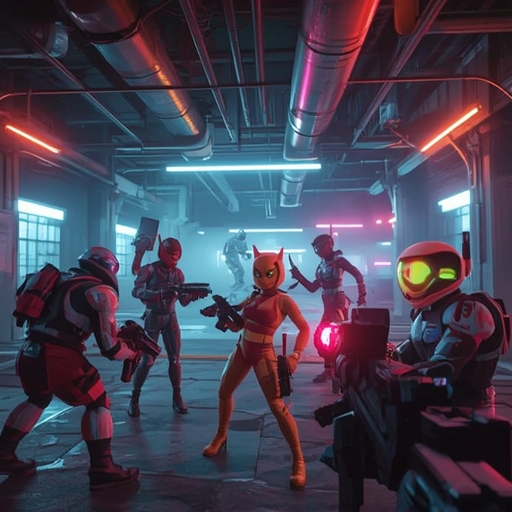
When a close friend first extended an invitation earlier this year to join them in trying a new cooperative video game called REPO, my initial reaction was one of mild reluctance and skepticism. I was almost certain that I would end up wasting my money—not out of any doubt regarding the game’s production quality or entertainment potential, but because at first glance, it appeared strikingly similar to another popular title that had dominated our gaming sessions not long before: Lethal Company. That 2024 breakout hit in the co-op survival horror genre had players scouring abandoned, decaying industrial facilities for scrap and discarded materials, all while nervously evading terrifying monsters that prowled the shadows. It had been a huge success among my circle of friends, as well as the broader gaming community, yet its grim atmosphere and uncanny liminal spaces left me more uneasy than entertained. Still, my friends insisted that REPO was different—less of a horror experience and more of a comedic adventure. They assured me that its exaggeratedly silly robot avatars, slapstick mishaps, and absurd scenarios turned fear into laughter. To my surprise, they were absolutely right.
Over the course of a few weeks, REPO not only dispelled my doubts but swiftly rose to become one of my favorite games of the year. By 2025, it had also emerged as a major player in the cooperative gaming landscape, standing proudly beside another indie sensation, Peak. In fact, these two titles together helped define and popularize an emerging subgenre of multiplayer experiences that players and commentators alike have come to refer to—sometimes derisively, sometimes affectionately—as “friend slop.”
The phrase might sound pejorative at first, yet in gaming circles it describes a very specific breed of indie multiplayer games that thrive on shared laughter, chaos, and the unpredictable chemistry that arises among friends. Traditionally, these games are inexpensive—often priced under twenty dollars—built primarily for PC, and include in-game proximity voice chat to heighten the humor and camaraderie. Their mechanics tend toward the intentionally chaotic: wobbly physics, survival-horror undertones, and absurd tasks that invite spontaneous multiplayer mischief. But not all friend slop leans into scares. Some tilt the mood toward cheerful absurdity, as in Peak, a game about attempting to climb increasingly perilous mountain ranges with your friends, turning failure into its own form of entertainment.
That mountaineering misadventure only scratches the surface—indeed, the “peak,” as enthusiasts might say—of the diverse friend slop iceberg. There is Guilty as Sock!, where a group of players roleplay ludicrous courtroom dramas as sock puppets in a parody of televised trials. Then there is Lockdown Protocol, a title inspired by the social deduction phenomenon Among Us, in which one member of a stranded crew secretly sabotages the group while the others race to complete chores before the timer expires. Another standout, Mage Arena, retails for the almost symbolic price of $2.99 and distinguishes itself through its whimsical mechanic of casting spells aloud—literally shouting them into your microphone to duel your companions.
Despite their apparent variety, these games typically follow an identifiable pattern. You and your friends are given a collective objective—some sort of task, mission, or survival goal—but the real joy emerges not from flawless execution but from the inevitable blunders along the way. Failure is rarely punished harshly; in fact, it often produces the funniest, most memorable moments. Take Peak, for example: I have yet to reach the summit or complete a full run successfully, yet the hilarity of watching a teammate misjudge a jump, tumble hundreds of feet down a cliffside, accidentally ingest poisonous rations, or be pursued by an irate scoutmaster keeps me coming back again and again. Winning feels satisfying, certainly, but the laughter that arises from these small disasters is the true sustenance of the experience.
In friend slop games, humor serves as both the primary goal and the reward. Narrative depth or intricate lore play only a secondary role. Those who approach these titles expecting rich storytelling or finely tuned single-player progression will likely walk away disappointed. Their magic lies in the shared participation: the dynamic unpredictability of group play. Without friends to fill the virtual space with chatter, laughter, and chaos, much of their charm evaporates. REPO, for instance, loses its spark when played alone; it is the communal laughter—someone snickering after you accidentally topple a fragile vase or trigger a trap—that transforms its simplicity into joy.
This social dependency underscores one of the genre’s key criticisms and perhaps the origin of the term “slop.” Detractors argue that these games are engineered primarily for virality—for those brief, clippable, meme-worthy moments that circulate online—rather than for long-term depth or conventional replayability. They contend that such titles lack substance, built more as social experiences than as fully fleshed-out games. That critique is not unfounded, but it also misses a crucial point: friend slop exists not to replace other forms of gaming but to satisfy a particular social and economic need in today’s gaming climate.
Consider Elden Ring Nightreign, another major co-op release of 2025 that I also found deeply rewarding, though for entirely different reasons. Where REPO and Peak encourage carefree laughing fits, Nightreign demands focus, precision, and skillful coordination. Its gameplay is deliberate, its stakes high, and its systems complex. By contrast, in REPO you spend most of your time casually scavenging abandoned facilities for junk, keeping half an eye out for lurking enemies while joking with your teammates. It asks little of the player beyond light engagement and social participation. Moreover, REPO’s low price point and minimal hardware requirements make it a vastly more accessible option than a sophisticated epic like Nightreign, which assumes both a certain level of gaming literacy and a far more powerful computer.
That difference reveals the central strength of the friend slop phenomenon: approachability. These games are designed to welcome rather than intimidate. They demand little in terms of time investment, technical capability, or skill mastery, making them appealing to both veteran gamers seeking a low-stress hangout and newcomers still finding their footing. In a market increasingly defined by soaring prices and escalating hardware demands, friend slop titles provide a refreshing refuge—a reminder that fun need not come at a premium. For many players, myself included, the laughter shared with friends in a spontaneous moment of cooperative chaos is every bit as valuable as conquering a meticulously crafted boss or unraveling a grand narrative.
This context has become even more significant amid the rising costs of the gaming hobby. In 2025, triple-A titles routinely push price ceilings, and the specialized components required to build or upgrade a gaming PC continue to grow prohibitively expensive. Against that backdrop, friend slop emerges as a welcome countercurrent: low-cost, low-barrier experiences offering genuine inclusivity and communal enjoyment. Their simple mechanics, accessible pricing, and emphasis on group entertainment are precisely the qualities that critics dismiss as “sloppy” yet players celebrate as liberating.
That sentiment is echoed by Paige Wilson, community manager at Aggro Crab—the publisher behind Peak—who views the phrase “friend slop” with unmistakable affection. “We actually think friend slop is a fire term,” they explained in an interview with The Verge. Although originally coined as a jab, Wilson noted that the label now encapsulates exactly what makes these games endearing: inexpensive, slightly janky titles that let friends jump in, share some laughs, unwind, and not take things too seriously. The so-called imperfections are, in fact, part of the design—an invitation to loosen expectations and simply enjoy the company of others.
When viewed through that lens, the meaning of friend slop becomes clear. It isn’t defined by the polish of the graphics, the sophistication of the systems, or the density of the plot, but by the social energy that emerges between players. It’s about connection, spontaneity, and laughter—the shared chaos that turns minor glitches and mistimed jumps into treasured memories. If embracing that joy, messiness, and camaraderie qualifies as “slop,” then I, for one, am happy to claim the label proudly.
Sourse: https://www.theverge.com/entertainment/845347/friend-slop-co-op-games-2025