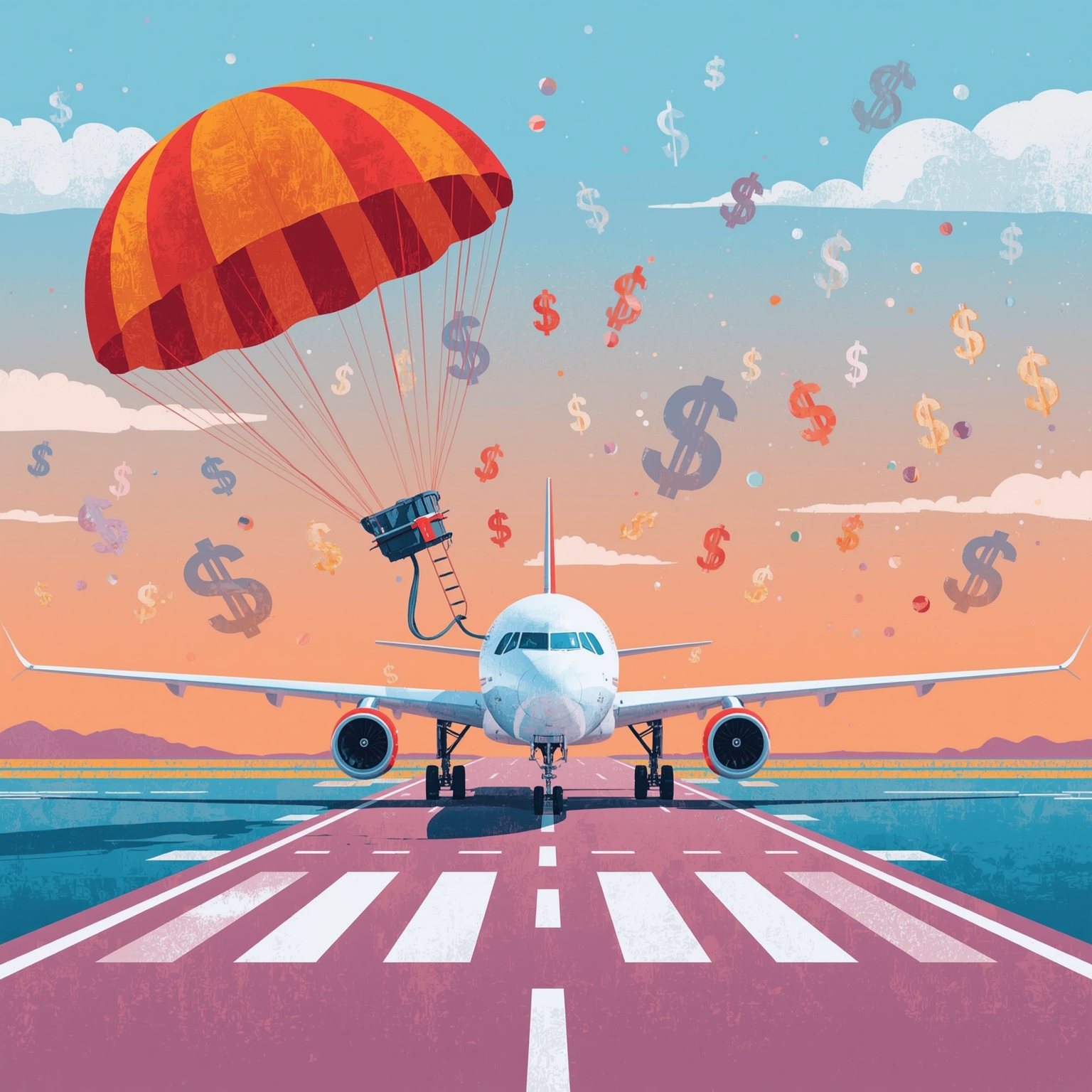
Travelers stepping off Delta Flight 3248 in Pittsburgh on Saturday were met not by the usual bustle of disembarking passengers and ground crew, but by a startling roar echoing through the gate—the powerful rush of compressed gas inflating a massive emergency slide. What began as an ordinary arrival quickly transformed into a spectacle more befitting an evacuation drill, as the unmistakable ‘boom’ of deployment left both travelers and airline staff momentarily stunned. One passenger described hearing the sharp, explosive sound that occurs when an emergency evacuation slide bursts into life—a sound that can only mean one thing: an activated safety device when none was needed. For the airline, such an error not only produces commotion and delay but also carries a significant financial burden, quickly turning a routine operation into a six-figure logistical headache.
According to a statement provided by a Delta spokesperson to Business Insider, the episode took place onboard an Airbus A220 that had just completed its scheduled route from Salt Lake City to Pittsburgh. After the aircraft arrived at the gate and parked safely, a crew member—whom Delta did not identify as either a flight attendant or pilot—initiated the opening of one of the cabin doors without first performing the crucial step of ‘disarming’ it. In aviation parlance, to disarm a door means to disengage the automatic slide deployment mechanism that is intentionally armed before takeoff. When armed, any attempt to open the door triggers the emergency chute’s rapid inflation sequence, allowing for the swift evacuation of passengers in critical situations.
To better understand the gravity of such a lapse, it helps to consider the arming and disarming processes as comparable to flipping a highly sensitive switch. Prior to takeoff, flight attendants carefully arm each exit door, ensuring that the slide will automatically deploy the moment the handle is engaged—an essential safeguard in the unlikely event of an emergency. After the plane has landed and taxied safely to the gate, the standard procedure requires cabin crew to disarm the doors before any are opened from the inside. Neglecting this step transforms an otherwise benign action—merely pulling the handle—into a costly accident. Once an armed door is opened, the inflation process unfolds within seconds, and the expanding slide cannot be halted. The system is intentionally designed this way to ensure immediate deployment when lives may depend on it.
Although this incident was unintentional and fortunately did not involve any injuries, it underscores how strictly calibrated aviation safety systems are. Emergency slides are engineered to deploy with exceptional speed and reliability, ensuring that, in a genuine crisis, passengers can escape a smoke-filled or burning aircraft within moments. Their functionality is a testament to aviation’s uncompromising focus on passenger safety. Airline crews of all ranks undergo rigorous instruction and frequent retraining on door arming and disarming procedures to prevent precisely this type of mishap. Around the world, specialized training centers—such as those operated by Singapore Airlines and other carriers—house full-size aircraft door mock-ups where flight attendants practice the muscle memory required to carry out these steps flawlessly.
The financial implications of an accidental deployment, however, extend far beyond the embarrassment of an avoidable error. Repacking an undamaged slide—a process that involves deflating, folding, and reinstalling the device in accordance with stringent safety standards—can cost as much as $12,000. If the slide has sustained abrasion or any form of material damage, additional repair or replacement costs can raise the total by another $20,000. Moreover, the incident triggers a chain reaction of operational interruptions: passengers must be rebooked on alternate flights, overnight accommodations and meals must be provided to those who cannot depart immediately, and the aircraft is temporarily removed from service until certified maintenance crews complete inspections and reinstall a functional slide assembly. Industry specialists estimate that, when all these expenses are accounted for, Delta’s ultimate bill could approach or even surpass $100,000.
Exact figures vary based on a continuum of factors, including the type of aircraft, the availability of replacement equipment, and whether the inadvertent deployment causes collateral damage to the surrounding airframe or fuselage. Modern evacuation slides are constructed from layers of high-tensile, lightweight materials treated with fire-resistant coatings—materials robust enough to withstand the forces of rapid inflation and the weight of numerous evacuating passengers. Airbus has previously estimated that even a 90-minute delay resulting from such an event can cost an airline roughly $11,000. Should the mishap result in a full flight cancellation requiring passenger re-accommodation and flight rearrangements, that number can climb substantially, sometimes approaching $200,000.
In this particular case, logistical challenges compounded the situation. Delta Flight 3248 had terminated its journey in Pittsburgh—a location outside of one of the airline’s primary hubs such as Atlanta or Detroit. According to flight-tracking data from FlightRadar24, the aircraft that ultimately replaced the disabled jet departed nearly four hours behind schedule. Former Delta pilot Mark Stephens explained to Business Insider that, in the absence of on-site spare parts or maintenance teams, Delta may have had to dispatch a qualified mechanic and a replacement slide to Pittsburgh from another operating base. At smaller airports, where backup aircraft and dedicated maintenance staff are scarce, such responses require extensive coordination and add further delay. By contrast, executing a swap at a major hub could have expedited the process considerably, as available aircraft and additional flight options would allow for smoother rebooking and quicker resumption of normal operations.
Delta later confirmed that all affected passengers were accommodated appropriately: those with immediate onward travel options were placed on later flights, while travelers stranded overnight received hotel vouchers and support from airline personnel. Though frustrating to those involved, isolated episodes like this are far from unprecedented. Airbus reports that approximately 30 to 40 unplanned slide deployments occur each year across the global commercial aviation network. In January, for example, a British Airways crew member accidentally triggered an evacuation slide on an Airbus A321—a simple oversight that, according to media reports, may have cost the airline more than $130,000. Even passengers themselves sometimes inadvertently set off these safety devices, as happened in a 2023 case involving a United Airlines traveler in Houston who attempted to open an exit door after landing, inadvertently deploying the chute despite the door never fully opening.
In the end, what occurred in Pittsburgh serves as a vivid reminder of the precision, discipline, and attentiveness demanded by aviation operations. Every procedural step—no matter how routine—exists to balance efficiency with an unwavering commitment to safety. A single moment of inattention can transform a standard flight turnaround into a costly lesson in the critical importance of procedural rigor.
Sourse: https://www.businessinsider.com/delta-crew-members-slide-mistake-may-cost-the-airline-thousands-2025-10


