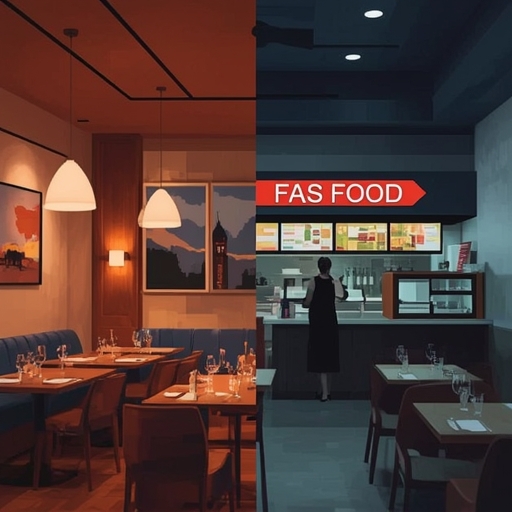
The K-shaped economy, a term used to describe the uneven recovery occurring across different sectors and income groups, is transforming the restaurant landscape in ways few could have anticipated. Once upon a time, economists and business analysts could look to quick-service restaurants — the familiar bastions of affordable dining — as reliable barometers of consumer confidence during challenging economic cycles. When recessions hit, these establishments typically flourished, benefiting from the trade-down effect as consumers sought cheaper meals. However, that once ironclad relationship has begun to crumble, revealing a far more nuanced and fragmented reality within the dining industry.\n\nIn this new economic paradigm, not all restaurants are experiencing the same fate. Luxury eateries in affluent neighborhoods often continue to thrive, buoyed by a clientele relatively insulated from inflation, wage stagnation, or market volatility. Meanwhile, mid-tier and lower-cost establishments, historically resilient during downturns, find themselves struggling with the combined pressures of rising labor costs, supply chain disruptions, and a customer base that may be dining out less frequently or shifting spending toward essentials. This dual-track dynamic — one segment soaring while another flounders — mirrors the broader inequalities embedded within the K-shaped recovery itself.\n\nThe contrast between winners and losers in today’s restaurant world underscores deeper changes in how consumers perceive value, convenience, and experience. For high-income patrons, dining out remains not merely a necessity but a form of cultural engagement and self-expression, often coupled with digital convenience such as app-based reservations, delivery subscriptions, or sophisticated loyalty programs. For lower-income households, however, even modest restaurant spending can represent a difficult trade-off against competing needs such as housing, fuel, or healthcare. Thus, the modern restaurant industry has become a vivid reflection of broader socioeconomic divides — a living metaphor for the bifurcation of the American economy.\n\nUltimately, the traditional rules no longer apply. Fast food is not the intuitive haven it once was, nor can fine dining be simplistically cast as an indulgence immune to economic reality. The K-shaped economy has redrawn the boundaries of consumer behavior and business success. For restaurant owners, policymakers, and investors alike, understanding these new dynamics is essential. It is not simply about identifying which establishments will survive or collapse, but about interpreting what those patterns reveal: a portrait of an economy where prosperity and hardship coexist side by side, and where something as ordinary as a meal can illuminate profound truths about inequality, adaptation, and the evolving nature of American life.
Sourse: https://www.businessinsider.com/america-k-shaped-economy-breaking-fast-food-playbook-2026-2