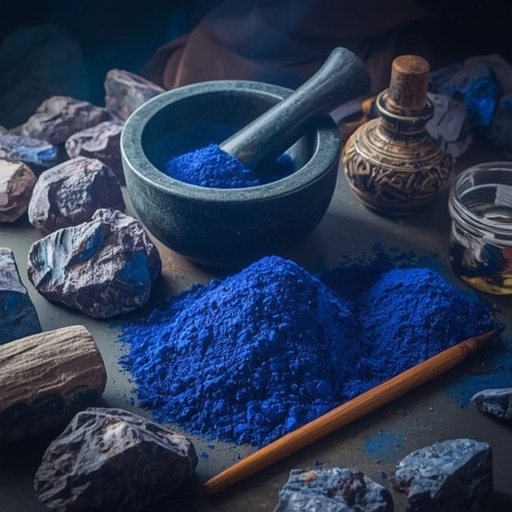
Ultramarine blue, often referred to with admiration as “true blue,” once possessed a value so extraordinary that it surpassed even that of shimmering gold. In centuries past, this hue was treasured not merely for its striking visual beauty, but also for the rarity of the raw material from which it was derived. The pigment was painstakingly made from lapis lazuli, a semiprecious gemstone whose deep, celestial coloration seemed to contain fragments of the heavens themselves. Artists and patrons alike regarded the color as a symbol of purity, divinity, and prestige—its very presence in a painting proclaimed both wealth and reverence. Because extracting the pigment was an arduous and costly process, its price exceeded that of nearly any other artistic material of its time.
This situation shifted dramatically in 1824 when a remarkable innovation transformed the world of art and science. That year, French chemists succeeded in developing a synthetic equivalent known as French ultramarine. This artificial version captured the same intense vibrancy and permanence as the natural pigment but could be manufactured on a much larger scale and at a vastly lower cost. As a result, the brilliant shade that had once been reserved for the commissions of royalty and the masterpieces of great painters suddenly became accessible to artists of modest means. The democratization of ultramarine marked a pivotal moment in the evolution of color technology, revolutionizing both artistic expression and the economics of pigment production.
Yet despite the prevalence of the synthetic variety in modern applications, ultramarine blue crafted from genuine lapis lazuli remains a luxury item of astonishing value. Even today, artisanal pigment makers who adhere to traditional methods must devote extensive labor to isolate the pure blue particles from the surrounding minerals within the stone—a meticulous undertaking that justifies its steep price. In contemporary markets, this authentic pigment can command upwards of sixty dollars per ounce, a testament to its enduring allure and the continued reverence for craftsmanship grounded in natural beauty.
Lapis lazuli itself is a striking gemstone, renowned for its vivid intensity and luminous depth. Traditionally classified as a semiprecious stone, it is mined predominantly in Afghanistan, particularly in the storied Sar-e-Sang region of the remote Hindu Kush mountains. This area, which has been the source of the world’s finest lapis for millennia, remains central to the trade and to the legacy of the pigment. When journalists from Business Insider visited this remarkable site—the largest known deposit of lapis lazuli on Earth—they discovered that its future was uncertain, clouded by political instability and the unpredictable dynamics of the global market.
This uncertainty raises profound questions for those who value art, tradition, and material heritage. How exactly is the world’s most costly color created, and why does humanity continue to prize it so deeply despite the availability of cheaper substitutes? The answers lie in a combination of artistry, geology, and history: the intricate transformation of a natural gem into a pigment of radiant purity; the centuries-long fascination with hues that evoke both spiritual and aesthetic transcendence; and the enduring human willingness to invest in objects that connect us to beauty crafted by both nature and skill. Even now, ultramarine blue stands as a vivid reminder of the intersection between art and rarity—proof that color can be as precious as any metal, carrying within it a story of value, devotion, and wonder.
Sourse: https://www.businessinsider.com/worlds-most-expensive-color-lapis-lazuli-true-blue-pigment-2025-12