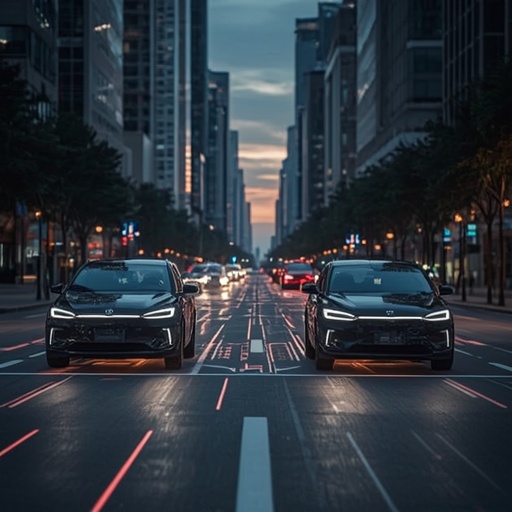
In the rapidly evolving realm of autonomous vehicle technology, both Waymo and Tesla are pursuing the same ultimate objective—achieving reliable, everyday driverless mobility—but their methods demonstrate profoundly contrasting engineering philosophies. Waymo has long been recognized for its methodical and safety-oriented approach, constructing an entirely self-contained technology ecosystem, often referred to as a full-stack solution. This model integrates hardware, software, and simulation environments under one roof, which enables unparalleled coherence between perception systems, decision-making algorithms, and real-world vehicle performance. Through this vertically integrated architecture, Waymo can rigorously control every component of its vehicles’ intelligence, from sensor calibration and machine-learning models to the complex frameworks governing road behavior. Such meticulous unification is complemented by extensive simulation testing—spanning billions of virtual miles—that allows the company to detect, predict, and mitigate potential hazards long before they manifest in real traffic conditions.
Tesla, by contrast, advances along a path rooted in scalability and the collective intelligence of its user base. The company’s strategy hinges on the deployment of vision-based technology—primarily cameras powered by neural networks—eschewing the costlier lidar systems favored by competitors. Instead of relying on isolated laboratory simulation, Tesla leverages data gathered from millions of real-world driving experiences, transmitted from its existing fleet of consumer vehicles. This decentralized, real-time learning framework enables Tesla’s autopilot and full self-driving systems to evolve continuously, drawing insight from diverse environments, weather conditions, and driver behaviors. The elegance of this vision-driven model lies in its capacity for rapid iteration and mass-market reach, though it also introduces unique safety and validation challenges that differ significantly from Waymo’s meticulously sealed testing infrastructure.
When viewed side by side, these two trajectories represent more than a competition between companies—they embody divergent conceptions of technological progress. Waymo’s conservative, safety-first methodology champions provable reliability before broad deployment, sustaining an image of caution and responsibility in the face of regulatory and ethical uncertainty. Tesla’s approach, conversely, embraces innovation through exposure, betting on data volume and real-world variability as the catalysts for machine learning advancement. Each philosophy, therefore, is a mirror reflecting a different vision of the autonomous future: one built on preemptive certainty and systemic control, and the other on adaptive evolution through public participation.
As the global race toward fully autonomous transportation accelerates, the contrast between these approaches raises fundamental questions about strategy, safety, and scalability. Will the meticulous engineering discipline championed by Waymo yield the first commercially viable driverless service, or will Tesla’s continuously learning fleet prove that exposure and iteration conquer complexity faster? Regardless of the outcome, both companies are reshaping modern mobility, challenging conventional boundaries of automotive design, and redefining society’s understanding of what it means to drive—or, perhaps more accurately, to no longer need to drive at all.
Sourse: https://www.bloomberg.com/news/videos/2026-05-08/how-waymo-s-driverless-strategy-compares-to-tesla-s


