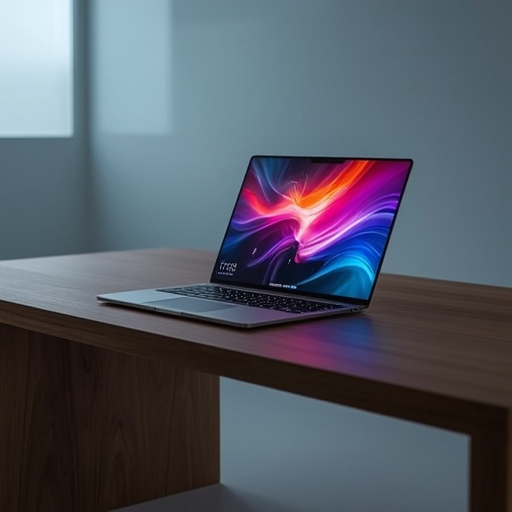
Few things capture my enthusiasm more profoundly than high-quality OLED displays — except, perhaps, OLED displays that come at a surprisingly low price. That irresistible combination of visual excellence and affordability is precisely what attracted me to HP’s latest 14-inch OmniBook 5. This particular configuration, priced at $700, runs Windows on a Snapdragon X Plus processor and features a vivid OLED screen. Those specifications alone promise two of the attributes I consider most vital in any modern laptop: enduring battery life and a screen that is a pleasure to behold. Both are qualities that make long hours of productivity or entertainment far more rewarding, so naturally, my curiosity was piqued.
The OmniBook 5 invites a deeper look through the lens of the familiar saying “good, cheap, fast — pick two.” That axiom describes the difficult balance between performance, cost, and quality that so often governs the computing world. My experience with HP’s higher-end OmniBook last year left me underwhelmed; despite its strong performance, the device suffered from a dull IPS screen, poor speakers, and an inflated $1,200 price tag. The new OmniBook 5, however, seems to upend that equation by offering a vastly superior OLED display and the promise of improved battery longevity, all while trimming $500 from the previous price. Naturally, compromises remain, but at this cost, many of them are easier to forgive.
For $700, the highlights are clear: the OmniBook 5 is remarkably affordable for what it delivers. Its battery endurance borders on the absurdly good, and the keyboard feels satisfying enough for sustained typing. The drawbacks? Its Snapdragon processor can occasionally seem a bit sluggish, the trackpad emits an irksome tick sound when tapped, and the speakers lag well behind the competition. HP offers this model in 14-inch and 16-inch variants, both available as standard clamshells or 2-in-1 convertibles, and with a diversity of chip options — Intel, AMD, and Qualcomm among them. The configuration I tested was the least expensive: a 14-inch clamshell with Qualcomm’s Arm-based Snapdragon X Plus X1P-42-100 processor, accompanied by 16GB of RAM, a 512GB SSD, and most importantly, that splendid OLED display — all for just $699.99.
In terms of component evaluations: the screen earns a solid B, the webcam sits at a B, the microphone trails behind with a C, the keyboard climbs back to a B, the trackpad and port selection both hover around a C, while the speakers fall to a disheartening D. And, as a small but noteworthy measure of user experience, there are two stickers that simply beg to be peeled off—one of which is uncomfortably large.
Securing an OLED-equipped laptop at this price is nothing less than a bargain, especially since sales sometimes push the cost down to around $480 — a figure so low it defies industry norms. OLED laptops typically exceed $1,000, and even many machines within that range are saddled with inferior IPS panels. The OmniBook’s 1920 x 1200 resolution won’t rival 4K displays, but on a compact 14-inch screen, it retains sharp definition, rendering text crisp and imagery vibrant. As expected from OLED technology, black levels are nearly perfect, and contrast is strikingly rich. The trade-offs are visible: this display tops out at 60Hz, lacks HDR functionality, and achieves only 300 nits of peak brightness. Working outdoors or beside a bright window isn’t ideal under direct sunlight, yet under most conditions, it remains perfectly usable.
Equally impressive are the two other pillars of its appeal — the keyboard and battery life. The keyboard proves comfortable even during marathon typing sessions, delivering tactile feedback that feels slightly deeper and more substantial than what MacBook users are accustomed to. While the keys could benefit from marginally greater travel distance and the addition of backlighting, the large printed legends make them easy to read, an asset for users with reduced vision. The aesthetic that dominates this device is undeniably silver — chassis, keys, and even accents — presenting a clean yet somewhat monochromatic design language.
A true champion within this machine is its 59Whr battery, which provides power that seems inexhaustible. The OmniBook 5 is the sort of laptop you can take to work without the slightest anxiety about leaving the charger behind. During a typical mix of real-world use — active browsing across numerous Chrome tabs, messaging across several platforms, and occasional streaming audio or video — it easily carries on through a full day, stretching into evening, and sometimes pushing past the next morning’s coffee. Only during tests involving heavy use of Copilot AI and Copilot Vision, features of minimal practical benefit, did the battery show accelerated depletion.
The heart of the system, Qualcomm’s eight-core Snapdragon X Plus processor, prioritizes efficiency over raw performance. It manages background tasks adeptly and sustains excellent battery metrics, but its responsiveness falters when multitasking intensifies. While it never crashed or froze, switching rapidly between numerous apps produced perceptible hesitation. Curiously, this same chip performed more smoothly in Microsoft’s 13-inch Surface Laptop — a reminder that optimization often matters as much as raw specs. In contrast, several similarly priced Chromebooks using Arm-based MediaTek processors, even one with its own OLED display, felt somewhat snappier. And when juxtaposed against Apple’s M4 MacBook Air, which now frequently sells for around $750, the OmniBook simply cannot compete on sheer power. For lightweight productivity and media, it’s dependable; yet anyone planning to multitask heavily or push demanding workloads will eventually encounter its performance limits.
Only a few additional shortcomings mar the experience. Chief among them is the trackpad, which though functionally decent, suffers from a peculiarly audible tick when a finger makes contact, preceding the actual click. This faint but distinct vibration creates the illusion of a double-click, a distraction that grows increasingly irritating. The more glaring flaw, however, resides in the downward-firing stereo speakers. Their sound profile is muddy, as if filtered through layers of fabric. Much like the audio system of the previous OmniBook X, the speakers sit beneath the wrists, relying on the surface beneath the laptop to bounce sound upward. When placed on a soft or uneven surface — a lap, for instance — this design all but mutes clarity. For video calls or speech playback they suffice, yet for music lovers they are deeply disappointing.
Externally, the laptop’s right side houses a headphone jack and a single drop-jaw USB-A port. Up above lies a clean deck featuring the aforementioned quality keyboard — and, less attractively, an oversized promotional sticker that at least removes easily. Aesthetically, the OmniBook 5 inherits many design traits from the OmniBook X but manages to avoid feeling corporate or soulless. The new OLED display instantly elevates the device, making it infinitely more agreeable to use than the previous $1,200 model with its uninspired IPS panel. At this price, one could purchase the OmniBook 5, invest in premium headphones to counter its weak audio, and still spend less overall.
Naturally, compromise is intrinsic to affordability. Budget laptops require a tolerance for imperfection, yet in this case, the strengths greatly offset the weaknesses. External peripherals—especially headphones or an external mouse—can mitigate much of what the OmniBook 5 lacks. The value proposition is clear: a vivid OLED screen and astonishing endurance combined in a beautifully slim package. If these qualities rank high in your priorities, as they do in mine, the OmniBook 5 deserves your attention. On sale for $500 or less, it’s an excellent choice for everyday computing. At its full price, though, options like Microsoft’s Surface Laptop or Apple’s M4 MacBook Air, which frequently appears around $750, may deliver greater long-term performance. Alternatively, those comfortable with ChromeOS might find the Lenovo Chromebook Plus 14—with its equally bright OLED and better speakers—an even more balanced option.
The reviewed 2025 HP OmniBook 5 features a 14-inch 1920 x 1200 OLED display operating at 60Hz, a Qualcomm Snapdragon X X1P-42-100 processor, 16GB of LPDDR5x memory, and 512GB of NVMe SSD storage. It includes a 1080p webcam with privacy switch, Wi-Fi 6E and Bluetooth 5.3 for connectivity, two USB-C ports with DisplayPort 1.4a support, a single USB-A port, and biometric access through Windows Hello facial recognition. Weighing just under three pounds, the system measures approximately 12.3 by 8.6 by 0.5 inches and carries a 59Whr battery. With its $699.99 retail price, the OmniBook 5 represents the convergence of sensible pricing, elegant design, and practical performance — proof that even midrange laptops can deliver touches of premium charm when balanced with care.
Sourse: https://www.theverge.com/tech/839858/hp-omnibook-5-14-snapdragon-arm-oled-laptop-review