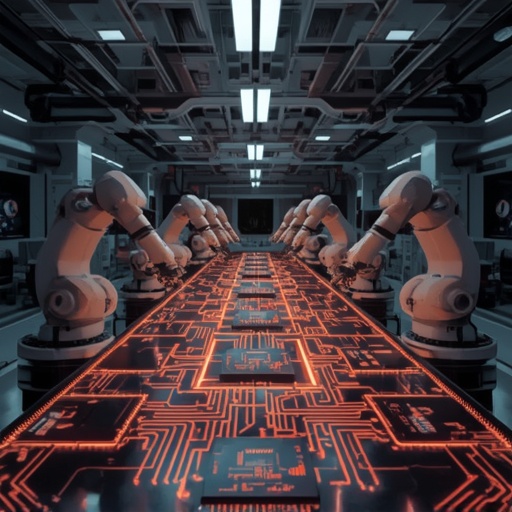
Huawei has officially declared a significant advancement in its semiconductor fabrication capabilities, revealing a novel technological method that could profoundly influence the global balance of power in the chipmaking sector. This newly developed approach, according to the company, represents an innovative refinement of manufacturing processes that enables the production of increasingly sophisticated semiconductors, even in the absence of the latest generation of lithography or advanced fabrication equipment. Such progress not only narrows the long-recognized technological divide between Huawei and Taiwan Semiconductor Manufacturing Company (TSMC)—generally acknowledged as the leading force in global chip production—but also demonstrates the extent to which innovation, driven by necessity, can overcome existing technological constraints.
In practical terms, Huawei’s announcement suggests that creative engineering and optimization of existing tools can continue to yield meaningful leaps in production efficiency and chip performance, even when access to state-of-the-art machinery or international supply chains is limited. This development could, therefore, signal a transformative moment for the broader semiconductor ecosystem, which remains central to the functioning of virtually every modern technology, from smartphones and cloud computing infrastructure to emerging fields such as artificial intelligence and autonomous systems. The implications extend well beyond corporate achievement, potentially redefining competitive dynamics in an industry long dominated by a small handful of technologically privileged players.
By demonstrating the feasibility of achieving meaningful progress without exclusively depending on the most advanced fabrication facilities, Huawei is, in effect, challenging the long-standing assumption that cutting-edge semiconductor innovation is solely determined by access to the latest tools. It is a reminder that strategic ingenuity, deep scientific expertise, and resourceful adaptation can, under the right conditions, counterbalance material limitations. If this technological trajectory continues, the company may not only reduce its reliance on external suppliers but also inspire a rethinking of manufacturing priorities across the global technology landscape.
The semiconductor industry evolves at an extraordinary pace, with each breakthrough shifting the parameters of what is considered achievable. Huawei’s latest initiative encapsulates that shift perfectly—an emblem of resilience and visionary thinking in an era of accelerating technological change. As the global race toward ever-smaller, faster, and more energy-efficient chips intensifies, innovations of this nature will undoubtedly shape the next chapter of technological competition and collaboration alike. #Huawei #Semiconductors #Technology #Innovation #FutureTech
Sourse: https://www.bloomberg.com/news/articles/2026-05-25/huawei-touts-chipmaking-breakthrough-to-shorten-gap-with-tsmc