As modern corporations strive relentlessly to optimize productivity and sustain their competitive edge in a rapidly evolving marketplace, an increasing number are urging — and in some cases mandating — that employees develop proficiency with artificial intelligence tools. This growing corporate emphasis on AI adoption, while intended to modernize workflows and heighten operational efficiency, has also revealed a considerable divide between ambition and readiness: a widespread training gap among the very professionals expected to wield these technologies effectively.
Aureliusz Gorski, founder and CEO of the Warsaw-based startup CampusAI, explained in an interview with TechCrunch that only a narrow selection of educational solutions currently caters to non-technical audiences. In other words, while numerous advanced AI courses target data scientists or developers, few offer accessible paths for business professionals, creatives, or managers seeking practical knowledge of how AI can enhance their day-to-day roles.
CampusAI was created specifically to bridge that educational void. The company’s answer is an inclusive learning platform that demystifies AI and makes it usable for everyday professionals eager to integrate intelligent tools into their workflows. Whether employed in sales, human resources, legal departments, or personal brand development, the platform aims to help individuals understand AI conceptually, apply it functionally, and ultimately feel empowered rather than threatened by this technology.
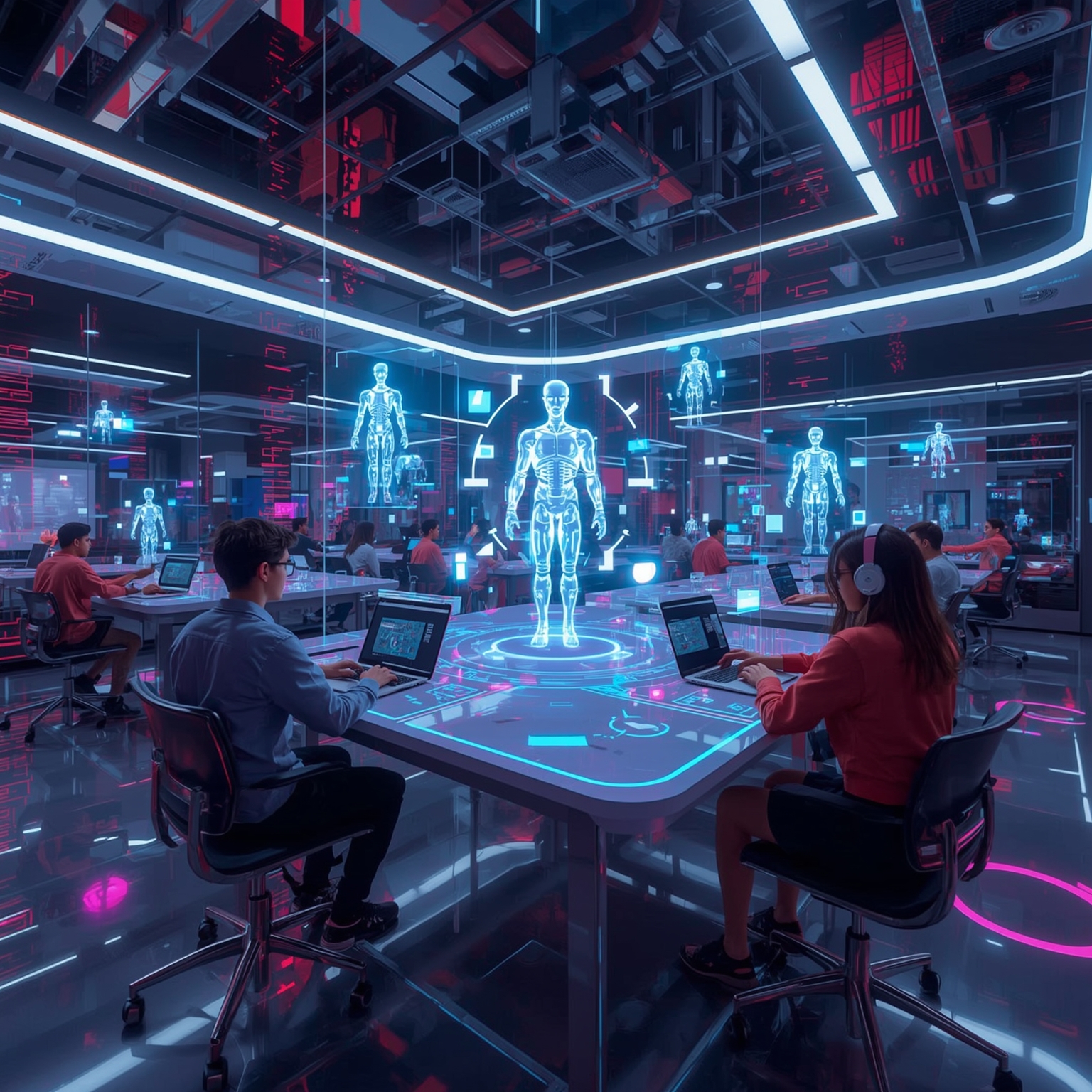
In anticipation of its participation as a Top 20 Startup Battlefield finalist at TechCrunch Disrupt, CampusAI outlined its flagship offering: a comprehensive online learning ecosystem designed to be as immersive as it is educational. The platform integrates two primary components — a curriculum of courses delivered through an avatar-based learning model and a fully realized virtual campus within the metaverse. This digital environment enables participants to acquire new skills, network with peers, engage in collaborative projects, and explore AI through a gamified yet professional interface — one might imagine it as “Roblox for adults,” where education, innovation, and community intersect.
CampusAI extends its solution both directly to individual learners and to corporate clients eager to upskill teams at scale. Through its unified platform, users gain seamless access to dozens of prominent AI systems — including ChatGPT, Gemini, Midjourney, and Flux — consolidating what would otherwise require multiple accounts and subscriptions. Moreover, the company’s team continuously revises and updates its coursework on a daily basis, ensuring that the content evolves in tandem with the ever-changing landscape of AI advancements.
Among its offerings, CampusAI’s flagship consumer product, Me+AI, invites learners to engage with an adaptive curriculum tailored to their interests for $250 per year. Meanwhile, its enterprise counterpart, Team+AI, positioned at $25,000 annually, extends this adaptability to entire organizations. According to Gorski, these programs focus on cultivating what he calls a “human plus AI readiness culture,” guiding companies through a smooth and sustainable transition toward integrated human-AI collaboration.
The Team+AI curriculum unfolds in two phases. During the initial three-week period, companies undergo an AI readiness assessment, attend managerial workshops, and participate in an organization-wide webinar introducing core concepts and opportunities. The subsequent four weeks comprise customized learning paths mapped to company objectives, ensuring alignment between employee development and strategic outcomes. As Aleksandra Przegalińska, an AI researcher and scientific adviser to CampusAI, explained, this structure allows professionals from a wide range of backgrounds — whether human resources experts, financial analysts, or marketing specialists — to select curated courses relevant to their expertise. Furthermore, CampusAI is capable of tailoring learning tracks for specific enterprises, thereby enabling a distinctly bespoke educational experience.
This pedagogical framework builds on academic research by Przegalińska and fellow scholar Dariusz Jemielniak, who have explored how effective human-AI collaboration can improve business outcomes and enhance problem-solving in complex environments. Central to their approach is the mastery of “prompting strategies,” a skillset that empowers learners to communicate with AI tools more effectively, thereby amplifying human creativity and analytical precision.
To support this methodology, CampusAI equips its learners with a comprehensive prompt book — a curated collection of examples and exercises that not only illustrates effective prompts but also guides students in constructing more sophisticated commands over time. Within the virtual campus, a feature known as the “AI Gym” presents interactive challenges devised by AI agents, offering real-time feedback and performance evaluation that sharpen learners’ capabilities through practical engagement.
Przegalińska emphasizes that the program’s philosophy is not about outsourcing tasks to machines but rather fostering authentic symbiosis between human ingenuity and technological capability. In the AI Gym, students can experiment with AI as a critic, collaborator, or creative partner — a digital colleague that expands their thought process rather than replaces it. In her words, the goal is to build an ecosystem where technology operates as an enhancer of human work, transforming AI from a tool of automation into one of personal and professional augmentation.
CampusAI asserts that its courses deliver measurable results: participating employees report up to a 40% increase in productivity and a 60% improvement in job satisfaction. The startup’s rapid adoption supports these claims. Following its 2023 launch, it captured substantial traction in Poland within two weeks, acquiring over 600 lifetime subscribers and swiftly expanding to a community of more than 35,000 users. Currently, CampusAI collaborates with 60 enterprise partners, including global names like ING, T-Mobile, Lenovo, and Ikea. The company projects over $2 million in annual recurring revenue (ARR) by 2025 and is raising a $20 million Series A round to reach 40 international markets by the end of the decade.
At present, CampusAI’s platform operates in Polish, English, and Spanish and has recently entered both the U.K. and U.S. markets, initially prioritizing business-to-business sales before deepening its direct-to-consumer offerings. Graduates of the core courses can transition into Community+AI, a networking and collaboration hub where members exchange insights, co-develop projects, and even contribute to initiatives such as hAI Magazine — an online publication dedicated to sharing sector-specific applications of AI.
In addition to its educational products, the company’s digital twin technology represents a major extension of its value proposition. This advanced feature allows CampusAI not only to manage its proprietary virtual campus but also to design and license custom-built digital replicas of physical universities, corporate offices, or government institutions. These tailored virtual spaces, available from $100,000 per year, allow organizations to conduct training, exhibitions, and immersive learning experiences in a secure and interactive environment.
CampusAI recently secured €18 million in support from the European Commission to collaborate with 11 universities across 10 European countries — including Greece, Spain, the U.K., France, Luxembourg, and Germany — aimed at creating digital twins and personalized educational ecosystems for students. Gorski envisions these partnerships as strategic foundations for localized innovation hubs, drawing from his previous work at the Cambridge Innovation Center, where he oversaw more than ten initiatives fostering Warsaw’s startup community. These digital and social environments are designed not simply as virtual classrooms but as thriving innovation districts, nurturing entrepreneurship and regional technological progress.
Gorski stresses the broader mission underlying this effort: to empower smaller ecosystems and safeguard diversity within the global tech landscape. Without the cultivation of robust local innovation centers, he warns, the next five years may witness a sharp decline in startup activity, particularly as large-scale providers such as OpenAI continue consolidating services within single digital ecosystems. For him, the answer lies not in resisting technological progress but in distributing its benefits through accessible education, empowering individuals, and strengthening local communities.
For those interested in learning directly from CampusAI and engaging with a wide range of pioneering startups, industry leaders, and visionary speakers, TechCrunch Disrupt from October 27 to 29, 2025, in San Francisco will serve as the ideal stage. Attendees will have the opportunity to witness CampusAI’s vision firsthand — an effort to make artificial intelligence education not a privilege of technologists, but a universal tool for creativity, productivity, and connection.
Sourse: https://techcrunch.com/2025/10/28/inside-campusais-mission-to-close-the-ai-training-gap-for-everyday-workers-check-it-out-at-techcrunch-disrupt-2025/


