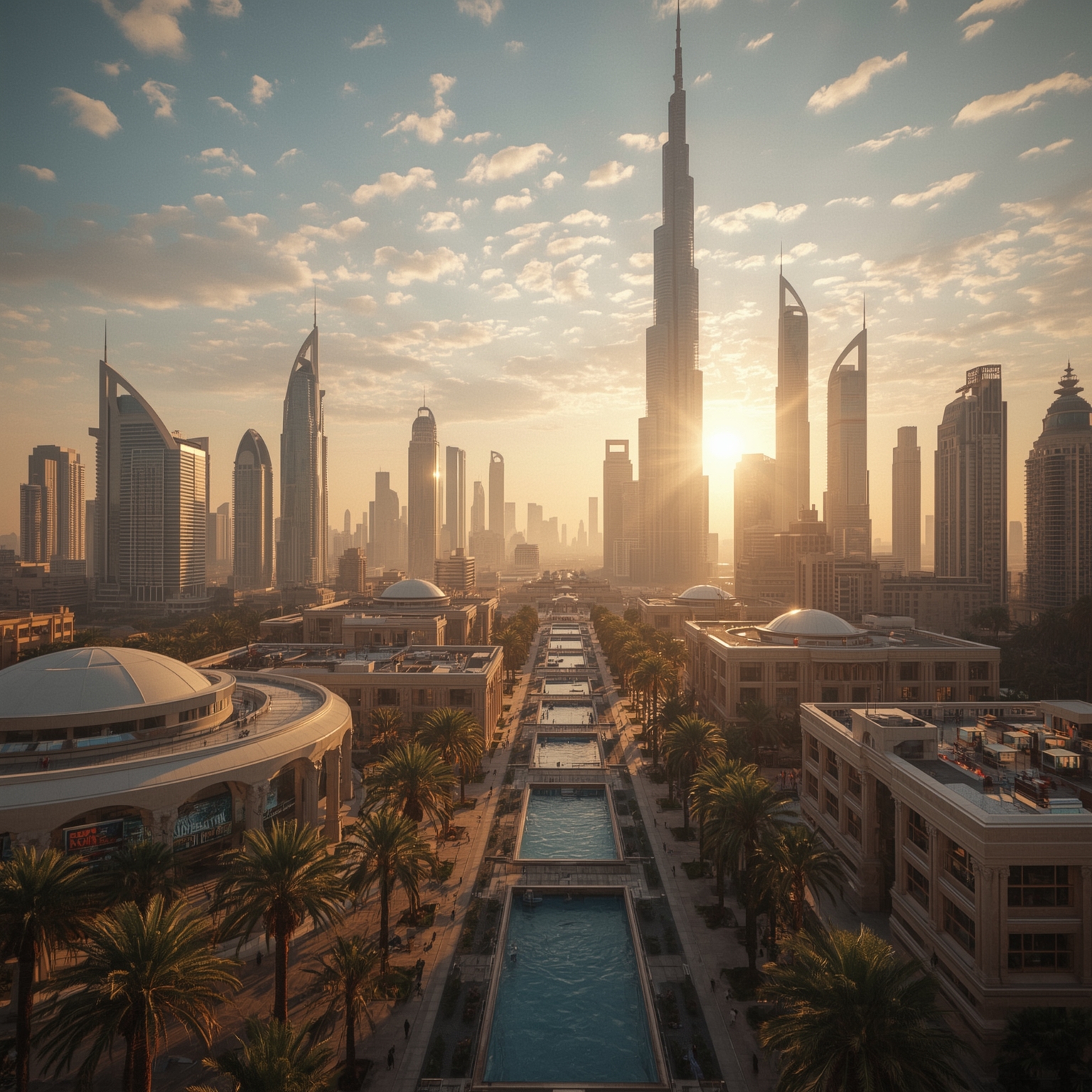
“You certainly don’t witness scenes like this in London.” Under the brilliant warmth of a weekday morning sun, in Dubai’s sleek International Financial Centre — the heart of the United Arab Emirates’ most populous and ambitious city — an unexpected sight captures attention: a peacock, its iridescent feathers glinting in the light, casually wanders past an outdoor table. There, a portfolio manager from one of the world’s most prominent hedge funds finishes a coffee and reflects on a new chapter of life amid the shimmering towers of the Gulf. This financier relocated from London a year earlier, drawn by the siren call of Dubai’s tax-free lifestyle, its perpetually golden climate, and the promise of a cosmopolitan environment that rewards enterprise. Such a move is no longer a rarity, nor will it be the last; a tide of financial professionals has begun shifting from the long-established power centers of London, Hong Kong, and Switzerland to Dubai and its more serene sibling, Abu Dhabi. Together, these migrations are solidifying the UAE’s status as a rising global nexus of commerce and capital.
Although its working population remains modest compared with the vast legions employed in New York or London, the Dubai International Financial Centre has grown rapidly, boasting a 9% increase since 2024 and now housing around 48,000 finance professionals. Even the most whimsical of details — peacocks striding through café courtyards — have become a defining feature of the district’s local flavor, symbolizing the city’s unusual blend of opulence, nature, and modern efficiency. The newcomers arriving in increasing waves are not low-level recruits. On the contrary, anecdotal evidence suggests a particularly senior caliber among the latest expatriates. Distinguished executives and affluent entrepreneurs, including billionaires such as Ray Dalio, have taken up residence, enticed by a region busily constructing luxurious high-rises, waterfront mansions, and sleek apartments to meet burgeoning demand. As property values have surged 70% since 2019, the city’s infrastructure hums with activity: high-end vehicles and electric BYDs glide through congested thoroughfares, personal chauffeurs and ride-share drivers navigating the morning bottleneck around the DIFC. Even within palatial hotels cooled to near-arctic temperatures, the muffled sounds of nearby construction — saws, drills, and hammers — echo the city’s relentless drive toward expansion.
When Business Insider visited the city to attend two major investment summits — SuperReturn Dubai at the Ritz-Carlton and AIM Summit at the Jumeirah Emirates Towers — the goal was clear: to capture the essence of life in this high-octane financial haven and to hear from those who have uprooted themselves to be part of its ascent. Many interviewees, though candid, requested anonymity, constrained by corporate policies that prevent public commentary.
The UAE’s transformation in the global imagination now mirrors the role once played by Switzerland in the twentieth century — a sanctuary where capitalism thrived unencumbered by political turbulence. Today, Dubai represents that ideal’s twenty-first-century incarnation. Three portfolio managers explained that their productivity here surpasses what they experienced in London or Hong Kong, largely because the local environment removes countless distractions. The service culture is deeply embedded; drivers, housekeepers, and personal chefs are commonplace, allowing even the busiest financiers to focus solely on their trades. Political unrest, labor strikes, or other disruptions that occasionally paralyze European capitals are virtually absent, thanks to strict governance and a national emphasis on order — a direct reflection of the Royal family’s guiding influence.
While immigration debates roil countries such as the United States and the United Kingdom, the UAE has chosen a markedly pragmatic path. Those eager to work find the process unexpectedly straightforward, a reality celebrated by many expatriates, including professionals hailing originally from India, who see the Gulf’s openness as a distinct advantage. Mark Oshida, Cambridge Associates’ regional head for the Middle East and Africa, who relocated to Dubai in April, summarized this ethos succinctly: the city, he said, has excelled at cultivating tolerance and inclusivity for people of all backgrounds.
The diverse array of voices at the two recent conferences further underscored Dubai’s global pull. Conversations in German, French, Hindi, and Mandarin filled the air as attendees balanced calls and gourmet plates of chicken lollipops and paneer tikki masala. Locals in flowing white kanduras stepped outside into shaded courtyards for cigarette breaks, while mixed groups of Emiratis and expatriates gathered over fragrant shisha or clinked glasses in haute cuisine venues helmed by the world’s top chefs. This convergence of cultures is not coincidental; it is foundational. Engraved in a plaque at the Jumeirah Emirates Tower, the city’s “Eight Principles of Dubai” explicitly prioritize talent attraction. Principle number seven — “A Land for Talent” — declares that the emirate’s prestige depends upon its continued ability to invite skilled and ambitious people to make it their base. As Khalil Chami, CFO of Ali & Sons, remarked during SuperReturn, “Here, business is conducted through logic, not politics” — a statement that captures the nation’s deeply pragmatic philosophy.
The magnetism of the UAE’s sovereign wealth — stewarded by institutions such as the Abu Dhabi Investment Authority and Saudi Arabia’s Public Investment Fund — has long drawn global asset managers to the region. Yet, increasingly, it is the movement of individuals, the so-called ‘talent flow,’ that propels companies to establish permanent offices in the Gulf. With proposed inheritance and wealth taxes looming in parts of Europe, many financiers anticipate a further wave of relocation. Representatives from the DIFC have even embarked on strategic recruitment tours, targeting gatherings in cities like Washington and Hong Kong to attract fresh expertise. Inside Dubai’s Gate Building — home to the stock exchange — evidence of this proactive expansion is visible. Despite the area’s steady population growth, its modern boulevards and café-lined plazas retain an air of spacious calm when compared to the frenetic scenes of Midtown Manhattan or Mayfair in London. Even during peak conference weeks, coffee counters and luncheon venues remain comfortably accessible, a detail many expatriates cite as one of the subtle luxuries of the Dubai pace.
Prominent global funds are expanding fast. Millennium, the powerhouse founded by Izzy Englander, already employs nearly 150 people in Dubai and has room for another hundred — a telling indicator of the city’s growing strategic importance. As Magellan Capital’s CEO Ahmed Omar revealed at SuperReturn, persuading employees to relocate is far simpler than one might expect; in just eighteen months, 20 of his staff have chosen to make the move. Meanwhile, local intermediaries connecting global investors with Middle Eastern capital observe another fascinating trend: some portfolio managers who first came with multinational employers are striking out independently yet electing to remain in the region, confident that Dubai now has the credibility and investor interest to sustain them. Where once global institutions hesitated to back teams operating outside traditional finance hubs, today, post-pandemic, supporting managers based in Dubai has become wholly acceptable.
Still, even amidst the optimism, opinions diverge about permanence. Of the many expatriates Business Insider spoke with, roughly half consider the Gulf a temporary adventure — a place to accumulate wealth rapidly before returning to their homelands. Others, however, find themselves unexpectedly settled: their families relish the safety, the top-tier schools, and the leisure lifestyle among palm-lined promenades and pristine beaches. Despite summer temperatures intense enough, locals joke, to soften car tires, many residents simply decamp to cooler parts of Europe, mirroring New Yorkers’ seasonal pilgrimage to the Hamptons. In a city renowned for security — where one might leave a wallet or laptop unattended in a café without concern — the sense of stability feels like a rare global luxury. As a banker who once split life between London and Geneva put it succinctly, “The more turmoil the world endures, the more appealing Dubai becomes.”
That stability owes much to the nation’s leadership. The confident continuity of infrastructure projects, economic reforms, and social openness reflects the steady hand of Sheikh Mohamed bin Zayed Al Nahyan. His visage is omnipresent — gazing down from hotel lobbies, towering along Sheikh Zayed Road, and presiding silently over reception desks — a visual reminder of centralized guidance. Yet beneath the city’s glossy exterior, some observers quietly raise the same question: what happens next? With political succession viewed as the region’s single greatest uncertainty, even steadfast residents admit that geopolitical tensions — such as the recent U.S. strike on Iran — occasionally shake their sense of remove from larger conflicts.
For many professionals, Dubai remains a chapter rather than a lifelong destination — a place to double salaries, secure financial independence, and then return to quieter domestic roots. A pair of British portfolio managers confessed that they already own countryside homes awaiting retirement, ready for the day they leave the Gulf behind. As another British wealth adviser summarized with pragmatic affection, “Ultimately, we all dream of going home.” For now, Dubai continues to stand as a paradox wrapped in sunlight: a city both transient and eternal, where opportunity is limitless, and ambition finds no boundary but the horizon itself.
Sourse: https://www.businessinsider.com/dubai-financial-services-expat-talent-hub-2025-10


