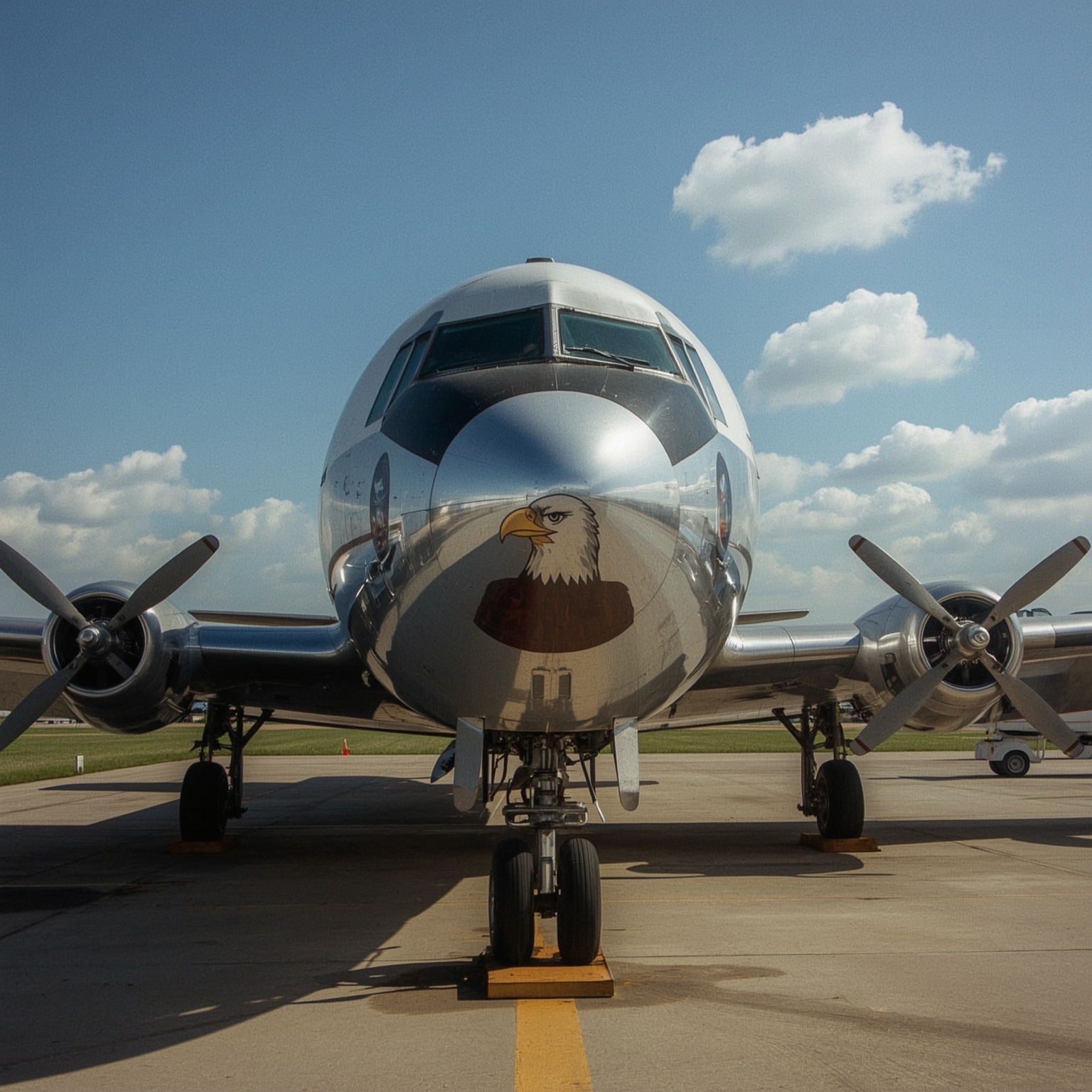
President Harry S. Truman’s official presidential aircraft, famously known as *The Independence*, was a Douglas VC-118 that embodied both symbolism and functionality at a pivotal moment in American history. This distinctive plane, which entered service in 1947, was not simply a means of transportation but also a mobile extension of the presidency itself. Its service life under Truman lasted until 1953, after which the aircraft continued to serve the Air Force before being retired and ultimately preserved as a permanent display at the National Museum of the United States Air Force in Dayton, Ohio, where it has been available for public viewing since 1965.
Truman named the aircraft after his hometown of Independence, Missouri, lending it a personal significance beyond its official role. Externally, *The Independence* was adorned with striking and symbolic artwork: its nose bore the cartoon-like face of a proud bald eagle, while its fuselage carried sweeping wing motifs, visually reinforcing the notion of strength, freedom, and national pride. The design was both whimsical and emblematic, creating a visual identity that blended patriotism with the approachable style Truman was known for.
As the second airplane specifically designed for presidential use, *The Independence* followed the precedent set by the Douglas VC-54C *Skymaster*, affectionately called the “Flying White House” or “Sacred Cow.” Compared to its predecessor, the VC-118 represented a significant technological upgrade. Derived from the commercial DC-6 airliner, the aircraft was powered by four Pratt & Whitney R-2800 engines, each generating 2,100 horsepower, allowing it to cruise at speeds of up to 360 miles per hour. The model’s larger fuel capacity, in particular, granted it the ability to traverse the entirety of the continental United States without the need to refuel—a remarkable improvement over earlier designs.
Visitors today who step aboard the restored aircraft experience more than just a historical exhibit; they are temporarily transported back into the environment of mid-20th-century presidential travel. Beginning in the cockpit, one encounters an era before digital avionics were conceived, a time when navigation relied on analog devices and mechanical instruments. The radio room located just behind the flight deck showcases equipment such as the dead reckoning computer—essentially a sophisticated slide rule for plotting courses—and the navigational plotter, a tool resembling a protractor-ruler hybrid that allowed precise chart calculations long before GPS made such practices obsolete.
A crew of nine was required to operate *The Independence*, each member filling critical roles to ensure both the safety of flight and the comfort of its passengers. Seating arrangements reflected a clear hierarchy: while the crew had functional seating in designated zones, the VIP passengers—including the president and top officials—occupied a far more refined space. Their section featured curtained windows, comfortable seating, and even a communal table intended for dining, conferences, and leisure activities such as card games. One notable historical episode took place in 1950, when Truman used *The Independence* to travel to Wake Island during the Korean War to meet General Douglas MacArthur, a flight that underscored the aircraft’s strategic importance at a volatile geopolitical moment.
Additional sections of the plane contained narrow berths—foldable sleeping bunks—that could accommodate up to twelve individuals, while the passenger cabin provided seating for as many as twenty-four. The galley was fully equipped with a stovetop, refrigerator, oven, and sink, enabling flight attendants to prepare complete meals for the president and his entourage during long flights. At the very rear of the aircraft sat the president’s private stateroom, a modest but dignified space. Central to this compartment was a desk decorated with the presidential seal, a functional workspace where Truman could continue his duties while airborne.
Walking through the plane today provides a vivid, tangible sense of how far presidential aviation has developed within a relatively brief span of time. Compared to modern-day Air Force One aircraft—Boeing VC-25A jets outfitted with cutting-edge communication systems, medical facilities, conference rooms that double as situation centers, and the unmatched ability to refuel midair—the Douglas VC-118 appears almost quaint. Its relatively small dimensions, reliance on propeller-driven engines, and straightforward amenities highlight just how quickly technological innovation redefined not only aviation but also the expectations and necessities of presidential travel. Yet despite its apparent limitations by today’s standards, *The Independence* served a vital role in bridging the transition between the earliest presidential aircraft and the advanced airborne command centers of the jet age.
Thus, *The Independence* remains more than a relic of the past: it stands as a preserved emblem of both Truman’s presidency and America’s evolving mastery of air power. Its very presence in the National Museum of the United States Air Force ensures that visitors can walk through history itself, experiencing firsthand the cabin where decisions of national significance were contemplated and missions of historic weight were carried out. In this way, the aircraft is not merely an artifact to be viewed but a living classroom, teaching the story of progress, leadership, and the shifting nature of presidential travel in the modern era.
Sourse: https://www.businessinsider.com/air-force-one-planes-harry-truman-the-independence-2025-9