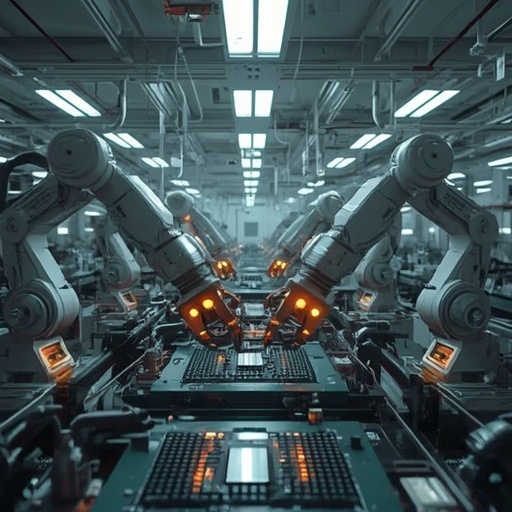
In the heart of Intel’s next-generation manufacturing complex in Oregon lies a realm where technology, automation, and meticulous precision blend to form an environment that feels almost otherworldly. This cutting-edge chip fabrication facility, often referred to as a cleanroom, operates with a level of exactness so extreme that even the minutest foreign particle—a single strand of human hair, an errant dust mote, or a skin cell invisible to the naked eye—has the potential to disrupt the delicate dance of microchip production. Within these sterile, climate-controlled chambers, robots glide smoothly along illuminated pathways, tirelessly assembling the processors that will power the artificial intelligence systems and smart devices of tomorrow.
The balance between human ingenuity and robotic efficiency defines this immaculate ecosystem. Although highly skilled engineers and technicians design, maintain, and monitor every stage of production, their physical presence inside the cleanroom is minimal; robotic automation now performs the majority of critical tasks. These intelligent machines maneuver with flawless synchronization, transferring silicon wafers, performing microscopic measurements, and executing precalibrated steps that ensure absolute uniformity across countless units. The workforce has evolved from manual operators to system overseers, guiding algorithms and data streams that dictate each movement of the robotic arms.
Every component of this environment is governed by stringent purity standards. To maintain the cleanroom’s classification—thousands of times cleaner than a hospital operating theater—workers who do enter must undergo a rigorous process of gowning, layering themselves in specialized, static-free suits designed to prevent even the smallest contamination. The air, constantly filtered through advanced systems, circulates in seamless cycles that remove microscopic impurities. Lights hum softly overhead, casting a sterile glow on rows of machinery that function with the precision of a perfectly tuned orchestra.
Yet, this seemingly sterile, mechanical world is not devoid of creativity or human brilliance. The engineers who envision and refine Intel’s chip designs work in unison with programmers who write the code driving automation, resulting in a symbiotic relationship between human intellect and robotic endurance. Each microchip produced here represents millions of calculations, countless hours of testing, and the fusion of science, design, and artistry. It is within such facilities that the physical foundations of artificial intelligence, advanced computing, and future digital evolution are meticulously crafted.
This factory stands as both a symbol and a workshop for the future of industry—where innovation is not merely a goal but a continual process of optimization and reinvention. As the world moves toward increased automation and AI-driven decision-making, Intel’s robot-run cleanrooms demonstrate how precision manufacturing can coexist with creativity to shape technology that pushes the boundaries of possibility. In this hushed realm of silicon and circuitry, where perfection is measured in nanometers, a single human hair is all it takes to remind us just how fragile—and extraordinary—the pursuit of technological excellence can be.
Sourse: https://www.businessinsider.com/inside-intel-ai-chip-factory-manufacture-humans-greatest-threat-2026-6