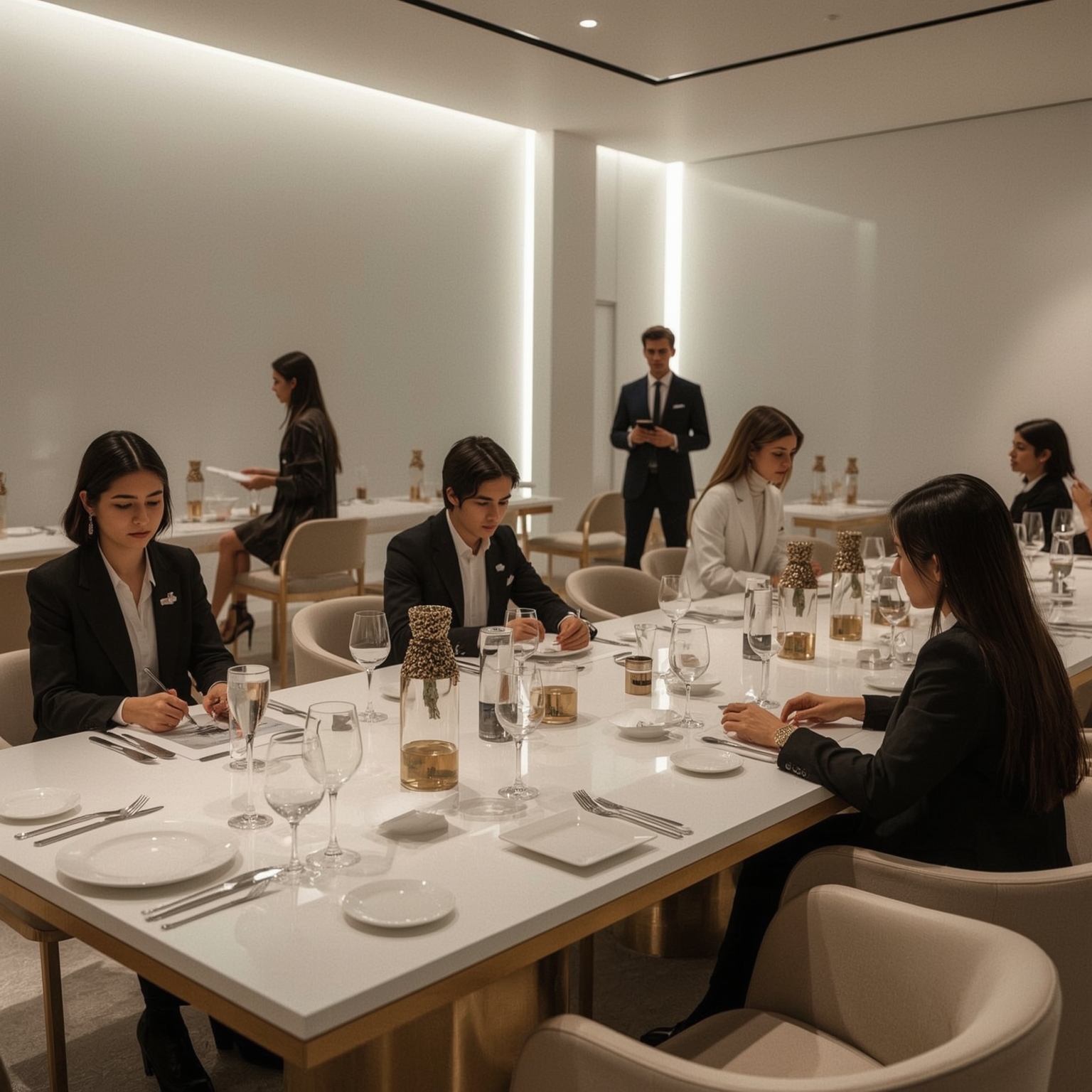
The public perception of Silicon Valley’s archetypal technology founder is undergoing a remarkable transformation—one that challenges clichés of the socially awkward coder in a hoodie. This cultural and stylistic shift is being deliberately cultivated, according to Sam Lessin, the founder of Slow Ventures, a venture capital firm recognized for its wide-ranging investments across industries. Seeking to redefine how emerging entrepreneurs present themselves to the world, Lessin recently organized an unconventional workshop he aptly described as an “Etiquette Finishing School.” The purpose of this event was to guide young founders, particularly those emerging from Y Combinator and the broader startup ecosystem, in mastering the finer points of social interaction, graceful self-presentation, and even the art of enjoying foods that might intimidate the uninitiated—such as caviar.
In his opening remarks, Lessin observed that the prevailing image of Silicon Valley is shifting away from the persona immortalized by the film *The Social Network*—the iconic portrayal of Mark Zuckerberg as an introverted college student whose uniform gray hoodie came to symbolize the casual, almost rebellious aesthetic of early tech culture. This new generation, he explained, seeks to balance innovation with elegance, ambition with charm. The venue for the event, a discreet private room nestled behind the second-floor restaurant of the Four Seasons Hotel in downtown San Francisco, reflected this evolution, situated within walking distance of a growing concentration of artificial intelligence startups defining the next phase of technological progress.
Setting the tone for the afternoon, Lessin reminded attendees that technology does not integrate itself naturally into society; it requires a human push, a translation into emotional and cultural language. To achieve this, he emphasized, technical brilliance alone is insufficient. When introducing disruptive or unfamiliar concepts, founders must rely on their personal magnetism, authenticity, and diplomacy. Charisma, he suggested, becomes not a superficial ornament but rather the essential lubricant that allows revolutionary ideas to glide smoothly into the public sphere.
The ambiance of the event was carefully curated to reflect this lesson in refinement. Four circular tables were elegantly adorned with small culinary delights—beetroot tarts with vivid garnishes, cubes of watermelon poke suggesting culinary playfulness, and delicate truffle cheese balls offering a whisper of luxury. Around these tables sat roughly three dozen aspiring entrepreneurs, each finding in front of them a small gift bag containing travel-sized grooming items: a sleek hairbrush, portable mouthwash, a lint roller for impromptu polish, and a $100 gift card redeemable at Wilkes Bashford, one of San Francisco’s most storied luxury menswear retailers.
The program unfolded in three distinct segments, designed to connect appearance, interaction, and confidence into a coherent philosophy of leadership. First came a series of lessons on professional style and attire; the second focused on the art of conversation as a strategic and human skill; and the third—a deliberately whimsical finale—offered participants an introduction to the etiquette of caviar tasting.
During the first portion on refined dressing for the workplace, the session commenced with a small runway presentation showcasing Wilkes Bashford’s collection. This boutique, which traces its origins back to the 1960s and counts dignitaries such as former San Francisco Mayor Willie Brown among its inaugural patrons, lent the event an air of historic sophistication. Chris Deehan, one of the store’s leading style advisors, delivered the keynote on personal appearance. Dressed from head to toe in complementary green hues, Deehan embodied the principle of deliberate coordination he was teaching. He explained that in the startup world, where informality prevails, founders enjoy significant flexibility so long as they avoid two cardinal sins: clashing colors and ostentatious branding that distracts rather than enhances. In his words, flamboyant logos or discordant tones “scream” for attention—an effect antithetical to quiet confidence.
Deehan’s advice took on particular nuance as he addressed the subject of formal settings. When a founder steps into a meeting with investors or presents before potential partners, he noted, the message conveyed by attire carries nearly as much weight as the spoken pitch. In such contexts, a well-tailored cashmere suit becomes a reliable expression of self-respect and credibility. He added that during the winter months—roughly November through February—a sleek turtleneck may serve as an acceptable and stylish substitute for a collared shirt, offering warmth without sacrificing elegance. Above all, Deehan stressed, one must never leave the neckline barren: if not wearing a tie, then a tastefully folded pocket square serves as the essential accent signifying sophistication. When he began outlining the intricate rules governing suit buttons—when to fasten, which to leave undone—a few puzzled expressions in the audience prompted him to smile and suggest, with light humor, “If ever in doubt, just send me a photo.”
The discussion then shifted to perhaps the most intangible aspect of social grace: meaningful conversation. During this panel, Sam Lessin was joined by Sunil Rajaraman, founder of Hamlet, an artificial intelligence enterprise that compiles and synthesizes data for developers and legal professionals. Rajaraman spoke candidly, noting that Silicon Valley’s cultural capital does not always translate into universal admiration. “You’re not exactly beloved everywhere,” he admitted, highlighting that outside the Bay Area bubble, the tech elite can come across as self-absorbed or tonally detached. His point was clear: to be a persuasive and respected figure, a founder must step beyond the confines of their technical expertise and re-engage with the larger human experience.
Rajaraman advised the next wave of innovators to nurture a self beyond their coding prowess and business metrics. He encouraged them to read fiction—a simple yet profound exercise that expands empathy, imagination, and narrative intuition, qualities vital to engaging others at social or professional gatherings. The ability to talk about stories, emotions, and ideas unrelated to technology, he explained, fosters connection and charm. He also touched briefly on the uncomfortable reality that many new technologies displace labor—rendering their creators responsible for the broader societal impact of their innovations.
Lessin built on this idea, reminding the audience that etiquette is less about rigid rules than about attentiveness to others’ energy. True composure, he said, means knowing how to read a room—to gauge when to speak and when to listen—and to enter every encounter not from a stance of taking but of giving. “Be interesting beyond your company,” he reminded them, suggesting that curiosity, generosity, and calm presence often achieve what aggressive self-promotion cannot. “Approach situations with a low heart rate,” he added metaphorically, describing the poised emotional balance of those who inspire trust simply by being grounded.
As the afternoon waned, the final component—a caviar tasting—brought a touch of theatrical indulgence. The timing was ideal, as the small plates scattered across the tables had grown empty. Soon, servers arrived bearing silver trays lined with tiny tins of caviar, each accompanied by delicate mother-of-pearl spoons that glimmered beneath the overhead light. The attendees, visibly intrigued, began peppering the facilitators with questions. One vegetarian participant asked, half-curious and half-concerned, whether the extraction process harmed the fish. Another attendee whispered an earnest query about the proper technique: “How much are we supposed to chew the caviar?”
For many—including the reporter observing the scene—the experience marked a first encounter with this elusive delicacy: a softly textured, olive-tinted array of glossy pearls whose flavor defies easy description. Geoffrey Chen, a representative of the Caviar House & Prunier Group and the event’s culinary guide, explained that this ingredient, often priced comparably to luxury narcotics, is less about taste than about ritual. The act of tasting caviar symbolizes celebration, refinement, and awareness of tradition, rather than mere indulgence. Chen advised pairing such delicacies with the right beverages: Champagne, for instance, enhances the salinity and richness of caviar, while full-bodied but smooth drinks like sake or chardonnay best complement oysters or similarly opulent bites. He concluded with a playful yet practical recommendation—when confronted with a multilingual wine list one cannot decipher, choose almost anything but a rosé.
As the participants received their certificates of completion and began to depart, conversation turned to the irony of the occasion. A fellow founder, a software designer seated nearby, remarked that events such as these were undeniably enjoyable and illuminating, yet those whose ventures were truly taking off would likely be far too consumed by their growing companies to spend a Wednesday afternoon at the Four Seasons. Nevertheless, he conceded, understanding decorum and self-presentation remains important. With a grin, he added, “Still, you can probably afford to be a little eccentric if you’re a genius with a truly exceptional product—just look at Elon Musk.”
In the end, the event encapsulated a larger truth about the evolution of Silicon Valley: the modern entrepreneur is no longer defined solely by innovation but by the ability to embody grace, confidence, and empathy. Charisma, taste, and cultural fluency are becoming as integral to leadership as vision or technical prowess, signaling that the Valley’s brightest minds are learning to navigate not only algorithms and markets, but also the subtleties of human connection.
Sourse: https://www.businessinsider.com/inside-silicon-valley-etiquette-school-for-young-tech-founders-2025-11


