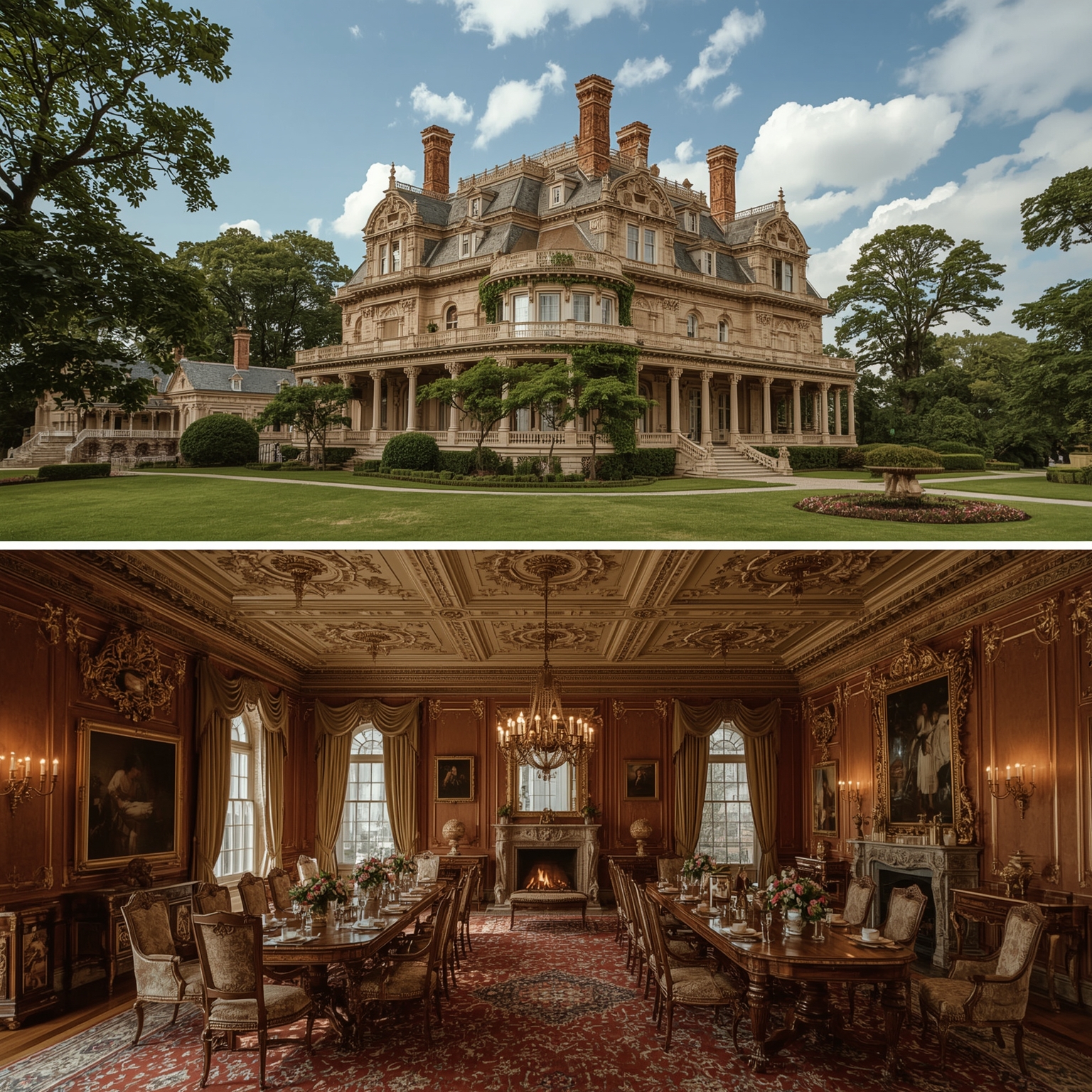
When Samuel F. B. Morse was not immersed in perfecting his groundbreaking communication systems—most notably his creation of Morse code—or in refining his telegraphic inventions and capturing the likenesses of prominent figures on canvas, he found tranquility within the sweeping landscape of his beloved Locust Grove Estate in upstate New York. This sanctuary, nestled amid the natural splendor of the Hudson Valley approximately eighty miles north of New York City, served both as a personal retreat and as an enduring testament to his artistic and scientific mind.
Locust Grove itself, built in 1852 atop a commanding bluff overlooking the tranquil currents of the Hudson River, is a magnificent example of mid–nineteenth-century Italianate villa architecture. The estate’s principal residence—an expansive 14,000-square-foot mansion comprising forty-five rooms distributed over six levels—embodies the elegance and ambition characteristic of its era. Designed in collaboration with architect Alexander Jackson Davis, a leading designer of the time, the home blends architectural sophistication with domestic comfort, its decorative arches and wide wraparound veranda providing both refinement and an intimate connection with the surrounding landscape. For many years, Morse shared this retreat with his wife, Sarah Elizabeth Griswold Morse, and their four children, cherishing the estate as a seasonal refuge each summer until his death in 1872. From his first marriage to Lucretia Walker, who had passed away in 1825, he also had three adult children who occasionally visited this distinguished property.
After Morse’s passing, the estate entered a new phase of its life. Initially rented to William and Martha Young—a prosperous and cultured couple from the local community—it later became their permanent home when they purchased the residence in 1901. The Youngs invested approximately $15,000 in modernizing the interior, equipping the mansion with such then-state-of-the-art amenities as electricity and central heating, thereby harmonizing nineteenth-century elegance with twentieth-century progress. According to the official records maintained by Locust Grove, their thoughtful renovations preserved the historic integrity of the home while enhancing daily living. Their daughter, Annette Young, deeply aware of the property’s historic and cultural significance, later took decisive steps to preserve her family’s legacy by establishing a nonprofit organization dedicated to its care. Thanks to her vision, the estate was ultimately opened to the public in 1979, ensuring that future generations could appreciate both its architectural grandeur and its layered history.
Today, Locust Grove welcomes visitors throughout the year, offering a rare opportunity to explore a nearly untouched nineteenth-century home. While the lush, landscaped grounds are accessible year-round, guided tours of the interior are conducted from April through December on Fridays through Mondays. These tours, conducted at a modest fee of $20 per guest, provide a deeply immersive experience. As described by Ken Snodgrass, Locust Grove’s director and curator, the house stands as an unusually well-preserved historical site—one that continues to captivate those with an interest in art, history, and architecture through its authenticity and atmosphere.
Arriving at Locust Grove reveals the estate’s remarkable extent—two hundred acres of landscaped terrain that seamlessly bridge cultivated gardens with natural woodlands. During a spring visit in 2023, one could stroll through fragrant flowerbeds and winding garden paths, each turn of the trail framing a new perspective of the villa’s graceful outlines. Although the mansion initially appears modest from certain exterior angles, the interior reveals its substantial proportions: forty-five interconnected rooms spanning 14,000 square feet make it ‘deceptively large,’ as Snodgrass aptly remarks. Every architectural detail—from the Italianate arches to the encircling veranda—reflects Morse’s artistic vision and Davis’s architectural precision.
The interior of Locust Grove remains particularly remarkable because, unlike many restored historic homes that are heavily curated or modified, the furnishings and décor exist almost exactly as the Young family left them. Entering through the main hall, the first impression combines warmth and grandeur, as one passes into the dining room adorned with formal portraits of the Young family, reminders of both their refinement and their lasting relationship with the home. Adjacent to the dining space lies the pantry, where members of the estate’s fourteen-person domestic staff once prepared serving trays for meals, raising the courses from the basement kitchen via a small mechanical elevator—a dumbwaiter characteristic of advanced households of the era.
Beyond these utilitarian spaces, the house unfolds into a suite of elegant rooms designed for social life and leisure. The drawing room—decorated with dainty furnishings that could be easily rearranged—served as a lively gathering place where the Youngs hosted dances, intimate concerts, and evening conversations. The adjoining tea room, by contrast, offered an atmosphere of refinement and repose, where family members and guests sipped from silver tea sets crafted by Tiffany & Co. The music room, showcasing color-corrected reproductions of its 1908 wallpaper, continues to evoke the air of grace that once filled it with melodies and laughter. Similarly, the receiving room functioned as a casual yet charming space for close companionship; it was here that Martha Young regularly held her twice-weekly card games, continuing a cherished domestic tradition.
The library, appointed in an Italian Gothic style, illustrates the Youngs’ sophistication and cultured taste. Lined with dark wood shelving and delicately ornamented trim, it boasts a whimsical collection of seventy-five teapots displayed above the cabinets—each one perhaps a relic of leisurely afternoons and travels abroad. Climbing to the second floor reveals the private quarters: three family bedrooms and three guest chambers, one distinguished by the presence of a lovingly constructed dollhouse crafted in 1895 for young Annette by her uncle. The spacious primary bedroom, located within the villa’s tower and offering commanding views of the Hudson River, is adorned with portraits of the Young children—a touching reminder of family life within this grand home.
Venturing further through the estate, visitors discover specialized rooms that speak to both recreation and routine. The billiards room, expansive and inviting, once drew guests for lively games on a pool table dating from 1895, accompanied by the soft strains of phonograph music. Descending to the basement reveals the working heart of the household: the kitchen, originally reliant on a wood-burning stove but later successively modernized with coal in 1910 and gas by 1920. Adjacent spaces include a laundry room—indispensable in a house featuring fourteen bedrooms and five bathrooms—and a servants’ dining and lounge area where the staff would dine, mend garments, write letters, or attend to domestic correspondence during brief moments of respite.
Completing the tour, visitors can explore the on-site museum and gallery housed within the estate’s visitor center. Here, displays illuminate the breadth of Morse’s genius, featuring original telegraph cables, early prototypes, and examples of his artwork, bridging his dual identity as inventor and artist. The exhibition deepens appreciation for how Locust Grove embodied not only personal comfort but also intellectual achievement and aesthetic inspiration.
Concluding a journey through Locust Grove, one is struck by its perfection of preservation. The balance between artistry, technological innovation, and domestic grace manifests a vivid portrait of nineteenth-century life along the Hudson. Walking through its rooms and gardens, overlooking the river that so often inspired painters and poets, it becomes easy to understand why Morse and his descendants cherished this haven so dearly and why visitors continue to be enchanted by its timeless beauty and historical resonance.
Sourse: https://www.businessinsider.com/historic-homes-to-visit-mansion-tour-locust-grove-photos-2023-5