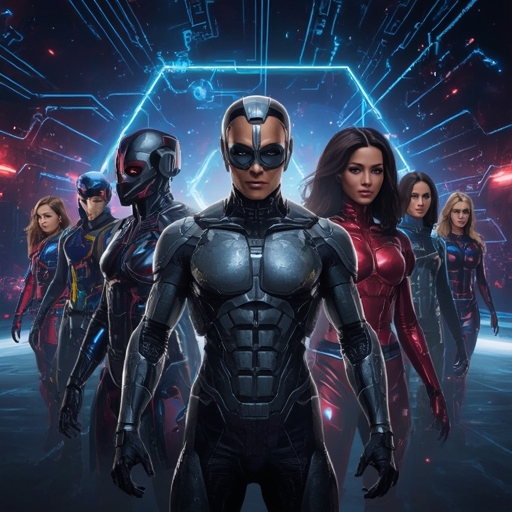
In recent weeks, countless conversations across the global technology sector have been buzzing with speculation about a bold and potentially transformative alliance that could unite some of the most advanced frontiers of human innovation — the vast realm of space exploration and the rapidly evolving domain of artificial intelligence. What began as casual whispers surrounding the monumental SpaceX–Cursor deal has now grown into a larger narrative: one suggesting that an unprecedented coalition of experts, engineers, and visionaries may be on the verge of coalescing into something akin to an elite task force of futuristic thinkers — a team that enthusiasts have already started calling the ‘AI Avengers.’
This rumored partnership is not merely about corporations joining forces on a single project; rather, it hints at a deeper kind of synergy — one that seeks to merge human creativity with the computational precision of machine learning, all applied to challenges as grand as off-world sustainability, deep-space navigation, and interplanetary communication. In essence, such an alliance could redefine the relationship between artificial intelligence and the cosmic frontier, accelerating humanity’s progress toward an era when data, algorithms, and spacecraft operate as organically together as neurons within a brain.
For professionals in both AI development and aerospace innovation, this moment invites reflection on the nature of interdisciplinary collaboration. The hypothetical ‘AI Avengers’ team, if it truly exists, would represent more than just a symbolic partnership. It would embody the collective aspiration to harness emerging technologies for the betterment of civilization — combining aerospace engineering, quantum computation, neural networks, autonomous robotics, and ethical design principles into a single, coherent vision. By doing so, such a group could reinforce the notion that the greatest technological revolutions are rarely the work of isolated geniuses, but the outcome of diverse minds uniting to tackle problems of staggering complexity.
Of course, details remain cloaked in secrecy, with official statements offering little beyond measured enthusiasm. Yet even without confirmation, the mere possibility of this collaboration has captured imaginations across industries. Analysts envision groundbreaking applications — from AI-assisted space missions capable of learning autonomously as they traverse distant planetary systems, to advanced predictive models that optimize cosmic navigation in real time. Others speculate that research undertaken by this prospective alliance might also feed back into Earth-based innovation: smarter infrastructure, cleaner energy systems, and more resilient planetary defense mechanisms.
Whether or not the ‘AI Avengers’ name endures, the concept represents something larger than branding — it symbolizes humanity’s enduring drive to expand both knowledge and capability through cooperation. As artificial intelligence continues to evolve into an indispensable tool for understanding complex systems, and as private space enterprises push the limits of where humanity can physically go, their convergence feels less like science fiction and more like an inevitable next chapter in technological history.
If these rumors prove true, we may soon witness a paradigm shift — one in which visionaries across science, engineering, and digital intelligence form an alliance that embodies our shared aspiration not just to reach the stars, but to bring intelligent design, ethical foresight, and creative problem-solving into the heart of that cosmic journey. The so-called ‘AI Avengers’ could thus stand as a powerful emblem of the age to come: a collaborative movement merging imagination with innovation to shape a smarter, more connected, and profoundly ambitious future for all humankind.
Sourse: https://www.businessinsider.com/elon-musk-ai-avengers-xai-spacex-mistral-cursor-2026-4


