Key Takeaways
For more than a decade, paper has enjoyed an uncontested reputation as the ostensibly “sustainable” alternative to plastic. Yet despite this head start, the overwhelming global crisis of packaging waste remains stubbornly unresolved. Mountains of discarded materials continue to accumulate, and the promise of a greener future has not materialized.
For business founders, innovators, and decision-makers involved in crafting packaging strategies, adopting a different perspective can completely alter the playing field. The real potential does not lie in marginally reducing the harm caused by disposable items but in transcending the very concept of disposability itself. The goal should be the creation of materials and integrated systems where the notion of a single-use product becomes redundant — where packaging can be part of an ongoing cycle rather than an endpoint of waste.
Very few individuals choose to spend their leisure time poring over research about waste streams, landfill decomposition rates, and the intricate science of garbage management. I do. This subject occupies the center of my professional life. Understanding what happens to a material once it has served its immediate purpose — its so-called “end-of-life” behavior — forms the core of my research and informs every recommendation I make.
That is why I was genuinely astonished when I came across a discovery that challenged even my assumptions: a print newspaper, buried for decades inside a landfill, could be exhumed forty years later and found to be so well preserved that the text remained perfectly readable. This revelation came not from speculation but from the meticulous, long-term work of William Rathje, an archaeologist from the University of Arizona. Rathje courageously ventured into a realm few researchers were willing to explore — he literally excavated garbage. Through his Tucson Garbage Project, which examined more than ten American landfills between 1987 and the early 2000s, Rathje and his team peeled back the layers of modern waste history. Among the refuse, they unearthed precisely 2,425 newspapers, some dating back to the 1950s, still crisp enough to read. Just as significantly, paper waste was not a minor observation — it turned out to be the single largest contributor by volume in every landfill studied. That truth embedded itself in my mind and never left.
So, when India instituted its ban on select single-use plastic products in July 2022 and later expanded regulations to require thicker, reusable plastic carrier bags by the end of that year, the immediate visible outcome was predictable: paper bags began appearing everywhere, from bustling street markets to online delivery parcels. Like many well-intentioned consumers, I initially assumed this shift represented genuine environmental progress. After all, paper is derived from natural resources, it decomposes, it is widely labeled as biodegradable — surely, then, it must be the better choice.
But as I examined the data more closely, a disquieting realization struck. The global packaging economy, valued at more than $1.2 trillion, includes a massive $370 billion paper segment, while bioplastics — the industry in which I personally work — make up only about one percent of the total materials used worldwide. Despite paper’s substantial head start as the “eco-friendly” alternative, our planet’s waste predicament persists and even intensifies. Oceans are strewn with debris, landfills are straining to capacity, and future generations stand poised to inherit contaminated soil, water, and air — all consequences of decisions we are making right now.
This fueled a deeper inquiry: if paper has long been heralded as the responsible choice, why have these grand expectations failed to change the results meaningfully? Is paper genuinely sustainable in the manner so often claimed, or has this narrative obscured a far more complicated reality? What I uncovered through this investigation was troubling, and I believe that every entrepreneur involved in material and packaging design deserves full access to the same data before making supposedly “sustainable” choices.
From Forest to Checkout Counter — The True Ecological Cost of a Paper Bag
To properly assess whether paper is sustainable, one cannot focus solely on the final product, cleanly printed and sitting innocently on a store shelf. True sustainability demands that we trace the entire production lifecycle — from the initial felling of trees to the crafting of pulp, the use of intensive chemical processes, the stages of bleaching, drying, and converting, and finally the distribution to consumers. Each phase imposes its own substantial environmental burden, and these cumulative costs often go unnoticed.
Energy consumption serves as an illustrative starting point: the fabrication of a single paper bag consumes approximately four times as much energy as the creation of an equivalent plastic bag. The contrast becomes even more pronounced in terms of water use. In the United States, pulp and paper mills draw on average around 17,000 gallons of water per ton of paper produced. Indian mills relying on wood-based pulp — as reported by the Central Pollution Control Board — require between 40 and 60 kiloliters of freshwater per tonne. Compiled industry comparisons show that each paper bag can demand up to seventeen times the quantity of water required for manufacturing a plastic one.
Chemicals deepen the picture further. Most paper bags are manufactured through the kraft pulping process, which breaks down wood fibers using aggressive reagents such as sodium hydroxide and sodium sulfide. Even when modern operations avoid elemental chlorine in their bleaching steps, they still release toxic by-products like dioxins and adsorbable organic halides into nearby waterways. Research based in India documented effluent levels with chemical oxygen demand reaching 19,100 milligrams per liter — figures far surpassing permissible limits and signaling serious ecological consequences.
While all manufacturing has an environmental cost, the true issue lies not in the existence of that cost but in whether the benefits throughout the product’s lifecycle justify its initial impact. Paper’s supposed advantage comes from its perceived reusability and biodegradability, which theoretically balance out the resource-heavy production. However, closer inspection of life cycle assessments (LCAs) challenges those comforting assumptions.
The 43-Reuse Problem — What Comprehensive Studies Reveal
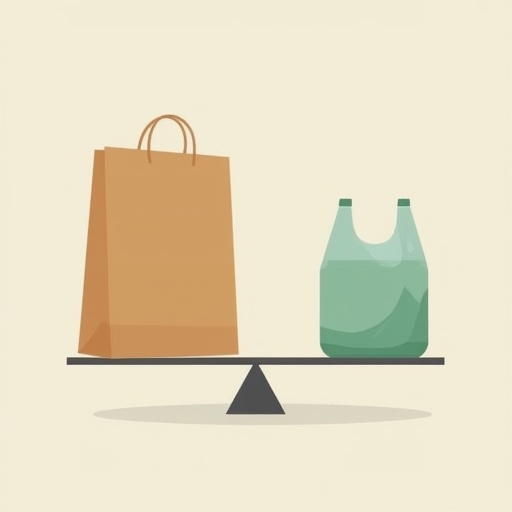
Two major government-backed LCAs provide the most credible comparisons between paper and plastic bags. The United Kingdom Environment Agency’s 2011 report evaluated supermarket carrier bags across ten environmental parameters. It found that conventional high-density polyethylene plastic bags scored best in nine out of ten categories. To equal plastic on climate change impact alone, a paper bag would have to be reused at least three times — a task that sounds feasible in theory.
Then came the Danish Environmental Protection Agency’s 2018 report, completed in collaboration with the Technical University of Denmark. This extensive analysis rated bags across sixteen environmental criteria, ranging from water consumption and acidification to ozone depletion and toxicity. The findings were startling: an unbleached paper bag would need to be reused forty-three times to achieve parity with a low-density polyethylene bag on overall environmental performance. Forty-three full reuse cycles — a figure that stretches credibility. When one remembers how quickly paper bags weaken when damp or overloaded, it becomes apparent that most will never survive more than one use before being discarded.
This divide between perception and measurable evidence exposes a painful truth about paper’s so-called sustainability — it simply does not hold up under rigorous scrutiny. Supporting studies verify this conclusion: a 2024 paper in *Environmental Science and Technology*, authored by researchers from the University of Sheffield, Cambridge, and the Royal Institute of Technology, examined sixteen categories of plastic use accounting for roughly ninety percent of global plastic applications. In fifteen out of those sixteen instances, plastics yielded lower total greenhouse gas emissions across their lifecycle than their alternatives, including paper.
The End-of-Life Conundrum — Why Paper Bags Don’t Magically Decompose
At this stage, many turn to the argument that paper redeems itself after disposal. Yet, even this final chapter offers no relief. Rathje’s landfill excavations demonstrated that once enclosed underground, paper does not undergo efficient decomposition. The reason is not chemical resistance but rather the artificial environment of modern sanitary landfills. These facilities are engineered to be airless — compacted, sealed, and kept intentionally dry to prevent leachate migration. In such anaerobic settings, paper remains inert for decades. When it eventually breaks down, it produces methane rather than carbon dioxide, a gas that is roughly twenty-eight times more potent as a greenhouse contributor over a century-scale timeline.
The U.S. Environmental Protection Agency reported that in 2022, municipal solid waste landfills constituted the third-largest human-related source of methane emissions in the country, contributing about 14.4% of total output — equivalent to the annual emissions of some 24 million passenger vehicles. This comparison starkly illustrates why a paper bag producing methane as it decays can, paradoxically, be environmentally more damaging than a plastic bag that simply lies inert.
Acknowledging What Paper Does Right — and Why That Still Isn’t Enough
To maintain fairness, the evidence is not entirely one-sided. Paper, in open and oxygen-rich environments, can biodegrade relatively quickly, whereas plastic can persist for centuries. In regions vulnerable to litter leakage into the seas, paper causes far less harm to marine ecosystems than plastic fragments. Furthermore, India’s domestic paper industry now sources approximately seventy to seventy-five percent of its feedstock from recycled fiber, lowering pressure on forests and somewhat mitigating its water consumption.
Even with these merits, however, substituting one disposable material for another does not resolve the underlying structural problem — our reliance on single-use design. At best, such substitutions constitute a lateral move dressed up as progress. The pertinent question, therefore, is not whether paper or plastic is the greener option, but why society continues to invest in disposable paradigms at all.
The United Nations Environment Programme’s comprehensive meta-analysis of lifecycle assessments underscores the same core insight: meaningful environmental improvement arises consistently from reuse systems, not from swapping one set of materials for another.
Thus, the real opportunity for entrepreneurs and designers lies in innovation that eradicates the very need for disposability. This could mean developing materials derived from agricultural waste that genuinely meet compostability standards, creating closed-loop packaging systems designed to be returned and reused, or engineering products that sustain multiple life cycles rather than a single one. Such approaches redefine value creation to include ecological longevity as a design parameter.
Consumers increasingly demand authentic sustainability, but they deserve solutions founded on quantifiable lifecycle evidence rather than marketing rhetoric stamped on a brown paper bag. Therefore, the next time you are offered a paper bag with the reassuring phrase, “At least it isn’t plastic,” pause and ask the deeper question — not “What is this made of?” but “How many times will this actually be used?”
That single question delineates the difference between superficial sustainability theater and genuine environmental progress — and for the entrepreneurs capable of addressing it, that distinction marks both the challenge and the transformative opportunity ahead.
Sourse: https://www.entrepreneur.com/starting-a-business/no-a-paper-bag-is-not-sustainable-here-is-the-math-to/504350