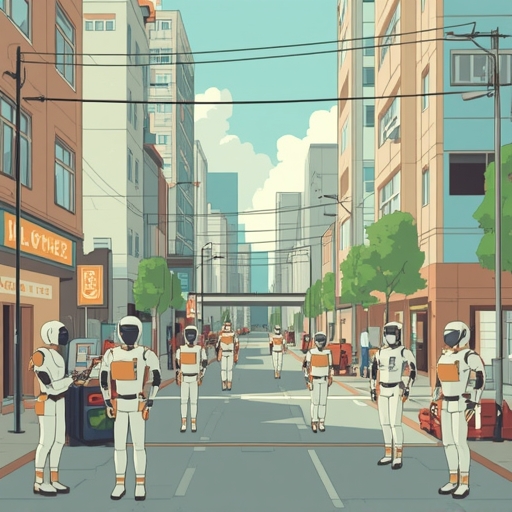
Across Japan, the integration of robotics into the labor force is transforming not only the structure of work but also the national perception of automation itself. Instead of replacing human employees, robots are seamlessly stepping into positions that have become increasingly difficult for companies to fill — tasks that are repetitive, physically demanding, or emotionally taxing, yet essential to the functioning of society. These mechanical coworkers, ranging from warehouse automation systems to empathetic caregiving assistants in senior homes, are quietly reshaping the nation’s approach to labor shortages brought about by demographic decline and changing social expectations.
What distinguishes Japan’s model from the often fear-driven discourse surrounding automation elsewhere is the country’s pragmatic and humane outlook. Robots are viewed not as adversaries threatening employment but as helpful allies, supporting human workers and industries that would otherwise struggle to sustain themselves. By addressing the chronic scarcity of labor in logistics, manufacturing, and caregiving sectors, these innovations are ensuring continuity, stability, and growth. This partnership between artificial intelligence and human skill represents a cultural and technological evolution — a testament to Japan’s ability to harmonize progress with compassion.
The shift from experimental robotics to widespread implementation marks a decisive new phase in Japan’s economic adaptation. Where other nations may still grapple with pilot projects or theoretical prototypes, Japan has moved forward into full-scale adoption. Hospitals, care facilities, and industrial centers are no longer merely testing robotic integration; they are actively relying on it. In warehouses, automated systems enhance safety and precision while freeing humans from monotonous, strenuous labor. In elderly care, assistive androids and AI-powered monitoring tools provide not just mechanical efficiency but also emotional responsiveness, designed to recognize gestures and speech in ways that comfort and reassure patients.
This harmonious collaboration has broader implications. It exemplifies how a society can apply innovation with a clear sense of moral direction: technology becomes a means to reinforce human welfare rather than undermine it. By filling gaps rather than displacing individuals, Japan demonstrates that automation can serve as a stabilizing force in the face of economic and demographic pressures. The lesson emerging from this transformation is both practical and philosophical — progress need not come at the expense of humanity. Instead, it can be cultivated thoughtfully to sustain communities, preserve dignity in work, and redefine the nature of productivity in the twenty-first century.
In essence, Japan’s approach offers a compelling blueprint for the rest of the world. It illuminates a future where humans and machines coexist in a balanced partnership, each complementing the other’s strengths. That vision — pragmatic, compassionate, and forward-looking — suggests that the future of work will not be a competition between man and machine, but a collaboration that reimagines what work can mean when infused with empathy, intelligence, and shared purpose.
Sourse: https://techcrunch.com/2026/04/05/japan-is-proving-experimental-physical-ai-is-ready-for-the-real-world/