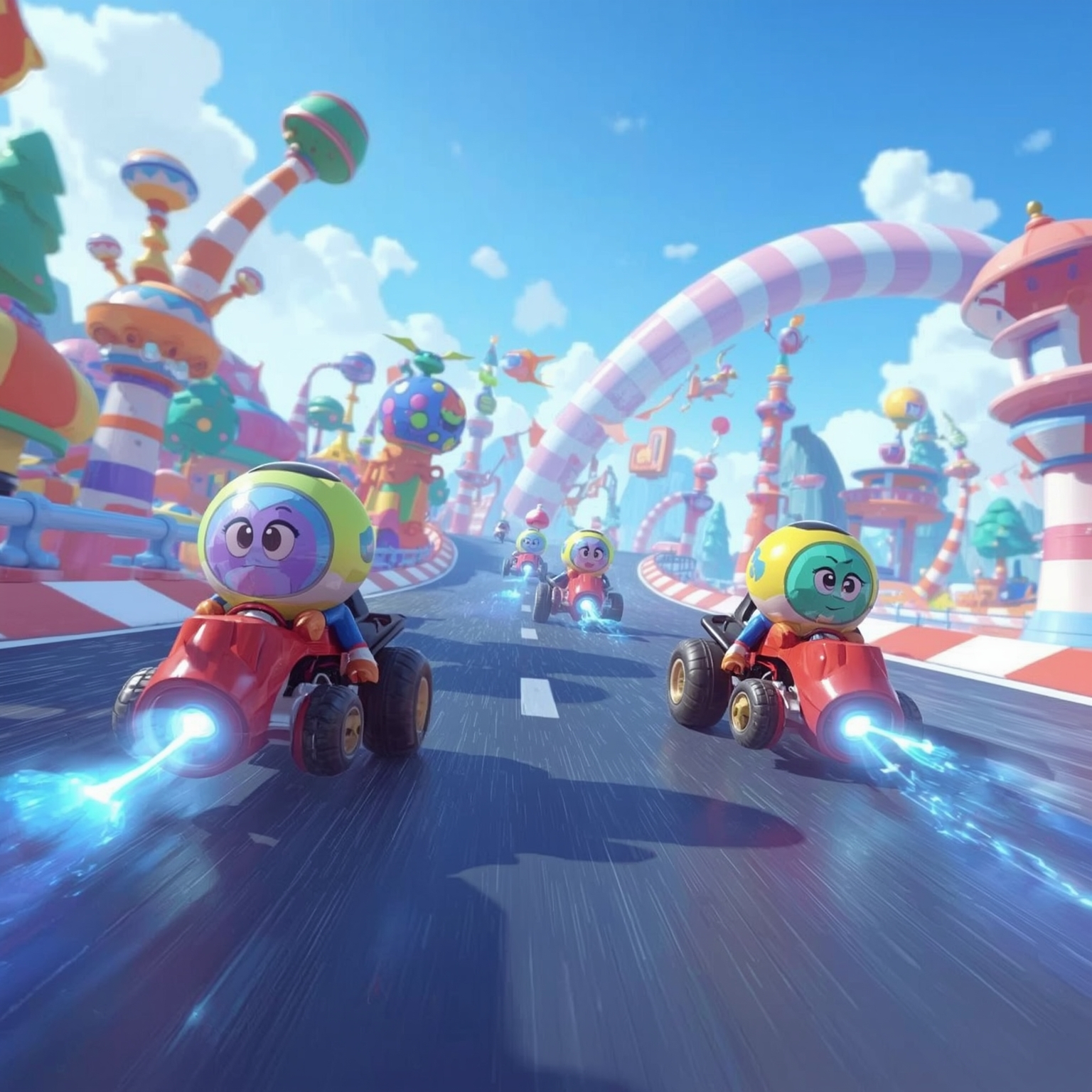
During the most recent Nintendo Direct broadcast, which aired on October 23rd, audiences were treated to an extensive, hour‑long exploration of *Kirby Air Riders*. The presentation not only offered a deep dive into the game’s exhilarating mechanics and newly refined gameplay systems but also concluded with a surprising and welcome announcement regarding accessibility — a topic Nintendo has historically approached with inconsistency. The event was hosted by Masahiro Sakurai, the well‑known and widely respected game director whose attention to design clarity and user experience has long set industry standards. Under his guidance, the Direct showcased a wealth of additional content for this upcoming racing title, revealing new modes, control refinements, and customization tools, all tied to the highly anticipated release of *Kirby Air Riders* for the Switch 2 console on November 20th.
Toward the end of the presentation, Sakurai shifted the spotlight to a subject seldom afforded generous screen time in Nintendo events — the accessibility options built directly into the game. This particular segment, though brief compared to the entirety of the showcase, stood out as a thoughtful and deliberate emphasis on inclusivity in design. It was a reminder that accessibility is not merely a checklist feature but an integral part of how players of diverse abilities can experience the same joy, speed, and vibrancy that define *Kirby Air Riders*. The inclusion of this focus was welcomed by many viewers who have often found Nintendo’s approach to such features to be inconsistent or secondary, although it does not necessarily guarantee that a broad company‑wide transformation is underway.
Within the accessibility suite, Sakurai demonstrated a multifaceted set of tools aimed at tailoring the playing experience to a wide range of needs. These include customizable button remapping — enabling users to rearrange inputs for comfort or necessity — and adjustable text size, a small yet crucial feature given the Switch 2’s compact portable screen when played undocked. To further enhance readability and inclusivity, the menu offers several colorblind filter settings, ensuring that visual cues remain distinguishable across different types of color vision deficiency. Players can also modify the heads‑up display (HUD) through preset adjustments that change its size and opacity, ensuring screen information can either stand out or recede according to preference. An additional toggle allows on‑screen outlines to be turned on or off, though this particular option, intriguingly, was not live‑demonstrated during the Direct. Significantly, unlike in many previous first‑party titles on the platform, control remapping is now conducted entirely within the game itself, freeing players from reliance on the console’s system‑level accessibility menus. More impressively, customized control profiles can be saved under unique names, letting players switch instantly between setups — including configurations designed for one‑handed play.
After delivering this detailed overview, Sakurai drew special attention to one category of accessibility he described as non‑negotiable: motion sickness mitigation. In *Kirby Air Riders*, such protections are approached through multiple layers of customization. Players may introduce adjustable on‑screen markers of varying color and thickness to improve spatial orientation, and they can modify the field of view to decrease the intensity of perceived motion. For those particularly sensitive to visual discomfort, camera shake and tilt can be entirely disabled. Each change can be previewed in real time within the settings menu, providing a practical illustration of how different filters and modes interact. For players who prefer simplicity over fine‑tuning, the accessibility configuration includes presets labeled from “none” to “medium” and “strong,” offering immediate relief levels without demanding granular adjustments.
The visibility of these options constitutes a considerable advantage — both for the broader player base and especially for individuals with disabilities. Equally valuable is the open communication surrounding them prior to the game’s release, allowing players to anticipate whether the title will be comfortably playable for them from day one. Historically, accessibility features of this depth have been scarce within Nintendo’s first‑party catalog, where minimal or system‑level adjustments often stood as the only recourse. That a flagship title aligned with the Switch 2’s launch window is taking a deliberate, multifaceted step toward inclusivity thus represents a notable evolution. Even so, it is prudent to temper optimism, understanding that a single promising example may not automatically herald reform across Nintendo’s development philosophy.
Ideally, the implementation of such measures should serve as an enduring precedent for Nintendo — one that influences not merely the retention of these features in later titles, but the proactive expansion of accessible design principles across all genres. At the same time, observers have noted Sakurai’s unique and clearly personal dedication to making gaming experiences more comfortable for players affected by motion sensitivity and related conditions. Over the past several years, he has publicly acknowledged the importance of addressing motion sickness in interactive media, and recent evidence hints that the innovations in *Kirby Air Riders* may have been driven primarily by his creative leadership rather than by an overarching shift in corporate policy.
The introduction of system‑level accessibility tools in the Switch 2 itself once inspired hope that Nintendo as a company was approaching a new era of user‑centered design. Yet subsequent first‑party titles did not consistently reflect that aspiration, offering few meaningful in‑game accessibility accommodations. This inconsistency became most visible with *Drag x Drive*, a title that features wheelchair basketball yet launched with control schemes paradoxically inaccessible to many of the players it sought to represent. Nintendo’s recommended solution, directing users back to the console’s general system menus, underscored a recurring pattern — an expectation that players themselves should adjust to hardware limitations rather than the other way around.
History likewise cautions against assuming that a single promising release guarantees an industry‑wide revolution. In 2020, *The Last of Us Part II* seemed poised to redefine accessibility standards across major studios. Around that time, Sakurai himself praised the accessibility of *The Last of Us Part I*, noting that he had learned a great deal from its detailed implementations shortly before embarking on development for *Kirby Air Riders*. Yet, in the intervening years, much of the broader gaming industry has since relaxed its emphasis on accessibility, treating what once seemed a new baseline of inclusivity as optional rather than fundamental.
None of this should detract from the immediate sense of accomplishment evident in *Kirby Air Riders*. The care and diligence Sakurai’s team has shown make the project stand out as a rare bright spot — proof that accessibility and creative ambition can coexist naturally in a title designed for enjoyment by all. Nevertheless, amid the well‑deserved enthusiasm, it remains essential to recognize historic precedent: while this may represent a laudable milestone, past patterns suggest that an isolated act of progress does not foretell a sweeping transformation. With measured optimism, we can celebrate *Kirby Air Riders* as both a triumph of considerate design and a hopeful signal, all the while maintaining a realistic perspective on Nintendo’s future trajectory regarding accessibility and inclusion.
Sourse: https://www.theverge.com/games/806242/kirby-air-riders-accessibility-features-nintendo-switch-2


