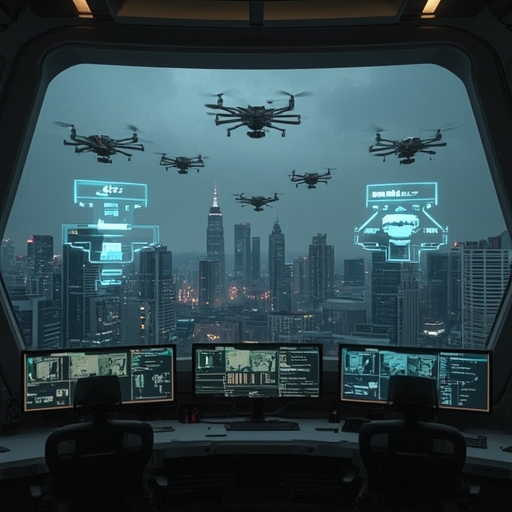
In an era defined by technological transformation and unconventional security challenges, Brigadier General Ross has underlined an urgent truth: small, commercially available drones represent not merely a minor nuisance but what he calls “the defining threat of our time.” These compact and easily deployable aerial systems have fundamentally altered modern defense landscapes, posing risks that range from tactical battlefield disruption to strategic vulnerabilities in national infrastructure. Unlike traditional weapons, their accessibility and adaptability make them especially difficult to predict or neutralize using conventional countermeasures.
General Ross emphasizes that the solution to this growing menace does not lie in a single breakthrough invention or one miraculous piece of equipment. Rather, the path forward demands an advanced and deeply integrated network of complementary technologies and coordinated strategies—a multilayered defense architecture capable of identifying, intercepting, and neutralizing drones across different operational domains. This layered approach functions similarly to a digital ecosystem: each component—sensors, jammers, kinetic interceptors, and artificial‑intelligence‑driven monitoring tools—plays a specialized role while feeding critical data into a shared intelligence framework.
By viewing the drone threat through the lens of systems integration rather than isolated gadgets, military engineers and defense researchers can build adaptive shields that evolve alongside ever‑advancing unmanned aircraft technologies. It is precisely this synthesis of domains—cybersecurity, electronic warfare, air defense, and real‑time communication—that transforms individual tools into a cohesive protective network. Ross’s assessment also reinforces a central doctrine of modern defense innovation: that technology alone cannot ensure security without strategy, policy alignment, and close cooperation among military, industrial, and governmental sectors.
The emerging counter‑drone initiatives in the United States illustrate this principle in action. Their goal is not merely to shoot drones from the sky but to anticipate attack patterns, interpret flight data instantly, and coordinate multi‑layer responses that safeguard everything from troops on the ground to urban communication grids. Such initiatives demand ongoing collaboration between software developers, hardware engineers, and tactical commanders, ensuring that every layer—from command center analysis to front‑line engagement—is both intelligent and responsive.
Ultimately, Ross’s warning carries a message that extends beyond any immediate battlefield: the future of national and global security depends on adaptability, foresight, and unity. Defeating the drone threat requires a culture of continuous innovation—one in which each new challenge gives rise to smarter, more integrated defense solutions that keep pace with the dynamic realities of twenty‑first‑century warfare.
Sourse: https://www.businessinsider.com/no-single-weapon-going-to-defeat-all-drone-threats-commander-2026-1