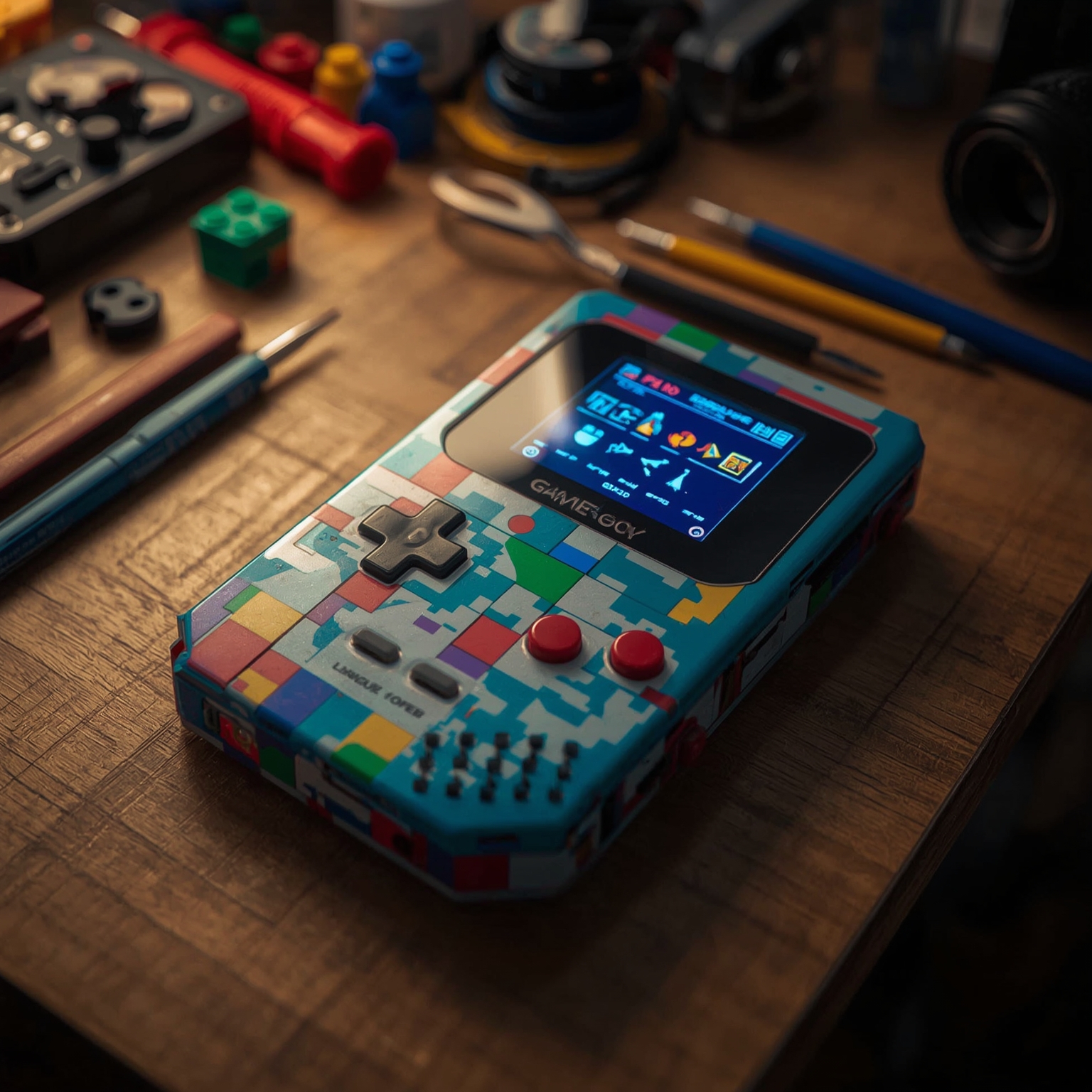
The competition to transform the Lego Game Boy into a functioning device capable of playing genuine Game Boy titles was over almost as soon as it began. On the very day that Lego released its officially licensed set, the inventive creator known online as Natalie the Nerd astonished the DIY community by unveiling her version — a remarkable modification that actually read real Game Boy cartridges and ran them using authentic Game Boy hardware components. In essence, before the public even had time to speculate on whether such a feat could be achieved, Natalie had already demonstrated that it could.
Yet, this initial accomplishment was only the beginning of a much larger and more ambitious project. Unwilling to rest on her early success, Natalie has since devoted herself to the development of comprehensive, user-friendly upgrade kits designed specifically for the Lego Game Boy. These forthcoming kits — which she envisions as complete drop-in solutions requiring absolutely no soldering or advanced technical knowledge — are being organized with assistance from Crowd Supply, a well-known marketplace and logistics partner that supports independent hardware makers. Although Natalie cautions that her creation may not be ideal for extensive, daily gameplay sessions, given the constraints of its Lego-based design, she nevertheless emphasizes that her goal is to make a fully functional and authentic experience possible.
She has named this imaginative project the Build A Boy, an affectionate nod to both its modular Lego roots and its Game Boy inspiration. The top-tier version of her kit will be entirely pre-soldered, making it as close to a “drop-in and play” solution as possible. Within this package will be her own custom-designed circuit board—engineered to house everything necessary to transform the Lego model into a playable device, excluding only the Lego bricks themselves. In keeping with her thoughtful approach, Natalie intends to accommodate users’ preferences in every detail. For instance, she confirmed to The Verge that she plans to offer an optional glass lens for those dissatisfied with Lego’s standard plastic screen cover, allowing builders to enjoy a crisper and more authentic display experience. Furthermore, she is investigating potential methods for adding a video output feature, which would permit gameplay on an external display such as a television or monitor. Although this capability remains experimental and not yet guaranteed, Natalie expressed openness to exploring creative solutions such as wireless video transmission via Wi‑Fi, provided it does not degrade performance.
Regarding the visual display itself, Natalie explains that while the original Game Boy used a distinctive 160 x 144 resolution with a 10:9 aspect ratio, her 320 x 320 panel will preserve the same proportions by simply doubling each dimension. This results in a cleaner, sharper rendition of the classic imagery while maintaining the familiar look and feel of the vintage handheld. Not every feature from the original system, however, will be replicated. Natalie has indicated that she has little interest in implementing the Link Cable port, the original connector that enabled multiplayer functionality between two devices. Nonetheless, she thoughtfully plans to leave behind an accessible pinout connection point on the board for enthusiasts or hardware modders interested in adding that feature independently.
Sourcing original Game Boy components presents its own set of challenges. Natalie reports that she has managed to acquire a supply of damaged Game Boy Pockets—devices she affectionately calls the “unloved sibling” of the Game Boy line—purchasing them in bulk to harvest the necessary chips. Despite this resourcefulness, she anticipates that her stock may be insufficient to meet the high level of interest her project is generating. To accommodate a wider audience, she will also offer alternative versions of her kit, including one that requires only a donor Game Boy Pocket’s CPU and RAM for approximately $60, appealing to those who already possess spare hardware. For experienced tinkerers comfortable with soldering, a fully DIY edition will be made available as well, and true to the open-source spirit of the maker community, Natalie will continue to release all design files publicly at no cost.
Determining the final retail price for the plug‑and‑play model remains a complex matter, particularly due to the fluctuating effects of international trade tariffs. Natalie hopes to offer the complete kit for around $99 USD, though she acknowledges that global economic conditions could influence that target. Her tentative schedule points toward an early 2026 release, with the first prototype circuit boards expected to arrive imminently for testing and refinement.
It should be noted that Natalie’s Build A Boy project is not the only attempt to bring a functional Lego Game Boy to life. Several other inventors and modders within the retro gaming scene are exploring similar ideas, each employing their own unique approach. One notable example is Hairo Satoh, who has gained attention on Instagram for his compact and elegant Game Boy Color variant constructed within a Lego shell. Like Natalie’s build, his version is compatible with authentic Game Boy cartridges, though he notes that achieving this required significant alterations to Lego’s structural design. Satoh does not currently plan to release a standardized kit but occasionally produces individual commissions for collectors and enthusiasts.
Meanwhile, an alternative project called the BrickBoy kit is emerging as a potentially more accessible and environmentally sustainable route for those who wish to power their Lego Game Boy models. Unlike Natalie’s hardware-driven system, the BrickBoy relies on software emulation to play ROMs rather than physical cartridges, meaning it reproduces the Game Boy experience without requiring the disassembly of any vintage consoles. Although details regarding the final pricing have yet to be disclosed, this kit is expected to debut through a Kickstarter campaign on October 28th. Altogether, these diverse ventures illustrate the continued vitality of retro gaming culture, in which creativity, nostalgia, and engineering enthusiasm converge to transform childhood icons into functional technological marvels.
Sourse: https://www.theverge.com/games/805673/nintendos-chips-make-this-lego-game-boy-upgrade-kit-the-most-authentic