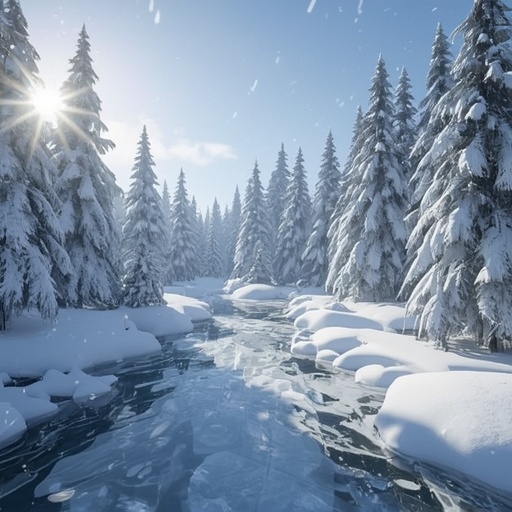
While water effects have traditionally dominated discussions of graphical realism in video games—with shimmering reflections, rippling surfaces, and fluid simulations often serving as technical benchmarks—a quieter revolution has been unfolding in the world of digital snow. In recent years, the meticulous rendering of ice, frost, and snowfall has become a new measure of visual sophistication, reshaping both the artistic and technical landscape of modern game development.
Developers now use snow not merely as decoration but as a dynamic element that interacts with characters and the environment in astonishingly believable ways. Imagine a player trudging through deep drifts, each step compressing layers of powder that shift, compact, and glisten under changing light. The footprints left behind remain as tactile evidence of movement, subtly deforming over time as wind sweeps across the terrain. This level of responsiveness requires a finely tuned blend of particle physics, procedural rendering, and material-based lighting—each component calibrated to create an illusion that feels almost tangible.
From the soft sparkle of untouched snowfields under early morning light to the wet sheen of melting ice after a storm, these details work together to evoke the sharp beauty and fragility of winter. Snow also provides an opportunity for artistic storytelling. Developers can use its texture, depth, and translucency to reflect tone and atmosphere: bright crystalline expanses can evoke tranquility or isolation, while darker storms laden with heavy flakes might heighten tension or drama in gameplay.
Moreover, snow demonstrates how far real-time rendering technologies have advanced. Engines that once strained to simulate convincing water surfaces now manage complex subsurface scattering—the subtle lighting behavior that makes snow appear both dense and luminescent. This evolution reflects a broader shift in priorities, where environmental nuance and sensory immersion are valued as highly as spectacle.
In this emerging era, snow is not just another visual challenge—it is a narrative and emotional tool. Whether powder falling gently from a digital sky or frost accumulating on a windowpane during gameplay, each flake contributes to an enveloping sense of place. Through careful physics modeling, sophisticated shaders, and artistic intention, developers have transformed something as fleeting as snow into one of the most powerful symbols of realism in interactive art. ❄️🎮
Sourse: https://www.theverge.com/entertainment/926911/snow-video-games-moomins-froggy


