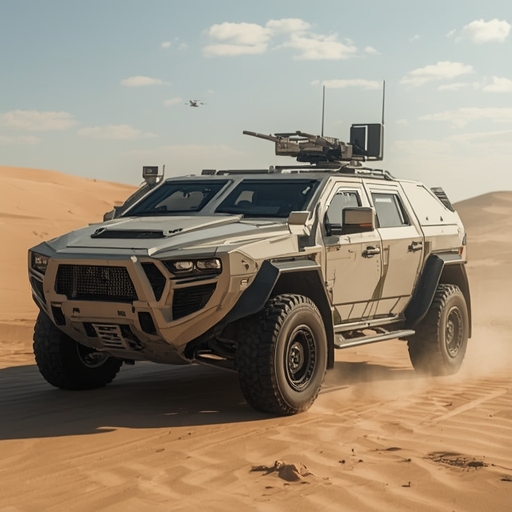
The United States Marine Corps has unveiled a cutting-edge air defense system engineered to revolutionize how light tactical vehicles operate on the modern battlefield, transforming them from simple transports into highly mobile weapon platforms capable of downing hostile drones and manned aircraft alike. This new system is not merely an incremental upgrade—it is a fundamental shift in how Marines can intercept and neutralize airborne threats in real time. According to the Marine Corps, the technology provides a modernized means for units to defend themselves and their allies from a growing spectrum of aerial dangers, an imperative that has become abundantly clear as contemporary conflicts, notably the war in Ukraine, demonstrate how decisive control of the airspace can determine battlefield outcomes.
This innovative capability, known as the Marine Air Defense Integration System—or MADIS—officially entered full-scale production earlier this fall, following extensive rounds of testing, including comprehensive training exercises and live-fire demonstrations. The system is mounted atop a pair of Joint Light Tactical Vehicles (JLTVs), converting these agile armored trucks into an integrated, short-range, ground-based air defense platform. Each vehicle fulfills a specialized role: one is optimized for detecting, tracking, and neutralizing smaller, agile aerial targets such as drones, while the other is configured to engage larger threats, including helicopters and fixed-wing aircraft. Working in tandem, the vehicles function as a cohesive combat network, combining their sensor suites, radar arrays, and electronic warfare systems to create a layered defense shield. This synergy enables Marines to engage targets with a range of weaponry that includes the highly reliable Stinger missile system and a formidable 30mm automated cannon.
The MADIS program provides an enormous leap beyond the Marine Corps’ previous Man-Portable Air Defense System, or MANPAD, which required personnel to dismount from vehicles and operate weapons independently, thereby exposing themselves to increased vulnerability. MADIS, on the other hand, allows for seamless operation on the move, preserving mobility and protection while enhancing overall readiness. Beyond immediate performance gains, the system’s architecture has been purposefully designed for scalability and future upgrades, ensuring that as technology evolves and adversaries develop new tactics or aerial platforms, the system can be adapted accordingly—whether through advanced software, new sensors, or updated munitions.
Developed by the Norwegian defense contractor Kongsberg Defense & Aerospace, MADIS has undergone a series of iterations since its earliest prototype. With each refinment, developers have enhanced its algorithms, sensor precision, and vehicle mobility to improve both target acquisition speed and engagement accuracy. The Marine Corps reports that in its final production form, MADIS allows Marines to not only detect and track enemy aircraft more rapidly but also to do so with an accuracy that significantly reduces response time. Its first live-fire validation occurred during joint military exercises between U.S. and Philippine forces earlier this year, where the system demonstrated its operational maturity under realistic conditions. Following these trials, engineers implemented additional upgrades drawn from lessons learned in field testing, refining how MADIS integrates with other Marine Corps assets and command networks.
Officials within the Marine Corps emphasize that this system fills a long-recognized gap within their air defense arsenal. What makes MADIS truly distinctive, they note, is its ability to execute the complete kill chain within a single framework—from detection and identification to engagement and destruction of aerial threats. In contrast, legacy systems often required multiple components or units to collaborate to achieve a similar result. The integration of radar, electro-optical sensors, and electronic warfare capabilities into one mobile defense node marks a significant evolution toward self-contained, autonomous battlefield systems capable of independent operation in dispersed environments.
Just as importantly, MADIS directly addresses the Marine Corps’ persistent concern about how best to counter small uncrewed aerial systems (sUAS), which are increasingly employed by both state and non-state actors for reconnaissance and attack. As potential future conflicts loom—particularly in theaters where U.S. forces might face technologically advanced adversaries such as China—the mobile and adaptable nature of MADIS becomes paramount. It offers forward-deployed Marines an agile shield against drones and aircraft that could otherwise threaten their positions or disrupt operations. In reimagining its force structure for operations across the first island chain spanning Japan, Taiwan, and the Philippines, the Marine Corps recognizes that future success will depend heavily on the ability to field systems that can move fluidly across dispersed environments while maintaining lethal effectiveness. MADIS embodies that doctrine: a fusion of mobility, precision, and adaptability designed to protect Marine units and extend their fighting reach in the ever-changing battlespace of modern warfare.
Sourse: https://www.businessinsider.com/new-marine-tech-turn-light-vehicles-into-drone-aircraft-killers-2025-12