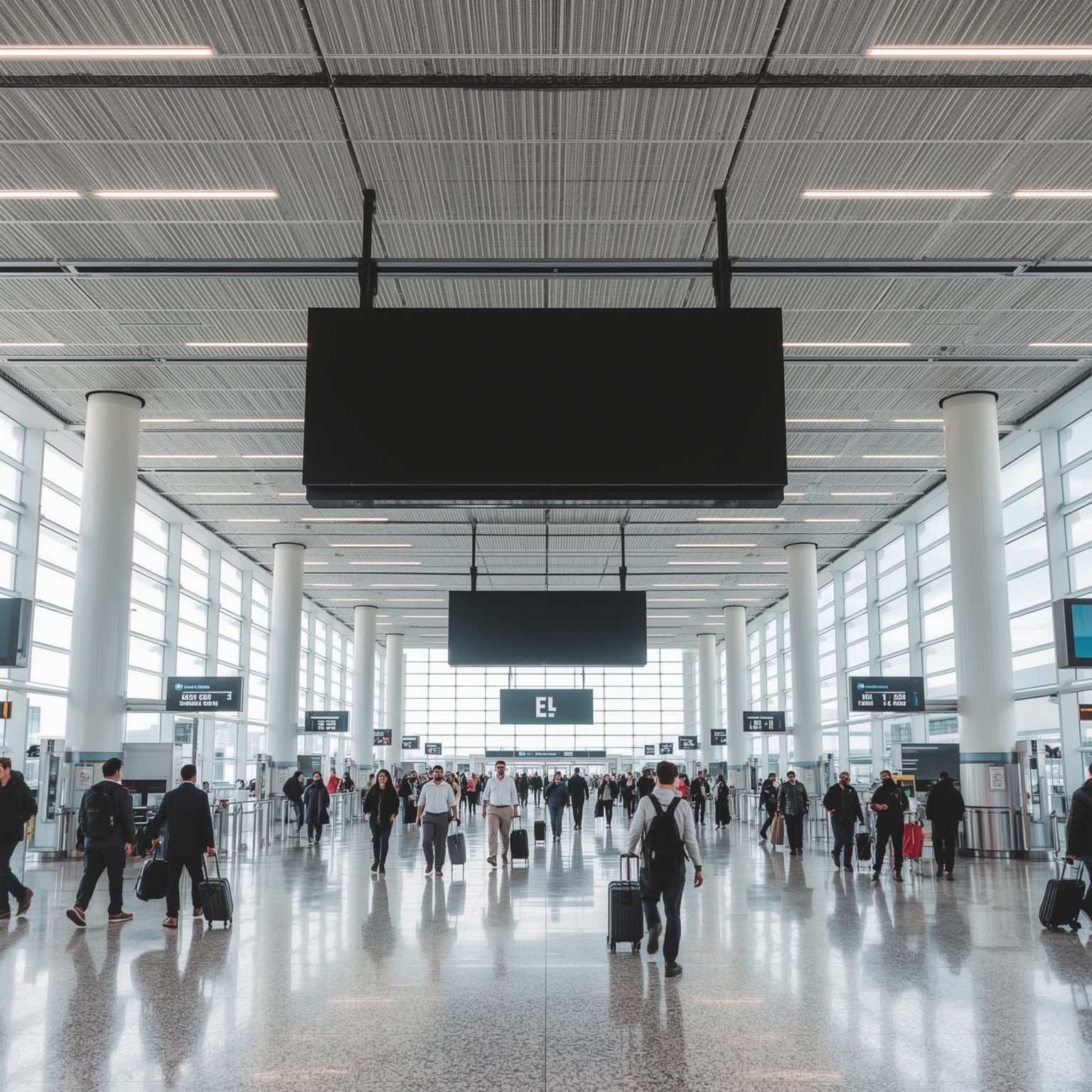
Across the United States, airports—institutions typically associated with the neutrality and efficiency of public transportation rather than partisan politics—are increasingly finding themselves drawn into the turbulent political controversy surrounding the federal government shutdown. The dispute has taken an unexpected turn as several major airports have rejected official requests to broadcast a video message recorded by Kristi Noem, the Secretary of Homeland Security. This message, which Fox News reported was intended to appear on screens at every public airport in America, quickly became a flashpoint in the broader debate over the ethics of political communication in publicly funded spaces.
According to the report, Noem’s video sought to explain how the ongoing shutdown was affecting the Transportation Security Administration (TSA). She asserted that TSA operations had been significantly disrupted and emphasized that most employees were continuing to work without pay. The Secretary attributed this situation to what she described as the refusal of congressional Democrats to agree to a federal funding measure, implying that their political stance had directly caused the closure of the government. Noem’s statement concluded with an expression of hope that Democratic lawmakers would soon come to recognize the necessity of reopening federal agencies to restore normal governmental function and stability.
However, airport authorities in several prominent U.S. cities–including Portland, Seattle, New York, Boston, Phoenix, and Charlotte–told Business Insider that they had chosen not to air the message. Their reasoning varied in wording but converged around a central concern: that the video carried overt political content and therefore conflicted with both federal and state limitations on the use of public resources for partisan advocacy.
In Portland, a spokesperson for the Port of Portland, which supervises operations at Portland International Airport, confirmed that the airport had indeed received a formal request from the TSA to display the recording. Nonetheless, after reviewing the request, the Port declined to grant permission. Officials cited the 1939 Hatch Act—a longstanding federal statute restricting political activity by government employees—as a key factor guiding their decision. The spokesperson underscored that, under this act, public assets such as airports must remain nonpartisan zones to preserve the integrity of federal programs. Additionally, Oregon state law, which strictly prohibits public employees from promoting or opposing political parties, reinforced their judgment that broadcasting the video would be a legal and ethical violation.
Similarly, the Port of Seattle, which manages the busy Seattle–Tacoma International Airport, explained that the refusal stemmed from concerns that the video’s tone and message were political in nature. While choosing neutrality, the Port also highlighted its ongoing humanitarian efforts to assist TSA personnel burdened by unpaid work during the shutdown, and called for renewed bipartisan collaboration in Congress to resolve the impasse.
Comparable determinations were made at other major transportation hubs. Representatives from the Phoenix Sky Harbor International Airport and New York’s Niagara Falls Frontier Transportation Authority both clarified that their internal policies explicitly bar the display of politically charged material on airport-controlled screens or properties. In Westchester County, New York, Democratic County Executive Ken Jenkins went further, stating that the video’s appearance in the airport would be “inappropriate, unacceptable, and inconsistent with the values expected from national public officials,” thereby framing the decision as both a legal and moral stance on governmental decorum.
Even beyond the question of political propriety, a number of large airports pointed to logistical and infrastructural reasons for their inability to comply with the TSA’s request. For instance, Charlotte Douglas International Airport, one of the nation’s busiest, explained that TSA has no dedicated monitors at its security checkpoints that could be used to display such a message. The airport further noted that its limited digital signage is already reserved for essential travel updates and commercial advertising—both of which generate revenue necessary for airport operations. In addition, North Carolina’s municipal regulations, along with Charlotte Douglas Airport’s internal policies, expressly forbid the dissemination of content with partisan implications.
At Boston’s Logan International Airport, overseen by the Massachusetts Port Authority (Massport), officials emphasized that not only were they not airing the DHS video, but they also had not received any official communication requesting them to do so. They pointed out a simple logistical barrier as well: TSA checkpoints at Logan do not include any video display systems, rendering the broadcast proposal impractical even if approval had been granted.
Responding to the growing controversy, Tricia McLaughlin, the Department of Homeland Security’s Assistant Secretary for Public Affairs, issued a statement defending the department’s intentions. McLaughlin insisted that TSA’s foremost priority remains ensuring that travelers enjoy a safe, efficient, and well-managed airport experience despite the extraordinary challenges imposed by the government shutdown. She also reiterated Noem’s claim that Democrats in Congress bore responsibility for the prolonged closure, accusing them of engaging in political gamesmanship at the expense of federal employees and the traveling public.
Democratic leaders, for their part, refuted those claims, arguing that the administration and its Republican allies were to blame for the ongoing crisis. Senate Minority Leader Chuck Schumer described the situation as an act of “deliberate chaos,” criticizing the majority party for what he viewed as an intentional and callous disregard for the livelihoods of federal workers and citizens dependent on government services.
As the shutdown approached its two-week mark, the debate over responsibility and messaging had expanded far beyond Capitol Hill, intruding into public spaces such as airports that traditionally serve as symbols of nationwide connectivity and nonpartisan purpose. The refusal of these airports to air the DHS video represents more than a technical policy choice: it underscores a broader national conversation about the boundaries between governance, political communication, and the ethical stewardship of public environments.
Sourse: https://www.businessinsider.com/airports-refuse-tsa-kristi-noem-video-blaming-democrats-for-shutdown-2025-10