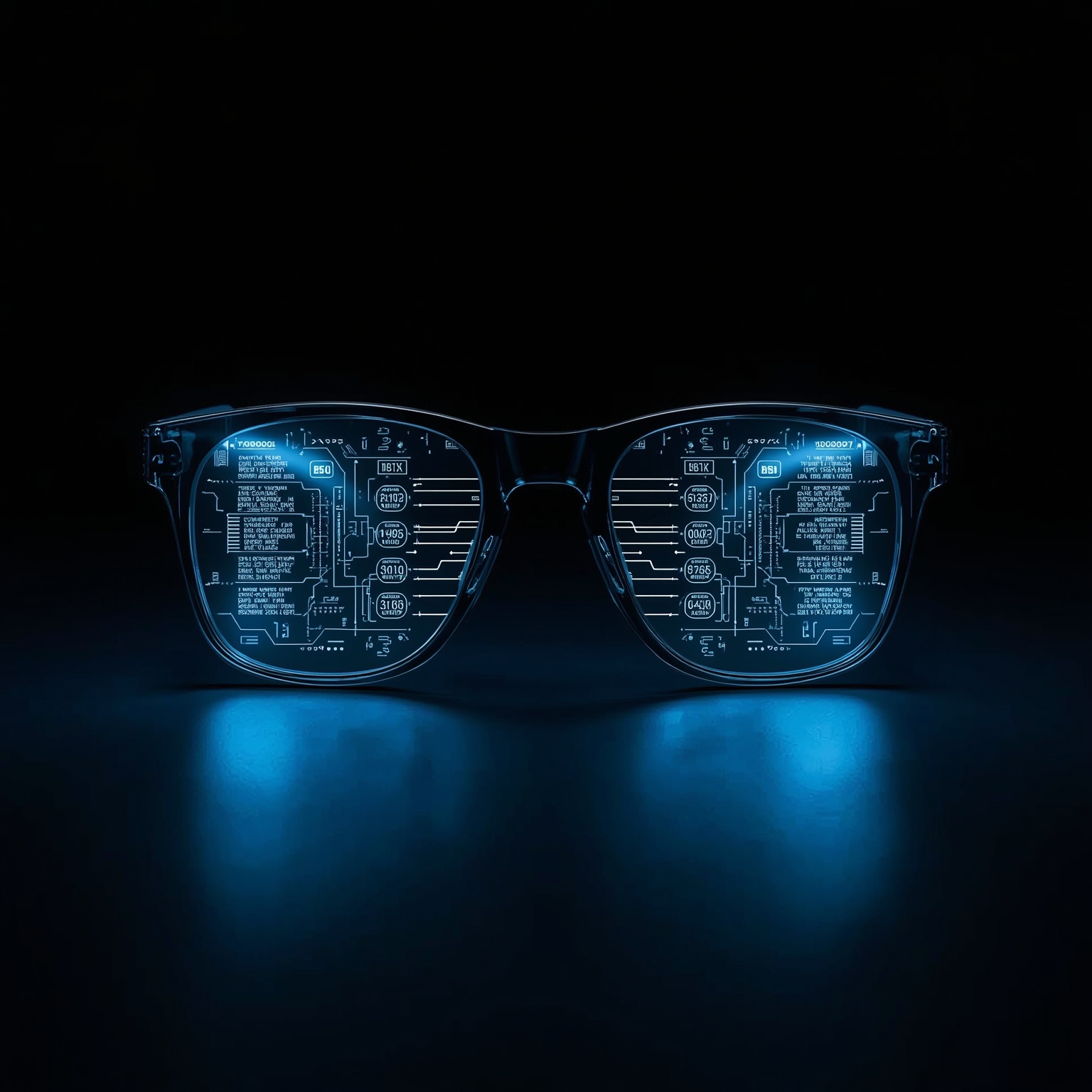
The moment I first slipped on Meta’s $800 Ray-Ban Display glasses, an undeniable surge of excitement coursed through me — that unique mixture of curiosity and wonder that arises whenever technology seems to leap ahead of our expectations. At first glance, having yet another glowing screen embedded so intimately into one’s daily life may appear unnecessarily indulgent, even excessive. Yet, the sensation of literally wearing a high-definition display inches from your eyes triggers an almost childlike astonishment. The ordinary transition from being just another person who happens to wear glasses suddenly feels like a metamorphosis into something far more dynamic — a hybrid of spy, cyborg, and dreamer. For those who appreciate the cybernetic allure captured in works like *Ghost in the Shell*, this transformation feels both uncanny and exhilarating.
When I first tried on these advanced spectacles at Meta Connect, a grin spread across my face as if completing a long-sought puzzle. This was the missing piece that earlier Ray-Ban smart glasses failed to deliver: a radiant, full-color display that didn’t simply augment your vision but expanded it. People had always asked me about the previous, screenless models with somewhat deflated curiosity, hinting that perhaps they lacked the real magic. Well, the “magic” has now arrived — and it is impossible to ignore. The sense of wonder only intensifies once you pair the glasses with Meta’s Neural Band, a deceptively small wrist accessory that can interpret the faint electrical currents running through your arm. Through subtle pinches of your fingers or a swipe of your thumb, you control digital elements projected before your eyes, turning human gestures into a seamless dialogue with technology.
Meta’s Ray-Ban Display hardware manages to feel simultaneously futuristic and polished, although its immense potential remains constrained by a dearth of apps. The few available features — navigation, notifications, and integrated messaging — are competent, even enjoyable, while the Neural Band performs its invisible wizardry with surprising responsiveness. The battery life holds its own, maintaining several hours of intermittent use without complaint. Yet inevitable drawbacks surface: an unenhanced camera, the mild discomfort of the wristband during long wear, and the omnipresent specter of privacy concerns. The result is both thrilling and existentially draining — technology that delights even as it unsettles.
The experience evokes a sensation similar to my first encounter with Apple’s Vision Pro. Both devices conjure that same spell-like magic, letting you manipulate digital content through mere gestures. It’s as if you’ve become a modern-day sorcerer, bending unseen circuits to your will with a flick of your hand. In that moment, I was reminded of a childhood memory: guiding my grandmother’s tentative hand across a computer mouse for the first time. Watching her discover that movement on a desk could command a luminous world on a screen felt like sorcery back then. Now, decades later, I realize that feeling never truly fades. Whether it’s moving a cursor or summoning apps in midair, the convergence of human action and digital response remains as intoxicating as ever.
And so, excitement became my first true reaction — genuine, immediate, and emotional. Yet, as the novelty began to settle, another question emerged: would this excitement endure?
Those unfamiliar with the glasses naturally wonder first how they look when worn. Their design integrates a 600 x 600-pixel full-color display running up to 90Hz in a discreet corner of the right lens. This specific placement ensures your central vision remains unblocked during everyday movement. However, glancing at the display necessitates a subtle downward eye shift that can make you appear anxious or distracted — a “resting Meta face” that might seem peculiar to outside observers. Despite this, the engineering choice is practical: the gaze remains clear, and the risk of bumping into obstacles — or pets — stays minimal.
Brightness, measured at a staggering 5,000 nits, makes the imagery vivid even under harsh sunlight, a crucial factor for real-world usability. All models come equipped with transition lenses that adapt to lighting conditions, granting visibility indoors and out. For wearers who require corrective lenses, prescription options exist, though the display’s clarity can vary by individual. Some users find the image crisp and steady; others detect subtle wobbling or visual fatigue. This variance likely stems from each person’s unique ocular physiology.
The underlying display system relies on geometric waveguides, using carefully arranged mirrors to eliminate distracting light splits that plague other optical engines. This design not only improves brightness uniformity but also conceals the screen from external view, adding a layer of privacy to what you’re observing. The mirrored interior, however, can sometimes cause stray reflections or glimpses of your own surroundings, resulting in minor disorientation. The visual fidelity overall feels adequate — not the world’s sharpest projection, but brilliant enough to convey the intended illusion of augmented presence.
Handling and interaction rely primarily on the Neural Band, one of the most intriguing aspects of Meta’s ecosystem. Wearing it feels like slipping into an entirely new interface philosophy — one where muscle movement translates into silent conversation with your device. Controlled gestures include finger pinches for selections and directional thumb swipes for browsing menus. A slight buzz confirms every successful command, a tactile whisper that assures you the system has understood. The Neural Band, composed of durable Vectran fabric fitted with EMG sensors, endures a full day of intermittent use but may press into the wrist enough to leave temporary impressions on the skin. Though remarkable, it doesn’t yet feel like the final frontier in human-device input; future iterations will likely integrate motion and eye-tracking to render such wearables unnecessary.
More practically, messaging and notification management remain foundational to Meta’s approach. Messages from WhatsApp, Messenger, or Instagram instantly appear within your peripheral vision, and you can answer them using voice dictation or quick gestures. Being able to spot an incoming notification without reaching for a phone creates a sense of frictionless communication that genuinely feels like the future in miniature. Video calling, by contrast, seems underdeveloped — limited by low-resolution output and the logistics of a camera facing outward rather than at your own face. Navigation, still technically in beta, performs well enough to guide you through city streets with turn-by-turn instructions floating just beyond your sightline. Features like live captions and instant translation bring functional accessibility improvements, even if their accuracy occasionally wavers.
Where the glasses fall short is not in potential but in the boundaries Meta currently imposes. The absence of an app ecosystem dramatically curtails experimentation. Beyond the built-in utilities, you cannot download your preferred email client, productivity suite, or even a scrolling feed to occupy downtime. At $800, that limitation feels restrictive — a constant reminder that this future remains under construction.
Physically, the glasses are slightly heavier and thicker than earlier iterations, but still retain a refined Ray-Ban aesthetic thanks to EssilorLuxottica’s craftsmanship. Available in limited colorways — glossy black or sand — they flaunt a contemporary look while maintaining optical comfort. Prolonged wear, however, accentuates their heft compared with ordinary eyewear. Battery life, impressive for such a power-hungry device, extends most of a workday under moderate use, and the portable case doubles efficiently as a charging dock capable of recharging several times before needing a plug.
Camera performance unfortunately remains stagnant, relying on a 12-megapixel sensor inherited from previous models. Photos and videos render adequately but fail to justify the price point for imaging enthusiasts. A minor innovation allows users to preview shots directly through the lens display and zoom with a subtle twist of the wrist, which feels almost cinematic in execution but doesn’t mask the fundamental mediocrity of the image quality.
Meta AI, meanwhile, continues to operate as a solid yet sometimes inconsistent assistant. Voice commands handle basic tasks like capturing photos, opening music apps, or reading messages, but anything more intricate — recognizing objects or identifying surroundings — exposes the limits of Meta’s current models. While speech interaction remains efficient, the overall AI presence feels more companionable than indispensable.
All these technical achievements provoke deeper philosophical reflections. Wearing a screen mere centimeters from your eyes shifts both behavior and perception. Notifications become impossible to ignore, and your daily awareness risks constant fragmentation. There’s an undeniable seduction in wielding so much information so effortlessly, yet also a creeping discomfort in the realization that you’re never fully offline. The wonder of technological empowerment collides with anxiety about surveillance, distraction, and social perception. Are you a pioneer of wearable computing, or simply another participant in the spectacle of perpetual connectivity?
Ultimately, the Meta Ray-Ban Display represents a daring stride toward blending the digital and physical worlds, merging surveillance, convenience, and aspiration into one sleek artifact. Whether this evolution heralds liberation or dependence remains an open question. The device stands as both triumph and warning — a glimpse into a reality where our screens no longer live in our hands but upon our very faces. The question, then, isn’t whether smart glasses are impressive — they are. The true question is whether we’re ready to live with their consequences: a world where the line between augmented experience and intrusive technology grows thinner than glass itself.
Sourse: https://gizmodo.com/meta-ray-ban-display-smart-glasses-review-is-this-the-future-we-really-want-2000679520


