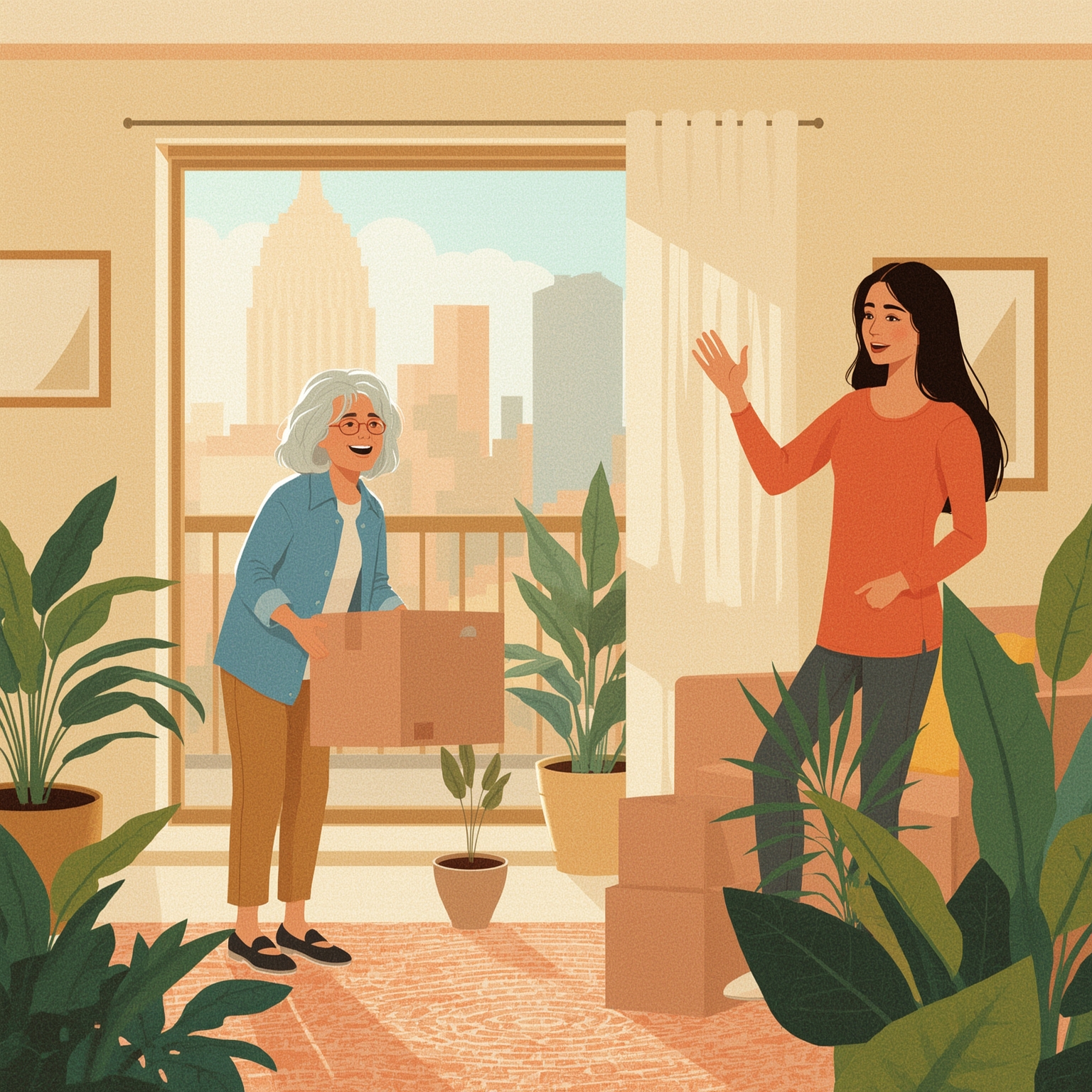
When my mother, whose personality has always been marked by daring independence and a free-spirited zest for life, entered her mid-seventies, she came to the difficult realization that continuing to live alone in her Florida home had become both financially burdensome and physically exhausting. Though my sister resided in a nearby town, her days were consumed by the responsibilities of raising a large family, preventing her from offering the level of daily companionship and assistance our mother increasingly needed. Recognizing this, I gently extended an offer filled with affection and optimism: ‘Come live with us, Mom. You’ll find rest, warmth, and tranquility here.’ Encouraged by that invitation, she decided in 2020—at the age of seventy-six—to uproot her life once again, leaving behind the familiar palm-lined streets of Florida to move into my home nestled amid the quiet countryside of upstate New York. She arrived accompanied by her two loyal dogs and a small collection of cherished mementos, carrying with her the hopeful intention of spending her later years surrounded by my two youngest daughters and me. Given our long-standing closeness and easy rapport, we were certain that this arrangement would solve everyone’s needs perfectly.
At first, her presence was a source of joy and renewal. After decades of living far apart, we relished the chance to share daily life again. The move felt like a homecoming, a reconnection after long separation. My mother had relocated from New York to Florida more than thirty years earlier, and over the decades her adventures had taken her even farther—she had once lived alone in the Dominican Republic and later in Costa Rica during her sixties, driven by her irrepressible appetite for novelty and exploration. By contrast, I have always been more rooted, the sort of person who feels a flicker of anxiety even when navigating the unfamiliar aisles of a new grocery store. In hindsight, we should have anticipated that such opposite temperaments might eventually clash. Although we shared many interests—our mutual love of creating and nurturing things, our appreciation for long, quiet hours immersed in reading, and our complementary culinary passions (she loved to cook, while I found fulfillment in baking)—decades of living in separate states had, in effect, glossed over the deep differences in our temperaments and rhythms.
These distinctions revealed themselves gradually but unmistakably. My mother, ever gregarious, thrived on social connection, surrounded herself with friends, and drew energy from the bustle of lively conversation. I, on the other hand, have always been her inverse—a solitary soul by nature. I live single and content in an isolated home tucked deep within the woods, work remotely for long stretches each day, and count only a very small circle of close friends. Together, we made efforts to share experiences beyond our walls. We would stroll through the local farmers market, have leisurely lunches at nearby cafés, spend hours exploring thrift shops, and, during warm summer weekends, sell handmade goods at a picturesque lavender farm. My mother’s charitable heart led her to craft knitted and hand-sewn cat toys, donating the proceeds to support the care of local feral cats. Yet despite these bright interludes, my demanding work schedule and the constant needs of my daughters often kept me home-bound. Slowly, a sense of restlessness began to stir in my mother.
It dawned on her, with a mix of humor and disappointment, that her daughter’s quiet life was simply far too subdued for her own exuberant spirit. She had spent a lifetime commanding her world with the confidence and vigor of a modern Wonder Woman, and now found herself, after a long, snow-laden winter, feeling more like a butler in someone else’s story—a spectator rather than the protagonist in her own. Although she rekindled a few friendships from her earlier years living in New York, the social energy here never came close to the lively community she had cherished in Florida. Nonetheless, she made the best of her days, indulging in small but genuine pleasures: the rhythmic act of knitting, the comforting rituals of cooking, the fascination of historical documentaries, and weekly shopping excursions with a close friend. She even found unexpected delights—the sound of my daughters singing as they dressed for school, the changing patterns of geese flying overhead, the shared laughter while watching her beloved ‘Golden Girls’ on TV. Yet, as the months went by, a quiet awareness settled in. When the most exciting part of her day became counting the species of birds visiting her feeder, she began to sense that life had grown too still, too diminished.
After two years, my mother accepted what her restless heart had been whispering: she was lonely, under-stimulated, and no longer content. The life she had created for herself here—though filled with family and love—had grown too small and quiet to satisfy the woman she truly was. One day, looking around her cozy yet confining new reality, she recognized, almost with alarm, that she had begun to feel old, something she had defiantly resisted her entire life. My fiercely independent mother could not tolerate that sensation of limitation. And so, with the same determination that had propelled her through countless past adventures, she made the decision to return to Florida, reclaiming her autonomy and vitality once more.
Now eighty-one, she lives contentedly in a modest mobile home situated on my sister’s property, a place where freedom and support coexist in perfect balance. There she thrives again—surrounded by her beloved friends, engaged in pet-sitting and creating art, tending to her dogs and her small flock of chickens. She has discovered the equilibrium that suits her best: she no longer desires the burdens of full homeownership or the endless responsibilities of maintaining a large property, but she deeply values living independently, with companionship close enough for comfort yet far enough to preserve her cherished solitude. My mother often says she will accept the natural passage of time and the inevitability of aging, but that one fate remains utterly unacceptable to her—she refuses, under any circumstances, to die of boredom.
Sourse: https://www.businessinsider.com/mom-lived-with-me-new-york-moved-back-florida-2025-10