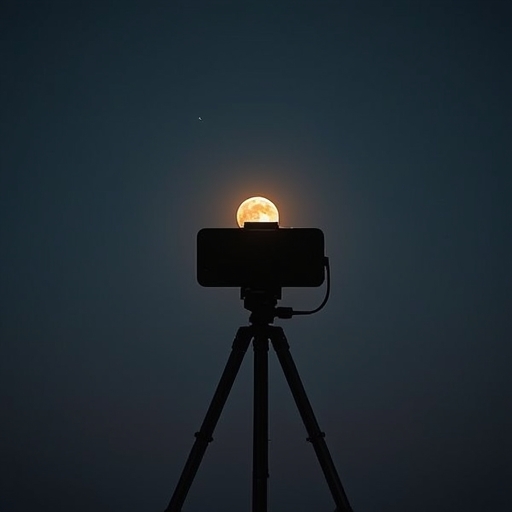
NASA has recently unveiled a remarkably inventive and scientifically grounded method that demonstrates how even the most casual iPhone user can capture an extraordinary photograph of the Moon. For years, countless mobile photographers have aimed their smartphone cameras skyward in pursuit of that elusive, perfectly detailed lunar image—one that conveys both clarity and atmosphere without the need for professional telescopic equipment. This pursuit, equal parts art and science, has captivated enthusiasts who crave to merge technology, creativity, and curiosity in a single shot.
What makes NASA’s approach so compelling is its elegant simplicity grounded in the principles of optics and light control. The technique emphasizes precise adjustment of the iPhone’s exposure settings, ensuring that the brilliant luminosity of the Moon does not overwhelm the sensor and wash out its surface details. By manually lowering exposure and stabilizing the device—preferably with a tripod or propping it firmly against a solid surface—users can vastly enhance sharpness and definition. When paired with the phone’s night or astrophotography mode, these deliberate adjustments result in a photograph that preserves the Moon’s nuanced textures: the cratered topography, the dimly shaded maria, and the glowing white brilliance that defines its perimeter.
NASA’s guidance cleverly transforms a handheld device, something nearly everyone carries daily, into a miniature astronomical instrument. What once required costly lenses and complex cameras can now be achieved through scientific insight combined with the computational power embedded in modern smartphones. The underlying message is far broader than photography alone—it reflects the way technology democratizes exploration. By applying a few thoughtful tweaks and understanding light as a measurable, controllable phenomenon, anyone can experience the deep satisfaction of engaging directly with the cosmos.
For amateur stargazers, this discovery opens a gateway to a more intimate relationship with the night sky. The Moon, which often appears as an unreachable celestial constant, suddenly becomes attainable, framed elegantly within the rectangle of a screen. It serves as a vivid reminder that science need not remain confined to laboratories or observatories; rather, it thrives wherever curiosity lives. In this deceptively simple act of photographing the Moon, innovation meets imagination, and the boundaries between professional expertise and everyday wonder blur beautifully.
In essence, NASA’s iPhone Moon hack encapsulates the spirit of accessible discovery. It exemplifies how a marriage of scientific understanding and technological creativity can transform ordinary tools into portals of exploration. With a steady hand, a patient mind, and the willingness to experiment, anyone can bring a fragment of the universe closer—illuminating not only the Moon itself but also our innate drive to look upward and ask, “what if?”
Sourse: https://gizmodo.com/someone-finally-took-a-good-iphone-photo-of-the-moon-good-luck-copying-their-trick-2000743218