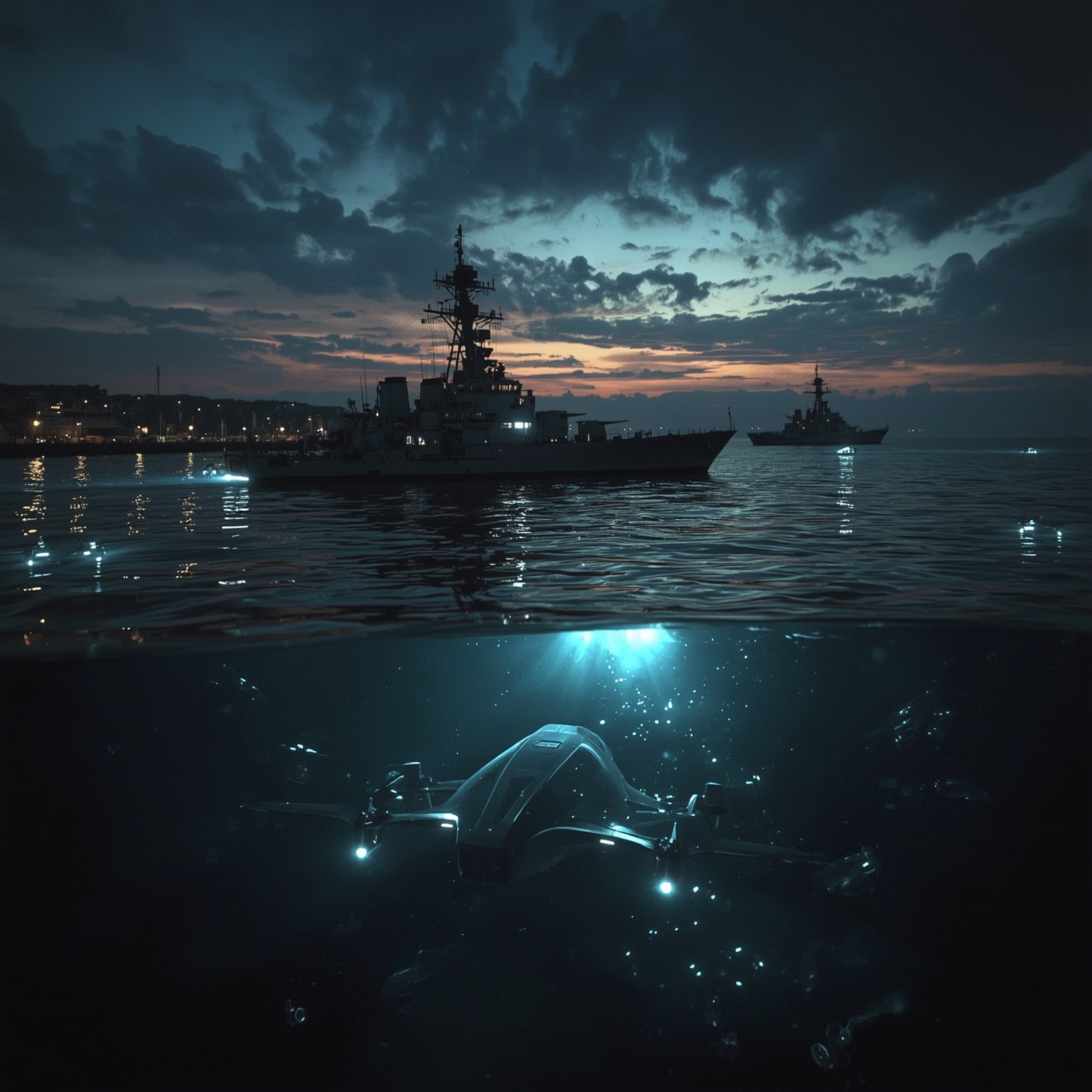
According to leading specialists in defense strategy and modern warfare, contemporary naval forces are confronting a peril that is at once familiar and yet alarmingly transformed. The rise of low-cost sea drones, engineered with the capacity to damage or even sink large vessels, has unlocked the possibility for adversaries to orchestrate long-range strikes against warships moored in port. This development reintroduces a form of vulnerability that has not posed a widespread danger since the middle of the twentieth century, a reality prominently detailed in a comprehensive new analysis published by the Center for Strategic and International Studies (CSIS) on the future trajectory of warfare.
The report devotes an extensive section to the challenges now facing naval forces, describing the situation as a kind of “back to the future” moment wherein technological innovation has resurrected dangers once thought relegated to history. Mark Cancian, a senior advisor with considerable expertise and the principal author of the naval portion of the study, emphasizes that the increasing availability and sophistication of uncrewed underwater vehicles (UUVs) and uncrewed surface vessels (USVs) present unique strategic complications. Naval fleets are especially at risk when ships remain anchored and stationary for long stretches of time, circumstances that make them highly susceptible targets for carefully prepared assaults. Cancian underscores that the greatest peril to any navy often emerges not when ships are maneuvering at sea but rather when they are immobile in port, providing adversaries with the window of time necessary to meticulously plan and then execute attacks.
The present conflict in Ukraine has demonstrated the practical and devastating effects of this vulnerability. Russia’s Black Sea Fleet has repeatedly encountered losses as Ukraine employed relatively inexpensive but highly effective sea drones to damage, disable, and force the retreat of Russian vessels. In direct response, Russia has invested in strengthening its defensive posture by fortifying port facilities, enhancing the resilience of its warships, and significantly increasing security patrols in its maritime strongholds, in an attempt to mitigate ongoing risks from these uncrewed systems. Notably, some Ukrainian sea drones have even been crowd-funded through initiatives such as UNITED24, signaling how broad public engagement can accelerate military innovation.
Historically, such threats are not entirely novel. The CSIS report points out that anchored warships have not been so systematically vulnerable since World War II. During that global conflict, Japanese mini-submarines conducted daring raids against ships in Pearl Harbor, Australian waters, and the Ulithi Atoll, resulting in notable sinkings. Similarly, Italian miniature submarines targeted British naval facilities in Egypt, while Germany’s U-47 famously infiltrated a Scottish harbor to sink a Royal Navy battleship. These episodes illustrate that modern navies now face a revival of an old danger, only in a new technological guise.
In recalling this precedent, Cancian stresses that present-day navies must once again consider fortifying their anchorages in order to defend against uncrewed attacks, just as their predecessors had to do nearly a century ago. The U.S. Navy, for instance, took measures to reinforce harbor protections after the suicide attack on USS Cole in 2000, which highlighted the risks of short-range asymmetric threats. Yet, the report warns that today’s expanding drone capabilities necessitate even further enhancements, ideally implemented proactively rather than in the aftermath of a catastrophic incident. Cost considerations, however, loom large: countermeasures cannot be prohibitively expensive nor so disruptive that they impede ordinary naval operations. Thus, navies must craft solutions that are both financially sustainable and operationally efficient if they are to adjust successfully to the challenges posed by modern sea drones.
Interestingly, while uncrewed vessels introduce a clear set of dangers, they also provide unprecedented opportunities. UUVs and USVs can serve not only as weapons but also as versatile instruments for infiltration of adversary harbors, intelligence-gathering operations, surveillance campaigns, reconnaissance patrols, and even offensive strikes against enemy fleets. Their small size, relatively low cost, and expendable nature render them particularly useful in contested environments, such as the heavily monitored waters of Europe or the Pacific, where traditional surface ships may struggle to maneuver without detection.
In recognition of these realities, the U.S. Navy has established a dedicated task force to ensure its warships can mount credible defenses against attacks from such systems. Cancian elaborates that many NATO navies face the persistent challenge of operating within zones dominated by adversary defenses, and uncrewed systems provide one means of altering the balance of risk. He specifically notes that NATO forces could use these tools against Russian ports, while U.S. allies in the Pacific might similarly leverage them against Chinese naval bases. Yet despite the evident effectiveness of Ukraine’s one-way attack drones, most Western navies are not openly pursuing this particular application. Instead, they focus more on the development of uncrewed capabilities designed for activities such as minesweeping, long-range sensing, or intelligence collection.
The CSIS report highlights that the U.S. Navy currently lacks established programs aimed at producing one-way attack drones. Although one highly advanced UUV, known as Orca, is technically built with capabilities that include strike missions, reconnaissance, and mine-laying, the program has already suffered years of delay due to technical hurdles. Moreover, its cost—approximately $110 million per unit—renders it economically impractical for one-way missions where the loss of the vehicle is expected.
Despite ambitious visions that foresee fleets numbering in the hundreds of USVs and UUVs, Cancian observes that U.S. Navy budgets do not yet reflect this anticipated expansion. Many of these concepts remain outside the category of official programs of record, meaning they have not proceeded through the formal acquisition process with guaranteed funding and production commitments. The most recent defense reconciliation bill does allocate roughly $5.3 billion toward uncrewed and autonomous systems across the Navy, signaling congressional interest. Nonetheless, uncertainty lingers as to whether naval leadership regards sea drones as a pressing operational requirement or only a theoretical possibility.
In closing, the report cautions that while theoretical projections might prompt incremental policy shifts, it often takes a successful and high-profile attack occurring outside of the Black Sea theater to truly galvanize global navies into widespread change. Should such an event occur, it would serve as a striking reminder of the evolving dangers of modern maritime warfare and reinforce the urgent necessity for navies worldwide to adapt swiftly, pragmatically, and economically to the realities of the next era of conflict.
Sourse: https://www.businessinsider.com/sea-drones-present-navies-with-back-to-the-future-problem-2025-9