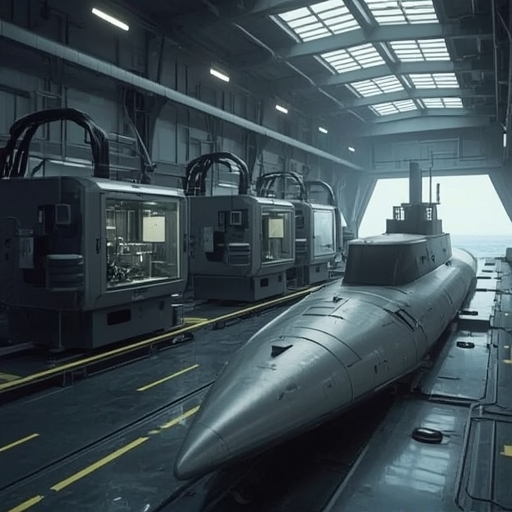
In a bold demonstration of technological progress and industrial ingenuity, the United States Navy has ushered in a transformative milestone by integrating 3D printed components into two of its most complex military vessels—an aircraft carrier and a submarine. This achievement, which represents far more than a symbolic success, highlights the growing confidence the Navy has in additive manufacturing as a sustainable, efficient, and forward-looking solution for twenty-first-century shipbuilding and long-term fleet maintenance.\n\nThe decision to employ 3D printed parts aboard naval ships stems from a deliberate effort to address persistent challenges that have historically plagued traditional manufacturing and repair processes. Conventional methods, though reliable, often involve lengthy production timelines, costly material wastage, and complex supply chains that can delay critical maintenance. In contrast, additive manufacturing offers remarkable agility: on-demand production of parts, minimal waste, and a degree of design versatility previously unattainable through standard metalworking practices.\n\nTesting these innovations on a carrier and submarine—the Navy’s most engineering-intensive environments—provides an invaluable proof of concept. These vessels operate under immense mechanical stress, temperature fluctuation, and corrosion pressure, meaning that any material or design flaw could have significant implications. The successful integration of 3D printed parts under such conditions demonstrates not only the structural soundness of these materials but also their potential to redefine logistical paradigms in ship maintenance and modernization.\n\nBeyond the immediate operational advantages, this project symbolizes a shift in industrial philosophy. Additive manufacturing allows naval engineers to iterate more rapidly, customize components for specific mission needs, and significantly reduce dependencies on distant fabrication facilities. For example, future naval bases or forward-deployed vessels could use compact 3D printing systems to produce spare parts directly on-site, drastically reducing downtime caused by part shortages or shipping delays.\n\nEconomically, the implications are equally transformative. By shortening production lead times and lowering material costs, the Navy can reallocate resources toward innovation, training, and sustainability initiatives. Furthermore, as digital modeling and metal-printing technologies continue to evolve, the potential to recycle and reconfigure materials may lead to an ecosystem of circular manufacturing—where ships effectively help produce and maintain their own components.\n\nThis initiative also aligns perfectly with the Navy’s larger strategic mindset of resilience and adaptability. In an era where global supply chains face frequent disruptions, the ability to independently manufacture critical components becomes a crucial tactical advantage. The 3D printing capability does not merely modernize naval engineering; it strengthens national security by ensuring that the fleet remains operationally ready even when external manufacturing networks are strained.\n\nLooking forward, this breakthrough marks a profound turning point. As additive manufacturing matures, the lessons learned from these initial installations will inform more ambitious applications—potentially encompassing entire structural assemblies, propulsion elements, and support systems. The future warship may well be conceived, designed, and partially constructed through processes that rely less on massive foundries and more on precise digital fabrication technologies.\n\nIn essence, the Navy’s adoption of 3D printed parts is not simply an engineering experiment. It is a blueprint for the future of shipbuilding—a convergence of innovation, sustainability, and strategic foresight. What began as a series of technical trials has evolved into a redefinition of what maritime construction can achieve. The fleet of tomorrow will not just be stronger and faster to repair; it will also embody the very principle of continuous transformation that defines modern defense and engineering excellence.
Sourse: https://www.businessinsider.com/navy-banking-on-3d-printing-after-aircraft-carrier-submarine-parts-2026-1